
‘Sole and absolute discretion’ – one in six foals could be banned from racing under RA crackdown
Racing Australia’s hardline compliance with foal registration deadlines presents a major welfare concern and could leave a significant number of the 2025 foal crop being banned from racing, according to Thoroughbred Breeders Australia president Basil Nolan.
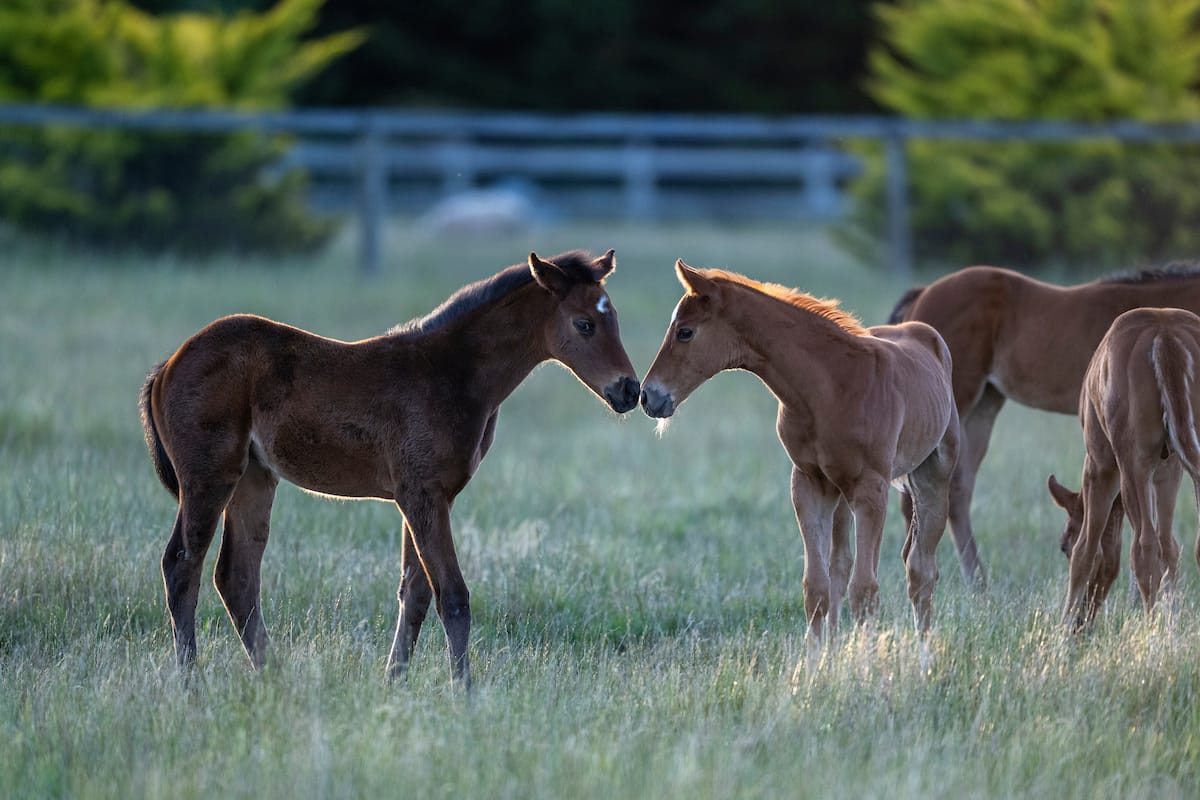
Australian breeders risk having their horses permanently banned from racing if they fail to meet foal registration obligations under Racing Australia’s looming crackdown on horse traceability compliance.
The harsher stance taken by RA in enforcing three rules of racing relates to obligations about lodging foal declarations in stipulated timeframes, It has further strained relations between the peak body and Thoroughbred Breeders Australia (TBA) ahead of the 2025 season.
One in six of the 11,666 foals born in Australia in 2024 did not have their mandatory ownership and location declarations lodged with the Australian Stud Book inside the 30-day deadline, prompting RA’s more stringent approach.
RA is expected to officially inform breeders next week about its course of action on enforcing the traceability rules.
The Straight understands the issue was briefly discussed by RA chief executive Paul Eriksson and TBA president Basil Nolan at Monday night’s Stud and Stable Staff Awards event on the Gold Coast, which coincided with the Magic Millions National Weanling and Broodmare Sale.
Eriksson told The Straight this week that breeders have been aware of their obligations under the Australian Rules of Racing for some time and RA’s action should not come as a surprise.
“We put something out last year on this and we said we would enforce this over a couple of years,” he said.
“So, last year we commenced educating (breeders) and getting feedback and this year we’re actually going to be enforcing the rules.
“And the rules say that you need to lodge a mare return and foal ownership declaration within 30 days or you are at Racing Australia’s discretion … that you won’t be able to race (that horse).

“It doesn’t have anything to do with the Stud Book, breeding, the export (of horses) or anything like that. This is all around traceability.”
The issue relates to Australian Racing rule 285, concerning the lodgement of mare return (live foals), and AR 286 which relates to the lodgement of foal ownership declaration.
National racing rule 287, which could have far-reaching consequences for breeders caught up in the regulatory stoush, addresses situations when a mare return and/or foal ownership declaration has failed to be lodged. It stipulates that RA has the authority to, “in its sole and absolute discretion”, deny an unnamed horse from being registered for racing purposes in Australia.
It is understood that infringing breeders who had not met their declaration obligations for more than 60 days from the time the foal was born will have to appeal to RA to argue why a ban preventing their horses from racing, as allowed under AR 287, should be overturned.
The RA CEO indicated that breeders who have failed to lodge foal declarations on time over the past two years crossed the spectrum of the industry, from hobbyists to large commercial operations.
He said 27 per cent of foal declarations were lodged after the deadline in 2023 but a greater proportion of breeders met their obligations under the rules of racing in 2024.
“That (figure) dropped last year to 16 per cent, which is a great result but out of that really there’s only 5 per cent of the overall foal declarations that are really problematic that we will want to focus on,” Eriksson said.
He dismissed claims breeders had been blindsided by the crackdown, but he did indicate RA had taken on board feedback on some of the possible unforeseen ramifications of the crackdown.
One concern raised where a ban on allowing a late-registered foal to race could have unintended equine welfare consequences, is the probable additional cost burden placed on studs when a horse is owned by a bad debtor. A possible ban would leave little recourse for a stud to sell the horse as a weanling to recoup financial losses.
“Well, we’ve certainly listened and we’ll be making some changes to what was being planned as the process for how we enforce it,” Eriksson said.
“But we’ll be making those announcements next week and I flagged that with Basil Nolan last Monday night. I’m sorry, but it isn’t that hard to put ownership details in (on time).
“Is it great? No, but it’s not complex that you could use that as an excuse not to do it (in) 60 days, say.”
The tense relationship between TBA and RA has been simmering for some time, particularly with the inertia with the Pattern and Racing NSW’s “go-it-alone” position when it comes to black type racing in the state, so the latest development has been viewed with cynicism by a proportion of breeders.
TBA president Nolan said RA’s systems were one of the main reasons for the lack of adherence to the horse traceability rules.
“Obviously, we are very concerned about the registration of foals and how archaic the system is to register the foals. Three or four years ago, they gave us an undertaking that they were going to upgrade the IT and that hasn’t happened,” Nolan told The Straight.
“It’s very, very time-consuming to have to return a lot of foals. Obviously, there’s a number of foals, and that varies from 2000 to 600, that are 120 days overdue to be returned to the Stud Book.
“Now, if that happens with the next foal crop, obviously, once it goes past 60 days, as I understand, then you’ve got to pay $500 to go to a tribunal to see why your foal should be accepted (to race).
“But I think it’s going to be a welfare issue, really, because if somebody doesn’t register a foal and they say, ‘well, I’m not going to pay the $500’, we’re going to have a lot of foals in paddocks that can’t race.”

Although largely placing the blame at the foot of the breeders for the number of late declarations, Eriksson conceded that lodging the foal ownership declaration via the Australian Stud Book online portal wasn’t as simple as it could be.
“That’s a reasonable statement. It’s not as good as it should be. We have merged the mare return and foal ownership, so that it is a single process now,” he said.
“But the process that we would like to move to is … a fully digital process, which means that every (owner) needs to have a digital ID and people don’t.
“We need to educate and we need to find a better way to engage people so they have a digital ID.”
Author

Related Articles
McArdle sets new mark as Tassie sale rebounds strongly
Tasmania’s yearling market staged a revival of fortunes, with a more than $800,000 jump in aggregate, a near record average and a new benchmark for a top price at the state’s yearling sale at Quercus Park.
Rowe On Monday – A Super deal for Waikato and Coolmore, the emerging multifaceted talents of Anders on show at Caulfield
In today’s Rowe On Monday, Waikato Stud’s Mark Chittick says business won out in the decision to sell Super Seth to Coolmore, while young stallion Anders, known for his short-course prowess on the racetrack, is siring winners across a variety of distances.
Record trade as Perth Yearling Sale concludes
Magic Millions Perth Yearling Sale surpassed $21 million for the first time with the Book 2 session topped by a colt by Gingerbread Man.