
Written In The Stars – Michael Floyd – The father of Karaka
In the century of selling at the National Yearling Sale, there have been few figures as significant as Michael Floyd. In this week’s Written In the Stars, Jessica Owers speaks to the man whose vision brought the iconic sales complex at Karaka to life.
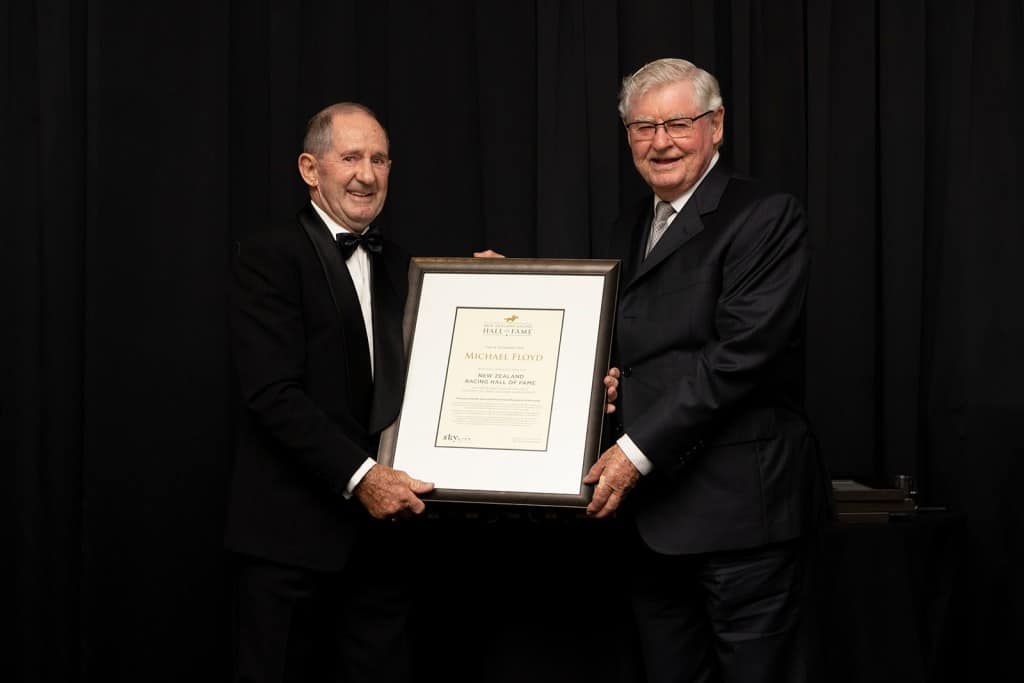
Michael Floyd, touching 92 years old, would have been good fodder for Benjamin Franklin.
‘If you would not be forgotten as soon as you are dead,’ Franklin wrote, ‘either write things worth reading or do things worth writing’, so Floyd built a thoroughbred auction house.
On a flat piece of greenspace a half-hour outside Auckland, in the year 1987 and in a township called Karaka (named for the native karaka tree with its sharp, orange berries), he established a selling facility that led the world then and leads the world today.
“At the time, you don’t think you’re changing history,” he tells The Straight. “You weren’t looking at it that way. You were just doing what you were doing and you weren’t really thinking about what was going to happen in the future.”
Had Floyd been thinking about the future, he would have seen that Karaka would become the beating heart of breeding in New Zealand, that its tawa-hardwood sale ring would withstand decades of trade, and its pair of Dutch elms by the parade ring would last longer than many farms.
“I remember getting a letter from someone, complaining there’d be no trees at the new place,” he says. “Well, when you look at the trees now, nearly 40 years later, we’ve got plenty, haven’t we? People forget that things grow.”
The upcoming Karaka will mark 100 editions of the National Yearling Sale, but few will recall that it’s there in the first place because of Michael Floyd.
It was Floyd who, in 1985, opted to relocate the selling of New Zealand’s best yearlings from Trentham to Auckland, a decision that split the breeders in the south, who didn’t support the move, from the breeders in the north, who did.
“I had a lot of opposition,” he says. “The January sale (the National Yearling Sale) brought a lot of people to Wellington, particularly from overseas. So, the mayor of Wellington (Ian Lawrence), plus someone from the restaurant society and the Minister for Internal Affairs, asked me to a meeting in parliament at the Beehive.
“I was told there was no way in the world I was going to move all this activity out of Wellington at that time of year, and even my senior directors didn’t want the expense of moving. There was a lot of opposition, and not least from the southern breeders who didn’t want to go north either.”
All of this happened 41 years ago, but Floyd has no trouble with the memories. At that time, he was the general manager of Wrightson Bloodstock, which was bought up by the Vela family in 1996 and rebadged as New Zealand Bloodstock (NZB) for January 1997.
In Trentham, the auction house had been at the mercy of the Wellington race club because the sale grounds were sat on the racecourse’s infield paddocks.
“I was quite determined I was not going to come under the control of another race club again,” Floyd says.
Mid-1985, he chartered a helicopter with one of Wrightson’s directors, Peter Kelly, and the two men scouted the Auckland hinterland for a suitable parcel of land. As they followed the motorway south towards the Waikato, they saw a large block off the exit ramp to Papakura.
It was about 80 acres, a featureless slab of dirt with a few tumbling houses here and there. After some negotiation, they eventually bought it for $2 million, “which seemed like a lot of money in those days”, Floyd recalls.
The last Trentham sale occurred in January 1987, and Karaka swung open its gates to its first National Yearling Sale in 1988. The response to the new facility was, Floyd says, overwhelming. He had modelled the Karaka complex off what he had seen at Deauville, France, which was the closest match to what Floyd had envisioned for Auckland.
“What I saw at Deauville was exactly what I had imagined in my mind, a big, blank wall behind the auctioneers with the horses coming in opposite. We ended up getting more ideas from the Deauville complex than from anywhere else in the world.”
Karaka was an immediate success, no explanation needed here. For 91-year-old Floyd, who retired from Wrightson in 1993, it is his greatest professional achievement.
“If it came down to one thing that I did in all my time, it would be moving, designing and building the Karaka complex,” he says. “It’s become such a major asset to the industry in New Zealand, and people often comment that it’s probably the best in the world. It was certainly the best at the time.”
Floyd has been out of the game a long time. After relocating from Wellington to Auckland with his auction house, he never left the city after retiring. He did a bit of consulting work, but as time pushed on, he sensed he was forgotten, not that he minded.
“I think it’s inevitable that people move on. They live in the present,” he says. “I had kept in touch with some people the first few years after my retirement, and then I just gradually drifted right out of things over the years.”
That was, until 2023 when Floyd was surprised with a telephone call from the New Zealand Racing Hall of Fame. He was being inducted, alongside his friend, the late Ken Austin, horses Verry Elleegant, Melody Belle and Beau Vite, and a sprinkling of significant industry names.
“I most certainly was surprised,” he says. “It was just on 30 years since I’d retired, and I really thought I had been forgotten. But then I realised,” and he laughs, unsure if he should say it at all. “They usually wait until people pop off, and I obviously hadn’t popped off in time.”
There are 103 individuals, both human and equine, in the New Zealand Hall of Fame. The selection committee is chaired by Trelawney Stud’s Cherry Taylor and includes journalists, historians and industry professionals whose brief is to isolate significant achievement.
“It was wonderful to have Michael Floyd among those names in 2023,” Taylor tells The Straight. “I don’t think it matters how far back you go, Michael’s name is a household one across the industry here.”
For NZB’s John Cameron, international bloodstock manager who is pushing 61 years with the auction house in its various moulds, Floyd is an icon in this centenary year.
“It’s a very important occasion, this 100 years, because Michael was instrumental in all of this at Karaka,” Cameron says. “He was a very thorough and accurate man to work for. He was meticulous, well-organised, highly respected and highly regarded throughout the world.
“The Hall of Fame recognition was a wonderful thing for the industry, but a great achievement for Michael. I consider him a dear friend and I’m certain he was very, very proud to receive that acknowledgement.”
In footage of the years when Karaka was rising from the dirt, Floyd appears soft but unflappable. He had firm answers for the mayors of Wellington and Lower Hutt in their opposition of the Wellington exodus, and for anyone else who doubted his ability to get Karaka finished.
He told a news broadcast: “A few people in town have been running a book that we’d never finish on time. Well, they’re going to lose their money because we’re finished and we’ll be ready to start.”
They were ready, on schedule, in January 1988, and New Zealand has never looked back.
Floyd was born Douglas Michael Floyd in Rotorua in 1935, from farming stock. It was a childhood spent in tough, depressive times, and he was just six years old when his mother died.
He began to ride across the pony club circuit in the Bay of Islands district, a fearless horseman. By 1951, when still a teenager, he had his first introduction to the sales scene when he led three yearlings for the iconic dairy farmer Ian ‘Tiny’ Dibble, whose futuristic attitudes pioneered GPS tech in the Kiwi dairy industry.
“Tiny Dibble had asked me to go down to the sales with him to help him with his yearlings, and that was my first introduction to the business, as a groom in 1951 leading horses through the sale ring,” Floyd says.
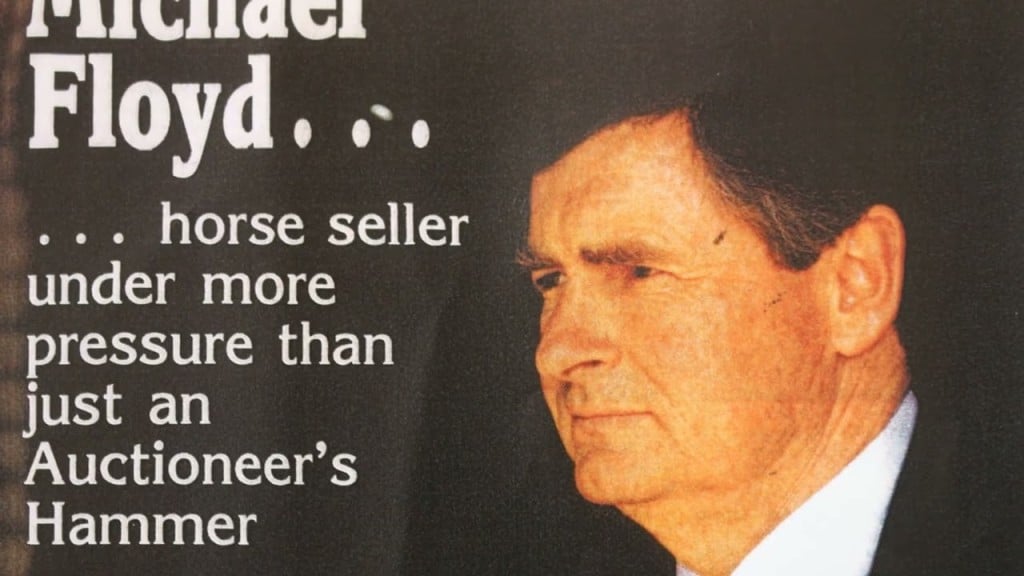
That year, Floyd met the head auctioneer, Charlie Roberston, which led to an offer of employment, which led to Floyd’s eventual and revolutionary leadership of Wrightson Bloodstock.
“I was always ambitious,” he says. “I wasn’t happy in a small environment. I wanted to see the world because I knew it was bigger than where I’d grown up, and I ended up in a position where I was able to travel the world extensively.
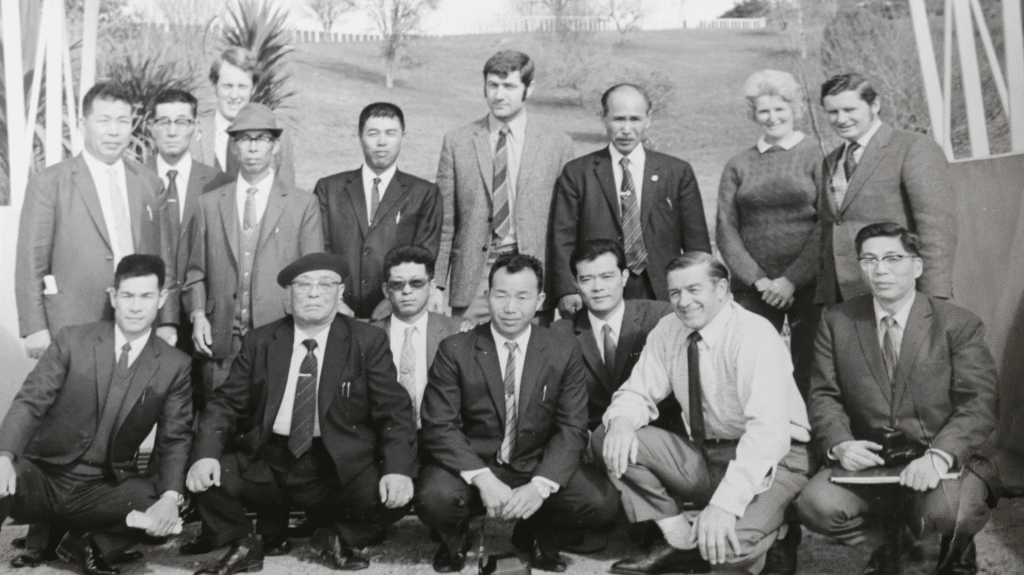
“I never imagined, at the time, that I would have this incredibly interesting career. I loved exploring new places, and while the Hall of Fame recognition was about Karaka for the most part, it was also recognised that I was the first person to do a marketing exercise into Asia.”
In 1968, Floyd was commissioned to buy 20 yearlings for Asia, of which 19 were winners, among them Daryl’s Joy. And it was Floyd who received the first order of overseas horses for Hong Kong, with 30 animals bought and shipped.
“Our initial Asian trip was in 1967, and it brought a lot of Asian buyers to our sales in 1968. That was the start of it,” he says, the consequences of which have been priceless.
Floyd will head to Karaka this week. Since 1951, he has missed only the odd edition of the National Yearling Sale.
He says he could never have imagined the prices he sees on the board these days, particularly because he remembers vividly the day they sold the first hundred-grand yearling at Trentham.
“It’s become far more commercial now with more people involved at a higher level,” he says. “Remember, Dubai didn’t exist in my day, and there weren’t any independent buyers in Hong Kong or the Middle East, or countries that I never imagined would get involved.
“Going back, you had Sir Patrick Hogan and Sir Woolf Fisher, and they were the big players. Sir Woolf was dynamic. He had Ra Ora Stud and was probably our first introduction to the South African market. Sir Woolf was a very influential man.”
New Zealand does history better than most, and it will be hard not to notice a centenary at Karaka this year. In the middle of it, quietly, will be the reason everyone is there in the first place.
Related Articles
Written In The Stars – Basil Nolan and a Raheen tale of triumph and tragedy
In an industry full of unsung heroes, Basil Nolan doesn’t know why he was singled out for induction into the Queensland Racing Hall Of Fame. But as Jessica Owers reports, Nolan’s experiences in 54 years running Raheen Stud have shaped a perspective which has helped him give back to the thoroughbred industry.
Written In The Stars – Emma Cully and the heartbeat of syndication success
Over 14 years, Emma Cully has become an indispensable and important part of the success of Star Thoroughbreds – the quiet constant beside Denise Martin. So how did this Irish-born daughter of a national hunt trainer end up in the heartbeat of one of Australia’s leading syndication companies? Jessica Owers finds out.
Written In The Stars – A Cat of a different colour
Apache Cat was born to stand out, be it on the racetrack, in the paddock or in retirement, as an ambassador for the industry. As the first equine subject of Written In the Stars, Jessica Owers found out from those closest to him that he was never destined to be “just another brown horse”.