
Be vigilant – The lessons learned from the extraordinary tale of Bill Vlahos
With news that Bill Vlahos has been released from prison, Matt Stewart reflects on how the one-time prominent syndicator’s world came crashing down in the aftermath of his record-breaking $5 million purchase of Black Caviar’s ill-fated brother Jimmy.
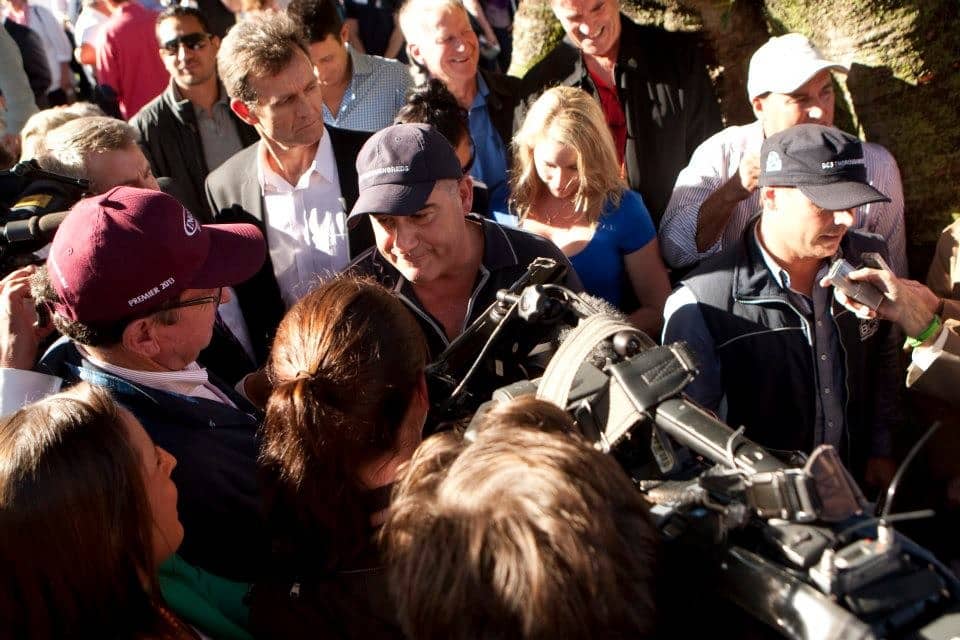
It was one of a handful of schmoozy Emerald Hotel lunches hosted by this Johnny-come-lately, Bill Vlahos.
It was in 2012 and best described as a freak show. At the conclusion of it, two reporters who had been entertained and confused by Vlahos, his cloudy life story and his cartoonish entourage, were left scratching their heads.
Vlahos was joined at the lunch at the South Melbourne pub by his brother-in-law and BC3 marketing manager James Jones, ex-jockey Simon Marshall, who’d played a minor role with BC3 and would later add himself to Vlahos’ long list of victims, and an American named John Brocklebank.
Vlahos had met bloodstock agent Brocklebank at a Gold Coast yearling sale.
It was a handful of years after Vlahos had first surfaced in 2007 as one of the new part-owners of a horse named Pillar Of Hercules.
In circumstances unrelated to the trouble Vlahos would eventually find himself in, authorities had discovered a link between Pillar Of Hercules’ ownership and the infamous Mokbel crime family, and the horse was ordered to be put under the hammer immediately.
Vlahos is believed to have stumped up a large chunk of the $1.8 million to buy the horse.
At the time of the Emerald lunch, no link had been made to the BC3 syndicate, a “pinhooking” offshoot of a US enterprise that morphed into a more standard syndicate.
The syndicate collapsed as the hammer came down on a yearling “Jimmy”, the half-brother to champion Black Caviar, at the 2013 Australian Easter Yearling Sale in Sydney.
The $5 million pre-purchase price prediction from Vlahos proved spot on, but he could not have predicted what would come next. It was the last act of delusion from a man a sentencing judge later described as having a “narcissistic personality disorder” and his behaviour as dazzling.
By the end of that year, Jimmy would be dead, reportedly from a reaction to a spider bite, and Vlahos’ empire was crumbling as the proceeds from his The Edge punting club evaporated.
The law caught up with Vlahos in 2015, and he initially faced 347 charges related to the punting syndicate.
The County Court in 2019 ended up finding Vlahos guilty of two cases of obtaining financial advantage by deception. There were 71 individual victims who were robbed of $17.5 million.
According to the court, extravagant spending included $38,000 on landscaping, $11,000 on home renovations, over $30,000 on a jacuzzi, $71,000 on an Audi and $149,500 on a Lexus.
Over $100,000 was spent on business-class plane tickets and $40,229 was spent on school fees for his children.
In 2021, he was given nine years imprisonment. Vlahos was paroled earlier this month and his release is the latest chapter in the Walter Mitty-like story of a man who became one of racing’s most infamous figures.
It’s a story of Peter chasing Paul, lavish spending of money that wasn’t really there, inventing players like Dubai-based business partner “Daniel Maxwell”, strip clubs, a staged bashing, an exploding car, “Where’s Wally?” sightings of Vlahos in hiding, all encompassed by human weakness that allows such scandals to occur.
Someone is always chasing a shortcut and there’s always someone in the shadows to facilitate it.
There had been first-class flights for prized clients, red carpets at casinos, new cars, private training centres. BC3 once flew high-profile trainers by helicopter to Sutton Grange, near Bendigo, to be celebrity buyera at a breeze-up sale. The operation later moved to a property at Connewarre, near Barwon Heads, where the story took one of its most dramatic turns.
It was late 2013, six months after Jimmy was sold at the Easter sale and just weeks before he was euthanised, The Edge had collapsed, unable to pay an ever-increasing and agitated band of investors who’d lost livelihoods.
BC3 had been placed into administration.
A fire and a bashing had been reported at BC3’s Connewarre property, not far from the Vlahos home in Torquay.
A car had been set alight before exploding. Vlahos appeared a little bruised, saying he’d been bashed by a handful of thugs.
Vlahos later claimed that information important to his credibility had been contained on a laptop that went up in smoke in the car.
Herald Sun feature writer Andrew Rule had been holidaying at Point Lonsdale and drove to the scene “even before the detectives got there”.
“I just drove right in and saw the jerry can straight away. It was tipped over, had lettering saying ‘four stroke only’ on it and it was sitting not far from the burnt-out car,” Rule reflected with the chuckle of a court reporter accustomed to staged scenes.
“You could tell exactly what had happened. Apparently, Bill had rolled around on the ground a bit to rough himself up.”
Vlahos then disappeared.
A Herald Sun reader sent a grainy photo to the newspaper of a goateed man in a baseball cap sitting in the TAB area of a pub at Barooga, on the Murray River in 2014. It was verified as Vlahos, whose wife grew up in the Cobram area.
When Vlahos started appearing through the courts to face the music, reporters delved into a back story and it revealed someone nondescript enough to do wrong without anyone taking much notice – until it was too late.
He had grown up in the Prahran Housing Commission flats, attended Prahran High then said he studied psychology at La Trobe University. There is no evidence that he gained a degree.
He was a half-decent club footballer and cricketer, friendly and popular. Vlahos reportedly used a post-grad course rather than a degree to become a counsellor. He later worked at a handful of resorts and hotels in Sydney and Queensland.
While in Sydney, he developed a punting “system” that seduced many into believing Vlahos was a magician. He also had a presence on racing and tipping websites.
At least one senior figure introduced the mostly well-to-do into what would become The Edge and then enticed many to take shares in horses raced by BC3.
Vlahos provided his growing client base with fake bets and fake returns. For a while, he was able to pay out but in the true nature of a ponzi scheme, there would always be a day of reckoning.
At roughly this time, Vlahos met Brocklebank for the first time at the Gold Coast. The Edge was underway and the smother, BC3, was being hatched.
News of a fake betting syndicate was spreading like wildfire. Investors from football clubs and retirement communities to businessmen, builders and real estate agents, were demanding returns instead of printouts of impossibly successful betting results.
The two reporters who’d been wooed by Vlahos’ softly spoken charm but left a little confused by his vague life story, would never forget the Emerald lunch. Future events made it more memorable.
Brocklebank was a respected pinhooker and fitness freak who appeared to have overcooked himself under a sun lamp.
At one stage of the memorable lunch, he pushed some dining tables aside to bowl over 50 push-ups. Meanwhile, Marshall had found a garbage bag in the kitchen and wrapped himself in it to illustrate the lengths he went to as a jockey to keep his weight down, running in garbage bags on hot days.
It would be revealed a handful of years later that BC3 was just a legitimate-looking sideshow funded by the proceeds of The Edge.
Brocklebank, who began the BC3 brand in the US, was never accused of any impropriety. He was never a serious business partner of Vlahos, more a distraction. Diners at the Emerald that day in 2012 would agree he was indeed that.
Vlahos doesn’t appear on the list of 30 people disqualified or warned off from Victorian racetracks. Inquiries to Racing Victoria established that he cannot attend or bet on the races or own racehorses.
Asked if rules and protocols were tightened after Vlahos, an RV spokesman said the scandal “was essentially a criminal matter. He stole money from people, it’s fraud and a police matter”.
“Our message to people would be to take care the same as you would with any financial venture. Be vigilant.”
Post BC3, horse syndicators reported a dip in investment. Peter McGauran, then chief executive of the Australian Racing Board, said in 2014 that the ARB was awaiting advice from an RV inquiry into ownership, syndicates and the auction process. It is unclear what came of that inquiry.
The Living The Dream syndicate was investigated and cleared of impropriety shortly after the collapse of BC3.
Living The Dream later claimed to have suffered from the ripple effect of Vlahos. It had forecast for 5000 new members and received just 87.
Prime Thoroughbreds’ Joe O’Neill said business “slowed up’’ and Spicer Thoroughbreds’ Brad Spicer mused that Vlahos had cast syndication and racing in a negative light during this time.
Many Vlahos victims stayed quiet, embarrassed by their reckless urge to take a shortcut and to avoid asking questions. Many have not recovered but would belatedly agree with RV. Be vigilant.
Related Articles
Via Sistina retired, set for date with Dubawi
Dual Cox Plate winner Via Sistina has been retired by Yulong, who will send her to the Northern Hemisphere to be mated to Dubawi.

Ray Thomas appointed Racing and Sports international editor
Former long-serving Daily Telegraph racing editor Ray Thomas has joined ASX-listed data company Racing and Sports.
Hazzard urged to consider Racing NSW integrity split and governance changes
A separation of Racing NSW’s commercial and integrity functions is on the wish list of a key racing participants group, which has lodged a submission to the Hazzard review into the way the state’s racing industry is governed.