
‘Failed the vet’ – Hong Kong Jockey Club seeks to remedy ’unfair’ reputation for rejecting imports
While blame for a sale of a thoroughbred to Hong Kong falling through is often attributed to strict veterinary protocols, data from the Jockey Club shows just 1 per cent of horses have been deemed unacceptable for importation.
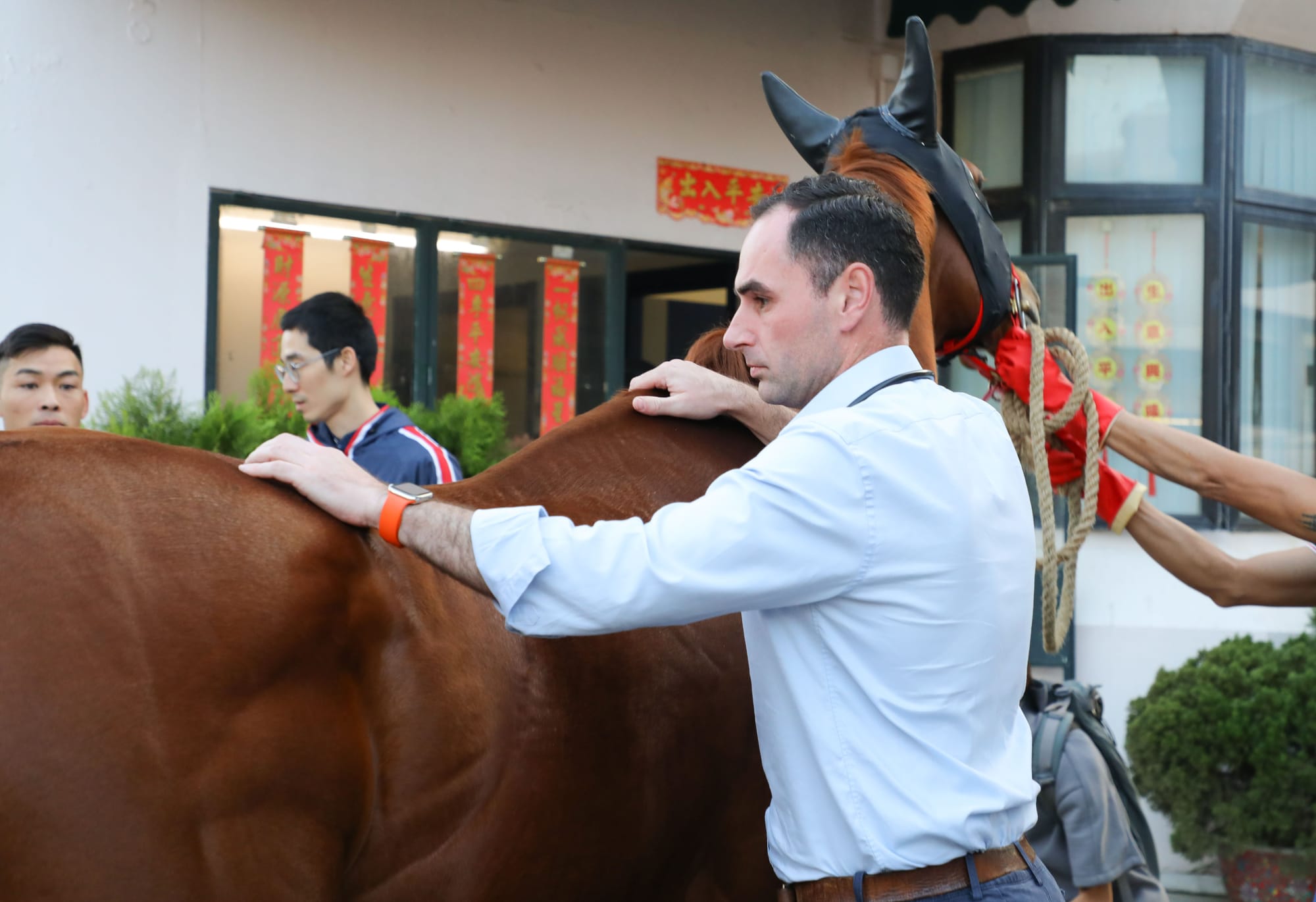
The Hong Kong Jockey Club can often be unfairly maligned for its perceived hardline stance when it comes to the veterinary assessment of racehorses on the radar of its owners.
For those breeders, owners, trainers, bloodstock agents and traders who service the Hong Kong racing industry by selling horses to its permit holders, the phrase “failed the vet” gets thrown around far more readily than they would desire.
And the blame for sales falling through is often put at the feet of the Jockey Club, particularly when the seller or the facilitator, such as an agent, believes the horse is physically capable of racing to a high level in Hong Kong.
But as Dr Bronte Forbes, the Jockey Club’s Head of Veterinary Regulation, Welfare and Biosecurity Policy, tells The Straight, there is a misconception that the HKJC stops horses being purchased due to perceived or real veterinary issues.
“At times, there can be some misunderstanding with owners, which we’re also trying to educate them about, and that is because on occasions certain words such as moderate can be misinterpreted,” Forbes said.
“If they see ‘moderate’ on a report they could think, ‘oh no, I don’t want the horse’. What we’re trying to do is educate them that often a well-performed, high-potential horse with no veterinary findings is like trying to find a unicorn.”
Expatriate Australian Dr Forbes, a third-generation vet from Western Australia, says the Jockey Club has for the past two years devoted extra resources and time educating its pool of owners on its veterinary assessments.
In the January update of its Veterinary Pre-import Examination Protocol document, the Jockey Club tempered the language used in the five-point pre-import grading system, that being low risk, low to moderate, moderate, moderate to high and high-risk horses.
After all, the so-called “perfect horse” more than likely will turn out to be much slower than expected by the owner, hence Dr Forbes’ use of the unicorn description.
Armed with the information from their own veterinarian, the Jockey Club’s nominated vet and the official grading from the Jockey Club, it is up to the owner and their advisers as to whether they want to proceed with buying the horse after assessing all the information put in front of them.
The Club rarely prevents a sale from going ahead and, therefore, importation of a horse to Hong Kong.
“In the last two years, we’ve had a really big push to try and communicate more with the vets and communicate more with the owners, so the nominated vets will now ring us and say, ‘look, I’ve got this horse, I don’t think it’s suitable, what do you guys think?’,” Forbes says.
“We might say, ‘well, if it comes to us we’ll give it a rating of this or that and then they’ll go back to the agent or owner’.”
Another change made by the Jockey Club to the pre-import protocols concerns the assessment of horses’ breathing capabilities, or laryngeal function. Vets are now able to use either the Lane-Bain Fallon or Havemeyer grading systems.
From this year, Australasia’s three sales companies, Magic Millions, Inglis and New Zealand Bloodstock, have been using the seven-point Havemeyer grading system for its post-sale endoscopic examinations.
Proponents suggest that the Havemeyer system is fairer in assessing horses that were in the “grey area” when determining if a horse was likely to develop into a “roarer”.

“We do allow roarers into Hong Kong, but they just get a much higher (pre-import) rating than non-roarers,” Forbes said.
In a further change, the Jockey Club veterinary department has recently started requesting video scopes from the time of examination.
“Now we have that documented at the time of examination, because horses can become roarers within weeks, so we can now protect both the examining vets and the trainer (who may have said the horse was not a roarer),” Forbes said.
“Another thing we are doing is for those horses that are in the grey area, which are the controversial ones and why people want to use different (grading) systems, is that we now ask for a dynamic scope.
“That helps us make our decisions and it reduces our grey area to a much smaller number. Again, we very rarely say that the horse cannot come to Hong Kong, we would just speak with the owner and say, ‘look, this is what you’re dealing with and this is the rating’.”
About 500 racehorses identified from around the world as potentially suitable for importation to Hong Kong come across the Jockey Club veterinary department’s desk annually.
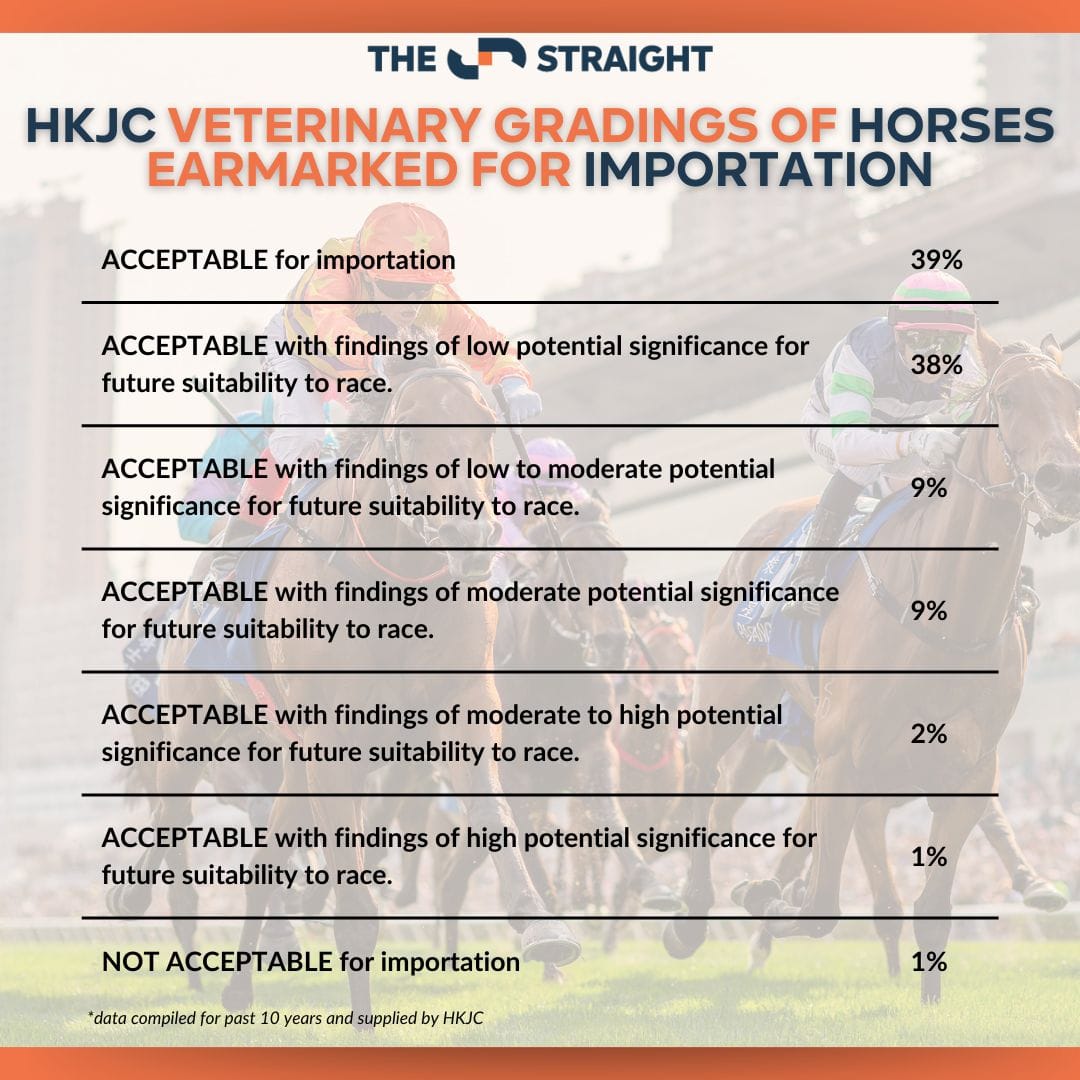
Data compiled over the past 10 years by the club shows that just 1 per cent of horses have been deemed unacceptable for importation to Hong Kong.
While the statistics provided to The Straight aren’t broken down into the reasons why certain horses fell into that category, one reason could be because they may have bled previously, an instant no-go as far as the Jockey Club is concerned, or because of a pre-existing significant injury.
There are 2 per cent of horses who were deemed high risk but the Jockey Club may still allow these horses to be imported on the basis the thoroughbred in that threshold is re-exported by the owner if the horse is unable to be trained or raced in Hong Kong.
The vast majority of horses, 77 per cent, fall into the categories of acceptable without any adverse veterinary findings, or acceptable with findings of low potential significance after assessing x-rays and the endoscopic examinations of horses. The other categories are set out in the table below.
“We understand from what we hear that there is sort of this underlying thing that sometimes Hong Kong vetting gets used to remove a horse out of the search system or as a reason not to purchase a horse by suggesting it hasn’t been approved by the club’,” said Forbes, who previously worked at the Singapore Turf Club and is in his second stint in Hong Kong.
“So, that can come from the examining vet, very rarely from the nominated vet. The other thing that sometimes happens is those initial examinations will be sent to the Hong Kong stable vet, and that stable vet may say to the trainer, ‘oh, you know what, I’d leave this one or I wouldn’t buy that one’ and that is then classed as Hong Kong rejecting the horse where it actually isn’t.
“It’s just the stable vet giving an opinion to a trainer who then gives it off.”
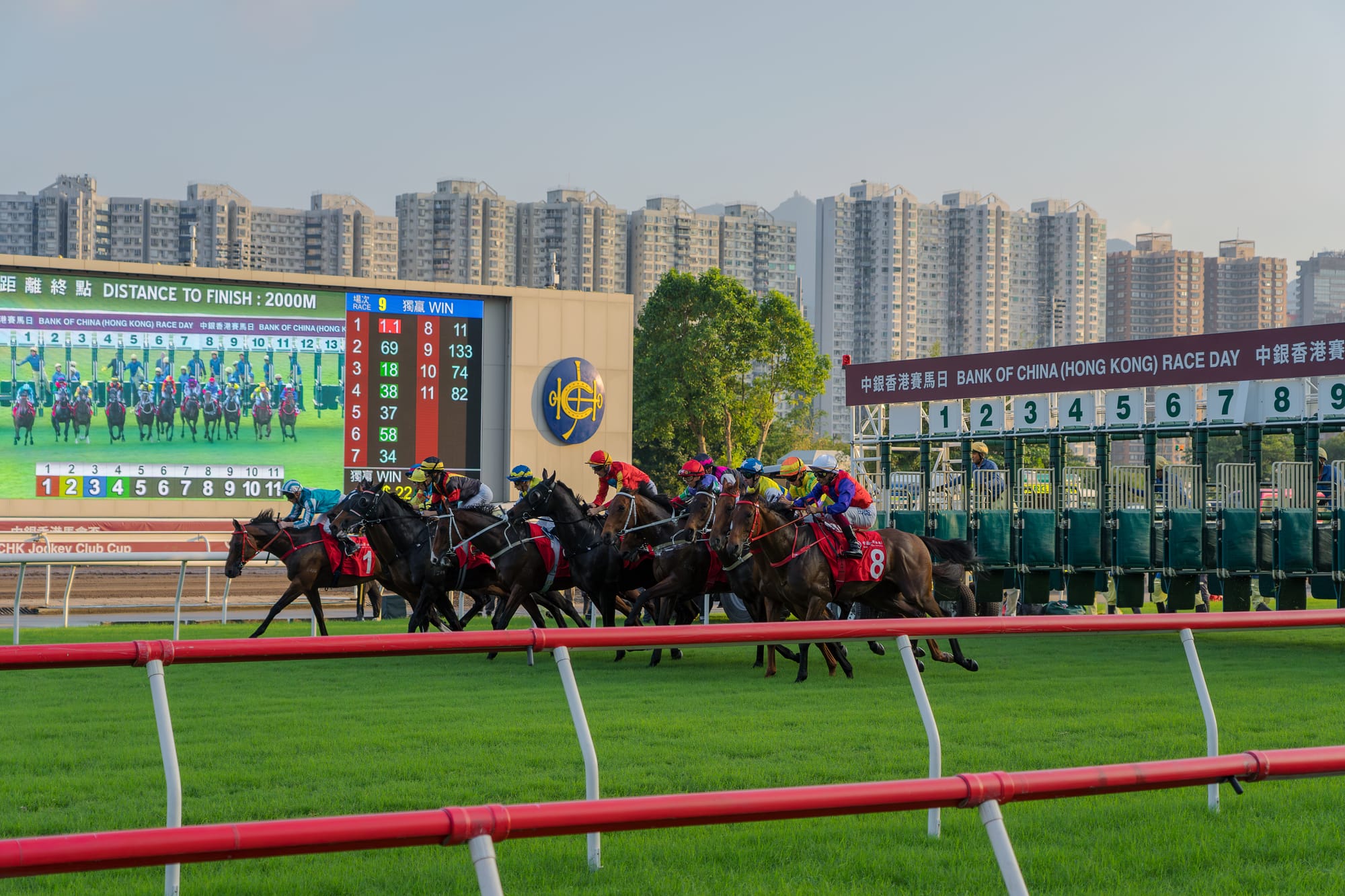
With a push for a bigger equine population to sustain racing across Sha Tin, Happy Valley and the mainland Conghua racecourse and training facility, it can be argued that educating owners about veterinary risk and reward is of growing importance to the industry.
Conghua was scheduled to host its first race meetings from April next year, but that has reportedly been delayed until later in 2026.
The Jockey Club, which is to welcome South African Brett Crawford onto its training roster next season, has a horse population of about 1350, up 100 year-on-year.
For that investment from owners to continue to increase, the reliance on veterinarians in countries around the world is an important part of the process.
In Australia, Dr Angus Adkins, Jonathan Lumsden and Paul Robinson are Jockey Club-nominated veterinarians.
Author

Related Articles
Rowe On Monday: Foote’s Kiwi plea, Taylors on song and a tight sales schedule
In this week’s Rowe On Monday, Tim Rowe has been busy on the sales grounds at Karaka, with the state of the New Zealand industry and the tight sales calendar turnaround on everyone’s lips.
Bittersweet Snitzel result for Cambridge Stud – $850,000 for Group 1-winning mare’s second and final foal at Karaka
An extended opening day of the 100th edition of the New Zealand Bloodstock National Yearling Sale saw averages, median and aggregate soar, and an $850,000 Snitzel colt topping trade.
From Petrava to a Satono Aladdin – Payne’s unlikely return to New Zealand
David Payne admits he thought there wouldn’t be a reason for him to end his 10-year absence from Karaka but long-time stable supporter Wayne Shelton made the master Sydney trainer think again – and he has Ceolwulf to thank.