
Has Racing Victoria’s All-Star Mile already run its race?
Analysis: When the All-Star Mile was launched on a platform of fan engagement as the world’s richest mile race, there was a clear intent to make it the centrepiece of the Melbourne autumn.
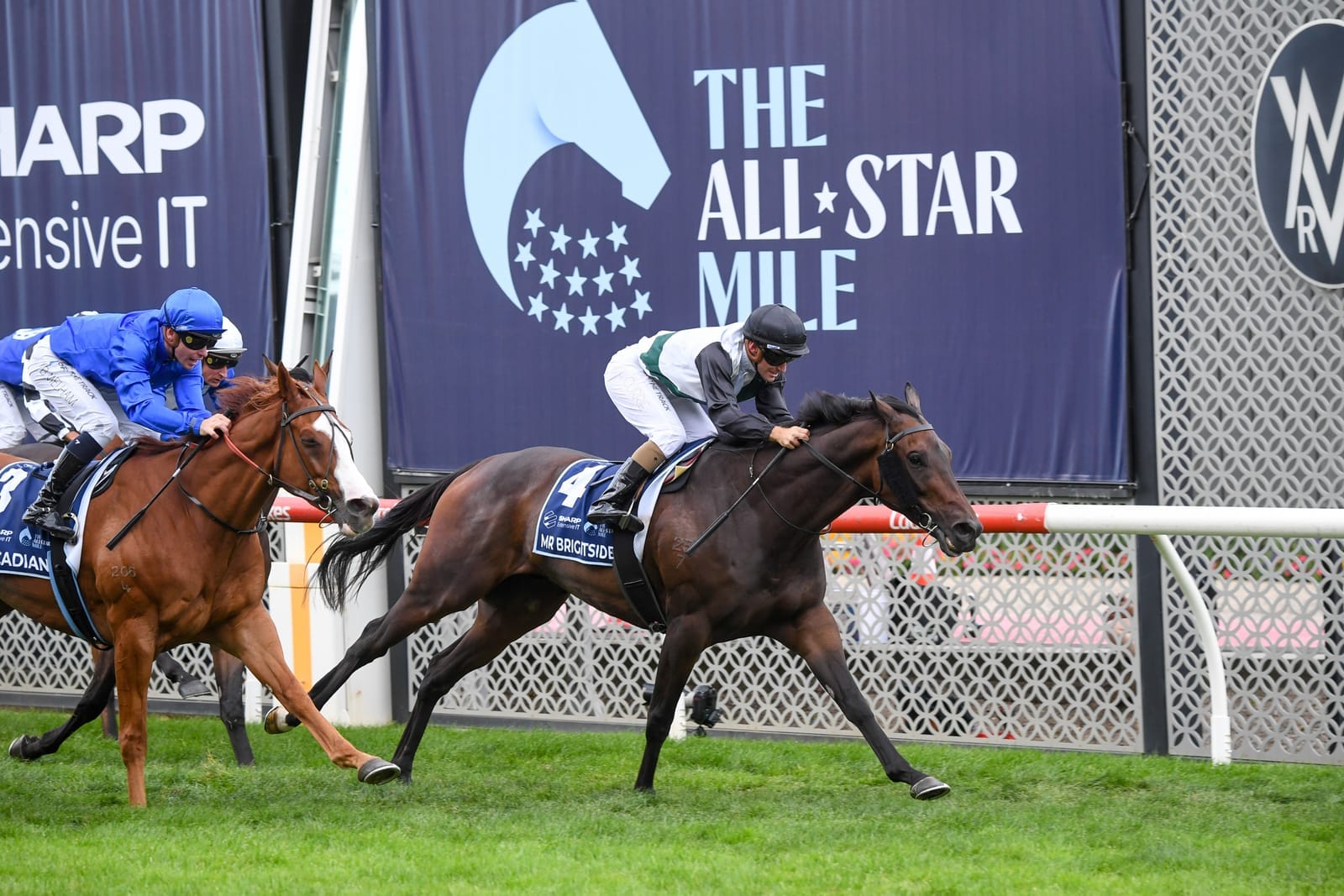
Five years later, cold hard facts tell us it is no longer the ‘people’s race’ nor is it one that carries a purse that is the biggest of its kind for a mile on racing’s global stage.
And whether the All-Star Mile remains the focal point of the Melbourne autumn carnival, at least in 2024, is up for debate.
It’s a conversation that has been gaining traction in the past few weeks in concert with an extended list of high-profile All-Star Mile withdrawals.
Despite Racing Victoria pushing a narrative that the birth of the All-Star Mile wasn’t a response to NSW positioning The Everest during the middle of the Melbourne spring carnival, it’s hard not to be sceptical.
In targeting an autumn timeslot, Victorian officials took their inspiration from the Japan Racing Association’s Arima Kinen, a race held in late December that comes together thanks mainly to a vote from highly engaged followers of the sport.
While the All-Star Mile voting system had its flaws because of its manufactured nature, a decision to change the selection process this year has backfired.
It has come at a cost to the public’s interest in the build-up to a race that has also lost its status as the world’s richest mile event with prize money reduced to $4 million from $5 million.
That move leaves the King George III Stakes at Randwick to take over that mantle after it was rebadged with a $5 million carrot in 2023.
When announcing changes to this year’s format, RV’s Matt Welsh said: “We’re revamping the 2024 All-Star Mile to provide greater certainty for connections, reduce frustrations around the changing composition of the field and simplify engagement for fans.”
It’s not unfair to say the opposite has happened as RV worked frantically in the hours before an acceptance deadline to put together a race that carries the most prize money and more promotion than any other during the Melbourne autumn.
The reasons why will no doubt be subject to another RV review but it is evident the All-Star Mile hasn’t measured up this year as an aspirational race for the owners of acclaimed horses such as Fangirl, Think About It, Think It Over.
Simply, the racing calendar is so cluttered that the All-Star Mile has found itself lost in a racing wilderness and lacking a real point of difference now the voting system has been axed.
While the Arina Kinen was a blueprint for the All-Star Mile model, the concept was also not too dissimilar to one employed in the NBA.
NBA All-Stars players are decided via the public’s input.
But unlike the NBA showpiece where exhibition is a priority over the importance of a result, the All-Star Mile has been a proper contest.
There has been enough Group 1 talent spread across the first five editions to give it gravitas as a race of significance, thanks to winners such as Zaaki (2022) and Mr Brightside (2023).
Ironically Mr Brightside’s presence on Saturday has been blamed for a lack of interest from the connections of potential runners willing to take up the challenge against Lindsay Park’s weight-for-age star.
He is set to start the shortest-priced favourite in the race’s brief history as potential inclusions such as Australian Guineas hero Southport Tycoon and the Chris Waller-trained Group 1 winner Atishu fell by the wayside.
Add several injured and recently retired wildcards to the list and only 12 horses could be mustered for a start at Caulfield.
The All-Star Mile field had a capacity for 16 runners.
“We’re revamping the 2024 All-Star Mile to provide greater certainty for connections, reduce frustrations around the changing composition of the field and simplify engagement for fans” – Racing Victoria’s Matt Welsh
That then flows into the other aspect of fan engagement, the owner ambassadors.
The idea was originally that those who voted in the All-Star Mile ballot would be eligible to win up to $250,000, as one of 16 selected owner ambassadors.
With the vote concept now abandoned and the total prize pool halved to $250,000, this year’s ‘ambassadors’ simply had to provide their details to Racing Victoria to be eligible.
What had been originally touted as ‘gamification’ of All-Star selection has now been reduced to a raffle at half the price.
Not only that, but with a less-than-capacity field, several of the already selected ambassadors face the prospect of being without a runner. That would be a further embarrassment for RV.
Furthermore, there have been concerns that the All-Star Mile cannibalised Victoria’s existing autumn offering for the sake of trying to match NSW for innovation.
Three races – the Blue Diamond Stakes for two-year-olds, the Newmarket Handicap for the fastest sprinters and the Australian Cup for the best middle-distance weight-for-age horses – have been traditional focal points of the Melbourne autumn.
The first cracks started to appear in 2021 when Moonee Valley chief executive Michael Browell expressed his agitation over the placement of the race, worried it had impacted the Australian Cup.
“Racing Victoria are investing a lot to get the All-Star Mile up and running but it’s perhaps coming at the cost of the promotion of what is a fantastic autumn carnival,” Browell said on Melbourne radio at the time.
Racing Victoria heeded the advice, switching last year’s Australian Cup to the last weekend in March in a move that remains in place in 2024.
The Australian Cup therefore becomes Victoria’s finale autumn race at the expense of the All-Star Mile. There is a strong argument from a marketing perspective that it should be the other way around.
Extending a gap between the All-Star Mile and the Australian Cup, RV has also created an inevitable interstate programming clash that would have seemed unthinkable a decade ago.
The Australian Cup will be run on March 30 – the same day as the Tancred Stakes at Rosehill – and diluted editions of the Group 1 weight-for-age races seem an inevitability.
A congested calendar is becoming an enemy of racing. However, this would have been the least of RV’s worries as it tried to convince those connections sitting on the All-Star Mile fence to make an 11th-hour decision to run.
It followed RV’s attempt to broaden the race’s reach through a link to New Zealand’s Karaka Millions series and the Magic Millions 3YO Guineas on the Gold Coast.
The results have been hit-and-miss.
Magic Millions Guineas winner Abounding is resting up for the Queensland winter carnival and the Karaka Millions 3YO winner Orchestral is on her way to Sydney after winning the New Zealand Derby.
Desert Lightning who upset Legarto in the Aotearoa Classic, saved the day as a wildcard acceptor.
But having sales graduate-only races as key All-Star Mile qualifiers didn’t sit well with some industry people in Victoria, including trainer Wayne Hawkes.
In what has turned out to be a prophetic analysis, Hawkes predicted trouble for All-Star Mile about two months ago.
“Why are we going out of our state with the All-Star Mile?” Hawkes told SENTrack.
“We’re now going to go to a restricted Magic Millions race to be an All-Star Mile slot, and now there’s going to be two races in New Zealand.
“They’re restricted races and what that’s telling me is that we’re going to struggle for good horses.”
Related Articles
Daryz wins historic second Arc as stallion career beckons
Daryz gave the Aga Khan family a record ninth victory in the Prix de l’Arc de Triomphe, becoming the first colt to go back-to-back in 48 years.
Siena Grima fulfils Epsom dream on God’s Window at her first Group 1 ride
Siena Grima and God’s Window delivered Chris Waller his seventh Epsom Handicap, with an upset win in the famous Randwick mile.
Cosmic Crusader gives Andrea Leek her first Group 1 in Turnbull Stakes
Cosmic Crusader claimed his second Group 1 and William Pike’s 19th in the Turnbull Stakes at Flemington, with a Cox Plate or Caulfield Cup campaign now under consideration.
