
Rowe On Monday: Foote’s Kiwi plea, Taylors on song and a tight sales schedule
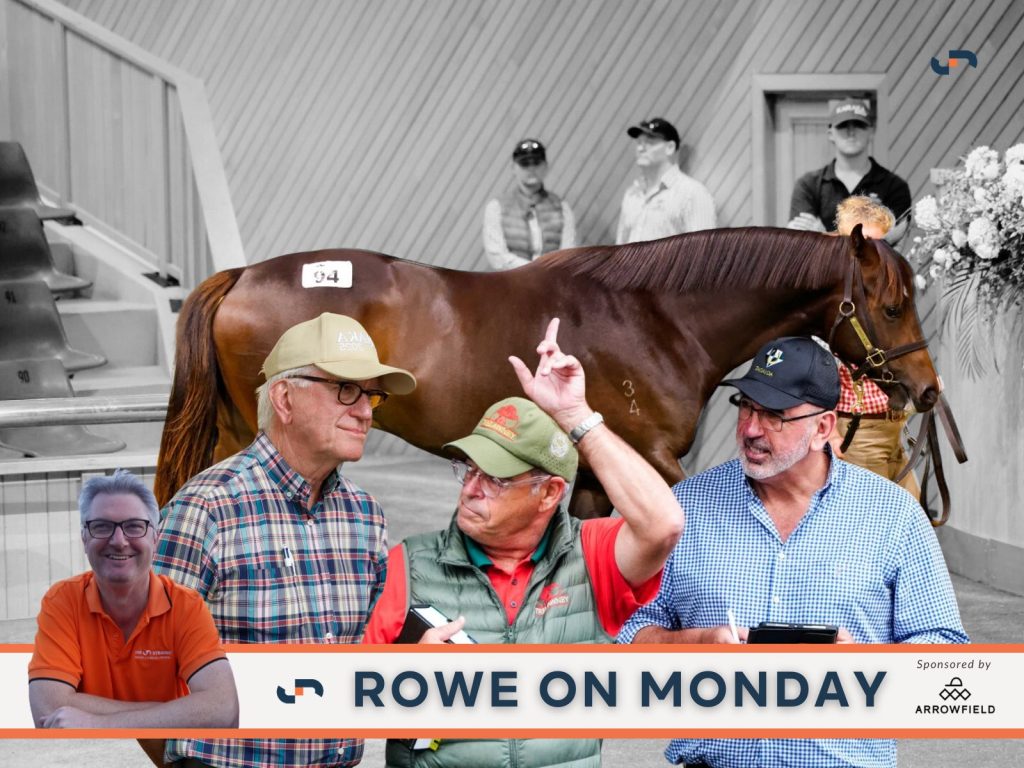
In this week’s Rowe On Monday, Tim Rowe has been busy on the sales grounds at Karaka, with the state of the New Zealand industry and the tight sales calendar turnaround on everyone’s lips.
Kiwis implored to get back to what they do well: breeding stayers
The focus on speed over stamina is nothing new. Australia markets itself as a source of speed and traditionalists are bemoaning Europe’s evolution towards precocity and the devaluing of Derby winners.
New Zealand breeders, too, have moved in that direction, a commercial reality of the industry, but respected agent John Foote has urged the country to not discard its ability to produce classic horses.
“Unfortunately, a lot of the good families have died out a bit and they went through a stage of trying to breed more sprinters and they’re getting some good stallions here now and they’ve got to get back to what they do well and what they do well is breed middle-distance (horses and) stayers,” Foote told the Straight Talk podcast.
“It has evolved because breeders have … brought more speed-orientated horses, speed-orientated stallions, whereas I think if they get back to what they’re good at. They’ll just dominate and Australians won’t need to go to England and spend, I don’t know what it is, some sort of massive figure they spend on racehorses in England.
“I also won’t have to go to the sales in Newmarket (in England) and buy staying-bred yearlings, so anyway, that’s my thoughts on it.”
Race-to-breed business model suits Trelawney
No one could accuse Trelawney Stud’s Brent and Cherry Taylor of not doing their best to improve the New Zealand breed.
Whether it was foresight or not, the Taylors elected many years ago to improve their broodmare band by purchasing yearling fillies to race rather than head to the broodmare sales.
That business decision has maintained Trelawney as one of the leading vendors by average for many years and it came before the likes of Yulong, Coolmore and other leading commercial farms dominated the top-end of the broodmare market.
“The reason we got out of the mare market was we had a restructure of our own business, and decided if we were going to access quality mares, and they were getting more and more expensive, we needed to do it earlier on, and buy the fillies,” Brent Taylor said.
“We’ll try and buy here (at Karaka), we’ll certainly be at Easter, we may go to Melbourne and try and buy fillies.
“I’m not saying we were smart enough to realise that these guys (Yulong/Coolmore) were going to do it, but the writing was on the wall, that (the top-end) stock was going to get harder and harder to buy.
“We’ve got in our broodmare band which would be very difficult to procure on the open market.”
The Taylors have a formula when targeting yearling fillies to race.
“A lot of the fillies we buy, we generally buy by proven stallions,” he said.
“We want fillies that have obviously (reached a) high performance on the racetrack, if possible, but they’ve got to have a good genetic structure.
“We’ve got to think, ‘OK, we’re going to breed with this, when I get that filly back, how am I going to breed her to get some, not only return, but to get positive results on the racetrack.”

Tight sales calendar making it hard ‘to do both of them properly’
The (unavoidably) cramped sales schedule this year has made inspecting yearlings in totality difficult and the same Magic Millions-New Zealand Bloodstock timeline is set to remain for the next two years.
Foote, who is attending his 51st consecutive New Zealand yearling sale this year, admitted it’d been a challenge for agents and trainers to complete their due diligence at both sales.
“That was a big issue this year and apparently it’s going to happen again next year and the year after, whereby we’re only going to have one week in between the Magic Millions and New Zealand and then a week into the Classic sale,” Foote said.
“It’s very difficult under those circumstances to get the job done properly, it really is, especially when you’ve got to do them on the ground.
“What happened before, we had a two-week break between Magic Millions and New Zealand, and I used to be able to come over and do three or four days down on the farms, and that made a big difference.
“I’d come up here (to Karaka) and it was very cruisy and very easy and you get your head around it.
“It’s quite demanding to try and work out what you actually want to do, but this year it’s been pretty hard this week, especially with the (wet) weather, and then next year we’re going to have the same problem, so I’m not sure how I’m going to attack it next year. It’s hard to do them both properly.”
Foote and the likes of his peers such as Paul Moroney often inspect every yearling, which adds to the workload, whereas other agents filter out large portions of the respective catalogues based on stallion preferences, pedigrees and other criteria.
Empress K a winner for Cressfield in Japan
We wrote last week about the growing interest by Japanese owners and trainers in the Australian market and that investment was demonstrated at the weekend when $1.4 million Inglis Easter graduate Empress K scored on debut.
A daughter of I Am Invincible out of Group 1-winning sprinter Pippie, the Bruce Neill-bred Empress K justified her odds-on favouritism with an emphatic win in a 1200m maiden for three-year-olds at Kokura in Japan on Sunday.
Her victory on debut came despite giving away a six-month age disadvantage to her rivals.
Agent Satomi Oka signed for the filly alongside Champions Farm at last year’s Easter sale.
Cressfield will offer Empress K’s brother, Pippie’s last foal, at this year’s Easter sale.
Speaking of Japan, trainer Yoshitake Hasida was an interested onlooker at this week’s NZB Karaka Yearling Sale.
Hasida was an assistant to his father Mitsu when top-class mare Dierdre was competing at the highest level in her own country as well as in the UK, Dubai and Hong Kong.
He was particularly intrigued by the Proisir yearlings and a compatriot Jun Naito paid $50,000 for a filly by the Rich Hill Stud-based champion sire on day one at Karaka.
Author

Related Articles

Rowe On Monday – New horizons for Rising Sun Syndications, an array of agents share Millions glory, backing in second-season sires
In this week’s Rowe On Monday, Tim Rowe puts the spotlight on Rising Sun Syndications, reveals the agents behind the Magic Millions raceday winners and looks at why there was sales value in the progeny of Stay Inside and Home Affairs.

Rowe On Monday – VRC Oaks winner gives Grunt a late breeding-season lift, an upward Graff for Kitchwin Hills sire, Distorted Humor tributes
In this week’s Rowe On Monday, Tim Rowe examines the impact of Strictly Business’s VRC Oaks win has had on her sire Grunt and what the emergence of Grafterburners can do for Graff. He also looks at the legacy left by US stallion Distorted Humor.
Rowe/O’Brien on Monday – Feeling fresh? Getting a read on first-season sires
In this week’s Rowe On Monday, Bren O’Brien takes the reins and looks at how a run of festive season racetrack success sets up the latest crop of first-season sires well for key two-year-old features in January.