
‘Syndicates within syndicates’: The changing face of racehorse ownership
Australia is experiencing a surge in racehorse ownership despite the average cost of a yearling bought at auction more than doubling in the past decade, latest industry figures reveal.
In a trend that would seem at odds with cost-of-living pressures, there were 141,190 combined owners involved in racing across all states in Australia during the 2022/23 racing season.
This represents a 23 per cent increase on the 114,614 who were registered across all states in 2019/20. It should be noted that those combined statistics from Racing Australia’s (RA) ‘double count’ owners involved in multiple states, however, the trend is undeniable.
Most of that rise can be attributed to the growing popularity and high-profile success of public and private syndication outfits, according to statistics in RA’s annual fact book.
Australia is recognised as a world leader in this area of ownership.
RA identifies four types of syndicates – ordinary, company, firm and studs – and these have increased from 7210 in 2019/20 to 11,321 in 2022/23. That figure does not include micro syndicates like MyRacehorse or miRunners.
That growth has sparked an almost 50 per cent increase in individual ownership within the syndicate model.
In 2019/20, RA figures revealed there were 40,809 people involved in a racehorse under one syndicate banner or another.
But in the 2022/23 racing season that number climbed to 60,454 registered owners who have a financial interest in a syndicated thoroughbred.
It comes as the average cost of a yearling sold at an Australian auction increased from $63,277 in 2013/14 to a peak of $123,000 in 2021/22 before encountering a slight dip in 2022/23 to $119,570.
Number of racehorse owners across all states in Australia
Source: Racing Australia (note owners who have horses in multiple states are counted for each state they are registered in)
In an era where bloodstock would give housing costs a run for its money in the affordability stakes, economic logic says it should be harder than ever to race a horse despite Australia having prize money levels that are the envy of most countries.
Nothing seems to be further from the mark and there are several factors at play, according to the syndicators at the coalface buying and selling for existing and new clients.
RA’s decision in 2012 to double the number of people allowed in the ownership of a racehorse from 10 to 20 has been a key driver.
Since the 2013/14 season, there has been more than a 100 per cent increase in horses registered who have more than 10 owners, from 1316 to 2799 in 2022/23.
In the same period, single ownership fell by 14 per cent from 4866 to 4177.
Where once it was not uncommon for an owner to take a 20 per cent stake in a syndicate horse, a bullish bloodstock market has resulted in diluted speculation.
That in turn has created opportunities for potential investors to become involved as smaller percentage shareholders as syndicators adjust their marketing strategies.
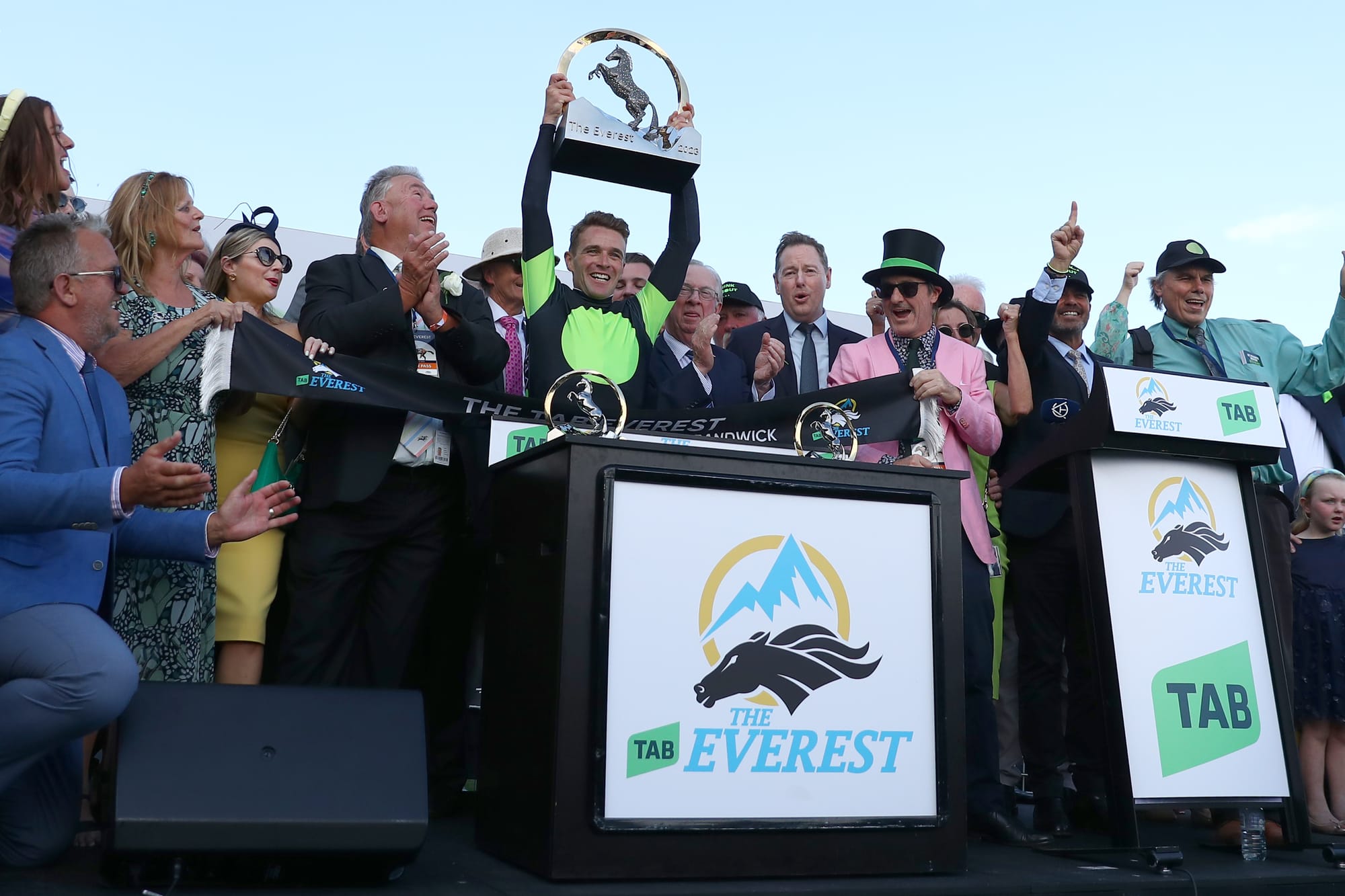
Lessen the outlay and risk while still having a meaningful involvement seems to be a winning formula.
That’s why a horse such as Proven Thoroughbred’s Think About It has 20 registered names in an ownership group enjoying the ride of their lives with The Everest winner.
Think About It embarks on an autumn campaign in the Canterbury Stakes on Saturday with every chance he will add a considerable sum to the almost $12 million he has won in less than two seasons of racing.
The $70,000 Premier Yearling Sale purchase is quickly closing in on Redzel, a two-time Everest winner who banked almost $16.5 million for Triple Crown Syndications, as Australia’s highest publicly syndicated racetrack earner.
“People are having smaller and smaller shares … it’s a definite trend and I think it’s great, frankly,” Proven’s Jamie Walter told The Straight.
“Our average is twenty to thirty people per horse, sometimes there is a bit more with syndicates within a syndicate.
“It is symptomatic of what a mainstream sport racing is here in Australia.
“The fact so many people from all walks of life are capable of getting involved in ownership is great.
“It really sets us apart from Europe where prize money is not nearly as good.
“Racing is of a very high order there but it’s dominated by about half a dozen players.”
“People are having smaller and smaller shares … it’s a definite trend and I think it’s great, frankly.” – Jamie Walter
Proven Thoroughbreds’ recent success with Think About It and his stablemate Private Eye has been matched across the Tasman with Te Akau Racing easily New Zealand’s biggest syndicator.
Built on the keen eye of David Ellis, Te Akau has dominated the racing landscape in New Zealand, and now with Imperatriz as a standard-bearer, the syndicator is making inroads in Australia as part of a trans-Tasman operation.
Imperatriz bids to extend a winning streak on Australian soil that includes five Group 1 victories when she contests the Newmarket Handicap as a warm favourite at Flemington.
Other prominent public syndicators to enjoy Group 1 success so far this season include Australian Bloodstock (Gold Trip), Darby Racing (Ozzmosis and Overpass), Go Racing (Atishu) and Bennett Racing (Southport Tycoon).
Militarize, a Dundeel colt raced by a high-powered and influential group of breeders, can also be categorised as a syndicate horse under RA’s policy.
Racing in the China Horse Club silks, Militarize added the Golden Rose to his two Group 1 wins as a two-year-old in 2022/23 and will be trying for a fourth elite-level success in the Randwick Guineas.
A stud career beckons, as it does for Written Tycoon’s son Southport Tycoon after his Australian Guineas win at the weekend for a Bennett Racing syndicate.
The importance of a booming syndication market isn’t lost on Nathan Bennett, still basking in the glow of the colt’s Guineas triumph.
Early results at stakes level gave Bennett a foundation for accelerated growth after going into business six years ago and horses such as The Astrologist and now Southport Tycoon have continued the momentum.
“You pinch yourself a little bit but I suppose if you have a little bit of success that’s makes the growth a little bit quicker,” Bennett told The Straight.
“In 2019/2020 we had 25 horses and now we are up to 75. It’s pretty much been doubling each year as we go along.”
Like Walter, Bennett says the impact and inclusive nature of syndication is one of Australian racing’s biggest assets and it shouldn’t be taken for granted.
“I think syndication is paramount for racing because without it I don’t know where the racing industry in Australia would be,” he said.
“A few guys racing against each is not going to be sustainable and having the syndication model is massive for racing in Australia.”
Related Articles
Rowe On Monday – A silver lining with Golden Slipper potential, blue riband result for Windsor Park, Black Opal shines brightest for All Too Hard
In this week’s Rowe On Monday, a prominent Singapore owner is enjoying the fruits of an Australasian foray, a Group 1 breakthrough for Windsor Park’s Circus Maximus and the Black Opal Stakes continues a purple patch for Vinery Stud’s All Too Hard.
Acting chair Jane Seawright resigns from Racing Queensland board
Jane Seawright has announced her departure from Racing Queensland after seven years as a director, as the state government moves to overhaul racing governance and expand the board’s structure.

Written In The Stars – A decade on – How Adrian Bott found his way in the shadow of Tulloch Lodge legends
Soft-spoken and studiously modest, Adrian Bott has spent a decade alongside Gai Waterhouse shaping Tulloch Lodge’s modern chapter. He talks to Jessica Owers about balancing pressure and expectation, all the while proving the quietest voices in racing can still command the highest respect.