
Written In the Stars – Luca Cumani and why the Melbourne Cup defeats still sting
Six years after retiring from a legendary training career, Luca Cumani is still making a major mark in global racing from the horses produced by he and wife Sara’s Fittocks Stud. But as he tells Jessica Owers in this week’s Written In The Stars, there is still one failure on his extraordinary resume, the Melbourne Cup.

The Melbourne Cup is a stain on Luca Cumani.
“That’s how I see it,” he says with stunning honesty. “It’s a stain on me because I failed to win it after coming so close, and it’s not something I’m very proud of.”
It’s a fortnight out from the 2025 Melbourne Cup, and Cumani is at home at Fittocks Stud, near Newmarket. He is in frank conversation with The Straight because at this time of year, and particularly with this man, an interview cannot occur without mention of the Cup.
“There is no doubt it was a failure,” he says. “I failed in my efforts, by a pixel or two, to win it. I didn’t fail in a Japan Cup or a Breeders’ Cup, but I failed in this.”
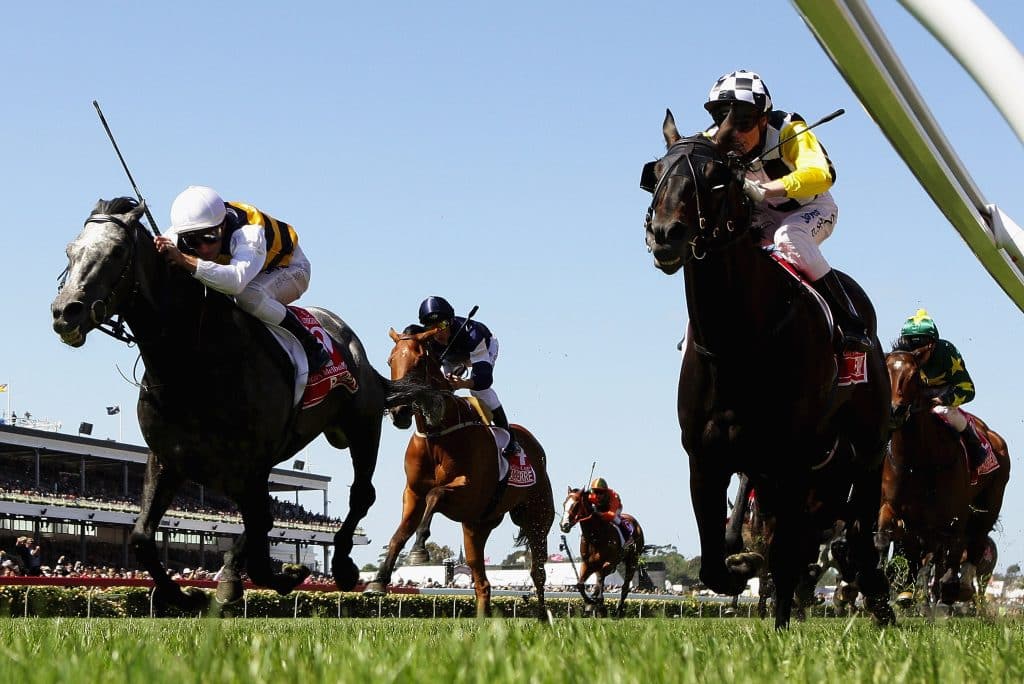
Cumani retired from training in 2019, 43 years just long enough at Newmarket. Starting in 2007 with a little chestnut called Purple Moon, he sent seven different horses to attempt the Melbourne Cup seven times, wrapping up with Mouth Athos in 2013.
The closest Cumani got to a result was back-to-back seconds with Purple Moon and Bauer, and in 2013, the final straw, he was third with Mount Athos.
In between were Mad Rush, Basaltico, Manighar and Drunken Sailor. My Quest For Peace was sent too but did not make the field.
If Cumani is to be believed, it was a maddening experience.
“The Melbourne Cup, I’m sorry to say, is not the greatest race in the world, but it is the greatest spectacle of any racing nation, and you want to win it for that reason, not for the prestige or value to the horse that wins it. It stands alone among all the other top races around the world.”
Few would expect Cumani, a trainer of such repute, to be so compromised by his years chasing Australia’s famous race. But it’s not bitterness; it’s frustration.
Cumani trained seven Classic winners during his career, which included two Epsom Derbies, but it was his globetrotting that really set him apart.
In 1994, he sent Barathea to Churchill Downs to win the Breeders’ Cup Mile, and in 2003 he trained Falbrav to win the Hong Kong Cup. In 2005 it was Alkaased winning the Japan Cup, and by 2019 Cumani had won Group races in the UK, Ireland, France, Italy, Germany, Canada, America, Australia (the Geelong Cup), Dubai, Hong Kong, Japan and Singapore.
“Luca was a pioneer with taking horses to race,” says Sara, Cumani’s wife and co-captain of 46 years. “He won the second running of the Arlington Million (in 1983 with Tolomeo). He was one of the earliest to travel horses.”
Cumani adds; “I was always convinced that racing had to move on the international scene for it to grow, and it slowly has gone that way and it’s much more cosmopolitan now than it was in my early days. The Melbourne Cup was another peak to be scaled.”
Cumani was born in Milan, northern Italy, in 1949. His father, Sergio, was a champion Italian trainer, his mother Elena a champion amateur jockey. Cumani headed to England when in his early 20s to learn from Henry Cecil, and he never left.
His accent is three parts Englishman, one part Italian, though Sara says she cannot hear the Italian in him anymore. The couple interviews like they haven’t spent a moment apart in 46 years, as close as oak and ivy.
“It was December 1974 and I had just started training, so I had about six horses in the stables,” Cumani says. “I was at the sales and I spotted this girl who, to my eyes, looked very, very beautiful. There was a party the following night at the BBA, and I knew she would be there because she was working for the BBA, so I asked Robin Hastings, who was the chairman, could he please introduce me.
“We walked over to Sara Plunkett, who was holding a gin and tonic in one hand and a fag in the other, and she looked me up and down and said, ‘you look like an immigrant’.”
It became a partnership for the annals. Their son Matt, who has trained out of Ballarat since 2016, says his father steers the ship but his mother is the engine room.
“I wouldn’t necessarily agree with that,” Cumani says, snatching back his pride. “I do steer the ship, or at least I try to steer the ship, but I get a lot of challenges on that.”
The Cumani marriage, its training operation at the former Bedford House Stables and Fittocks Stud, have been nothing but a partnership for Sara. She speaks with the same sharp intellect as Cumani and with the same measured insight, sometimes more.
She will tell you that her husband studied medicine for three years at university, that he loves to sail but doesn’t sail well, and that he didn’t get the recognition he deserved as a horse trainer.
“There are some major owners that he would love to have had,” she says. “Juddmonte would have been one of them, and Sheikh Hamdan would have been another. We were lucky enough to have Sheikh Mohammed and the Aga Khan, and some other great owners, but those were two big players that he thought he deserved.”
“No, I never said that,” Luca says. “What I said was that it would be nice to have them because to be champion trainer you need to have those big outfits. I was second in the list once to Henry Cecil, but I never scaled such heights again because I didn’t quite have the ammunition my competitors like Michael Stoute and Henry Cecil had.”
Why was that, does he think?
“We joke sometimes that it was because he was Italian, but then Michael Stoute was a Bajan (born in Barbados),” Sara says.
“Yes, but he spoke English and I didn’t,” Cumani says.
After his retirement, the couple sold Bedford House Stables but they didn’t go far. Fittocks Stud was just over the road in Upend, a property they had kept since 1984 after relocating it from Cheveley. Today it is 360 acres next door to Banstead Manor, Darley and Valiant Stud.
There aren’t many top-tier trainers who have left the game and become full-time studmasters. Cumani names just one.
“It happens to be another Italian, Federico Tesio,” he says. “But I’m nowhere near as good as him, neither as a trainer nor as a breeder.”
Recency might argue with that. Despite breeding just 15 mares a year, Fittocks Stud annually ranks among the top 10 of Book One consignors at the Tattersalls October Yearling Sale. In October just gone, the farm barnstormed the sale to rank third.
Sending only six yearlings into the ring, three of them sold within the top 10 lots – a Frankel colt for 2.2 million guineas, a Wootton Bassett colt for 1.9 million guineas, and a Dubawi colt for 1.3 million guineas. Collectively, the three horses fetched 5.4 million guineas, or A$11.5 million, and went to Godolphin and Coolmore’s MV Magnier.
“It wasn’t terribly out of the ordinary for us to see those results,” Cumani says. “We were third-leading consignor two years ago on average, and it’s always on average because we never have a large consignment. We’ve always been in the top 10 leading consignors by average.
“And that’s a conscious decision because I feel that in order to make it pay, you have to hit some home runs. Unless you hit a home run, you can’t pay for all the expenses that you have to sustain as a breeder.”
The Cumanis won’t shout about their success. It’s not in them, but their humility masks some sharp instincts at Fittocks Stud. At this level, nothing is accidental.
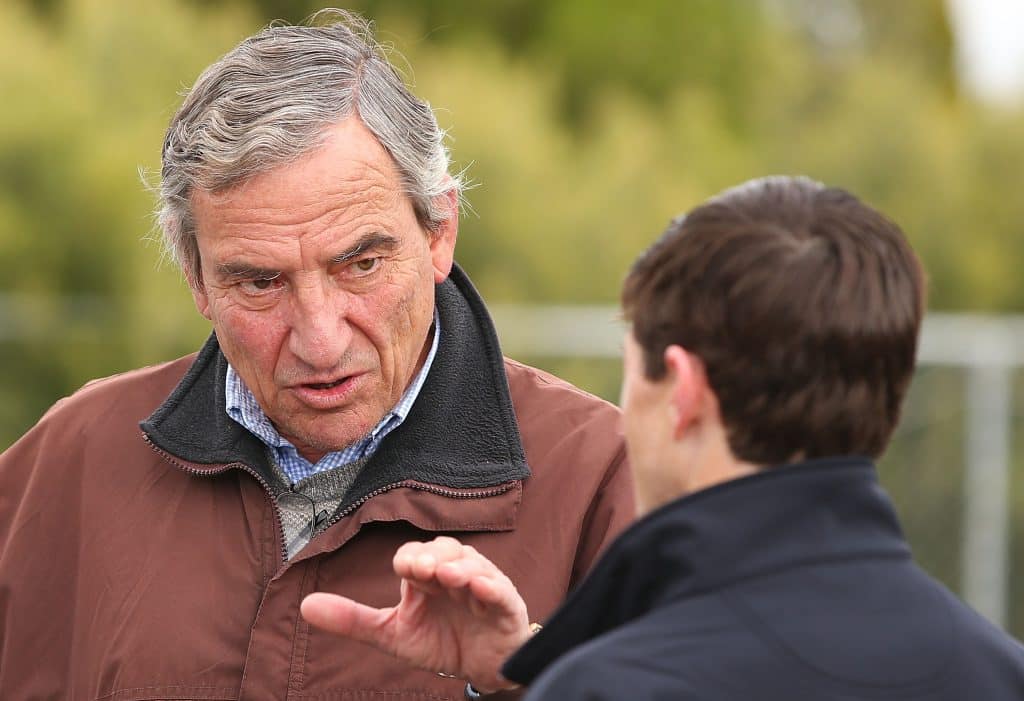
Cumani likes to see a stallion fresh to stud before he uses it, be it in England, France or Ireland. He says that is how he can gauge what the offspring might look like in training. He also believes that only one in 20 stallions will be any good, and a stallion would be extremely good if it can sire one Group 1 winner in every 10 horses it produces.
“Is that possible?” Sara says. “What are the stallions that have those stats?”
“Perhaps Galileo,” Luca replies.
“That’s very good.”
“Yes, that’s very, very good,” Luca says.
Even in the thick of his training career, the Italian kept Fiddocks Stud ticking over because he wanted to be a complete horseman. The couple has nurtured some fantastic families over the years, including that of Zomaradah, the dam of Dubawi, and Kalata, the grandam of Coolmore’s St Leger-winning stallion Milan. They credit this influence to time spent training for the Aga Khan.
However, neither was expecting that retirement from Bedford House would create a disconnect for them as breeders.
“I wish Luca still trained because he did very well with what we raised,” Sara says. “It was more holistic to breed them, raise them and train them. You just learn so much more about the families and where they went wrong, or where we went wrong with them. Even though we have trainers who are mates, it’s not quite the same thing now.”
Luca says: “For me it’s like there’s a bit missing, because while we were breeding and training what we were breeding, we could see the whole picture from birth to retirement of the horse. Now we only see it from birth to the time of the sale.”

The obvious question is why Matt, their son, didn’t take up at Bedford House in 2019. Now, Matt is married to an Australian, has Australian children and is unlikely to leave.
“I blame myself for that,” Cumani says, while Sara says she blames Terry Henderson (of OTI Racing). They are proud of Matt, but they would love to have him back home at Newmarket.
“It seemed easier for him, at the time, to start training in Australia than it would have in England,” Cumani says. “And when he was ready to start training, I wasn’t ready to give up, plus he didn’t particularly want to set himself up in competition with me.
“Much as I somewhat regret it now because it would have been nice to have him closer to home, I’m still sure it was the right choice.”
Between Matt in Australia and Francesca, wherever she is in the world broadcasting on racing, the Cumani brand has remained premium. This is a third-generation racing family that is beloved in Australia and Europe and respected everywhere else.
When Purple Moon ran second to Efficient in the 2007 Melbourne Cup, every Australian felt for the Cumani, and when Bauer ran into the same fate 12 months later, going down in a merciless photo to Viewed, a country bled with him.
“I always say that pressure is for tyres, not for trainers,” he says.
Related Articles
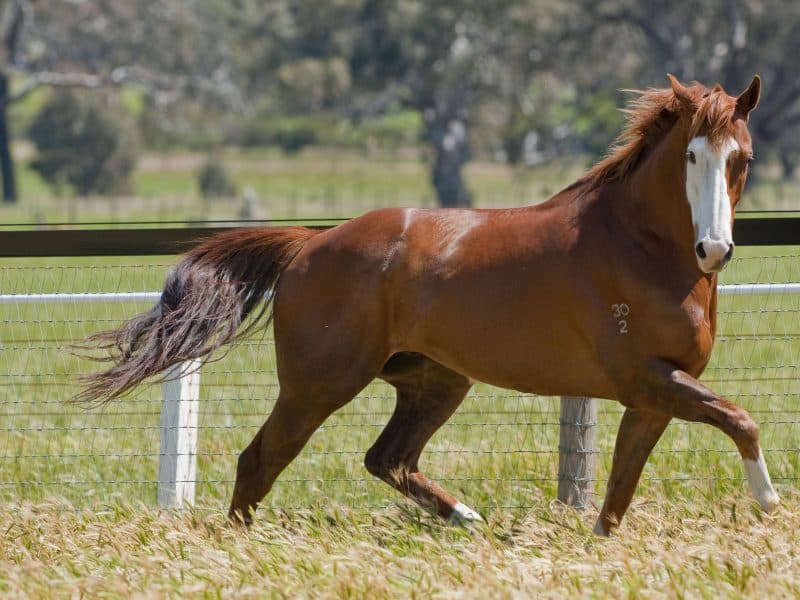
Written In The Stars – A Cat of a different colour
Apache Cat was born to stand out, be it on the racetrack, in the paddock or in retirement, as an ambassador for the industry. As the first equine subject of Written In the Stars, Jessica Owers found out from those closest to him that he was never destined to be “just another brown horse”.

Written In The Stars – A decade on – How Adrian Bott found his way in the shadow of Tulloch Lodge legends
Soft-spoken and studiously modest, Adrian Bott has spent a decade alongside Gai Waterhouse shaping Tulloch Lodge’s modern chapter. He talks to Jessica Owers about balancing pressure and expectation, all the while proving the quietest voices in racing can still command the highest respect.
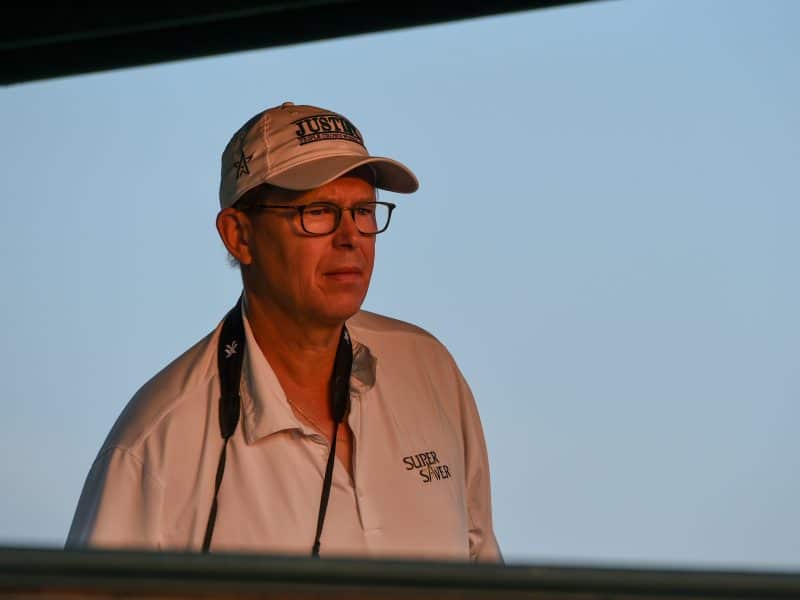
Written In the Stars – ‘A very blessed life’ – Walden, WinStar and winning
As a kid, Elliott Walden thought his farm life in Kentucky was boring, but after a detour via the training ranks, he became, through his association with WinStar farm, one of the most successful and revered figures in American breeding and bloodstock. He reflects on his journey with Jessica Owers in Written In the Stars.