
Sportsbet suffers revenue hit as Flutter enters US prediction market
Australia’s leading wagering company Sportsbet saw its turnover drop five per cent and revenue fall 10.6 per cent in the September quarter, as its parent company Flutter confirmed its ongoing global growth and an intention to enter the US prediction market.

Sportsbet, Australia’s biggest bookmaker, saw its revenue drop by 10.6 per cent across the September quarter, with the ongoing slump in racing investment cited as a major factor in a 5 per cent decline in turnover.
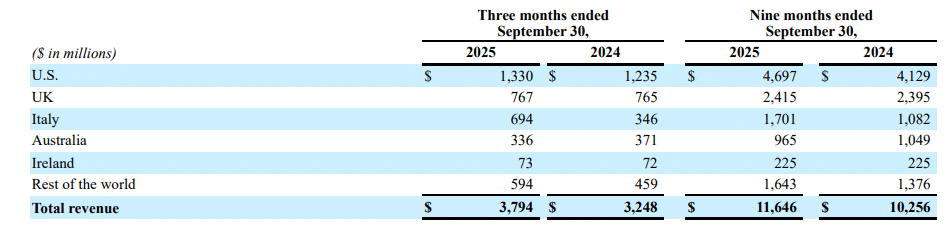
Parent company Flutter’s quarterly report detailed a US$35 million slump in revenue compared to the same quarter in 2024, from US$371 million to US$336 million. Sportsbet’s overall revenue across the three quarters of 2025 so far is US$965 million, down 12.5 per cent on what it was in 2024.
This occurred despite a growth in revenue in what Flutter calls its international market – that outside of the US – of 21 per cent across the latest quarter to US$2.4 billion, while the US business, headlined by FanDuel, grew revenue by nine per cent in that period to US$1.37 billion.
The Asia-Pacific business, which includes Australia, was the only region to take a backward step in revenue, with a 12 per cent drop in revenue across the September quarter.
Flutter’s quarterly report detailed a $50 million slump in revenue from the Asia-Pacific region compared to the same period in 2024, from US$413 million down to US$363 million.
The prohibition of real money online gambling in the previously growing Indian market did impact the Asia-Pacific result, but the overall Asia-Pacific downward trend was primarily driven by sports book results in Australia
”Sportsbook performance in Australia (was) primarily impacted by a 110bps adverse swing in sports results. Ongoing market trends in horse racing led to a five per cent reduction in sportsbook handle, partially offset by a 50bps reduction in generosity through more targeted spend distribution,” the report said.
“The decrease in Sportsbook revenue was also impacted by unfavourable changes in foreign currency exchange rates which impacted revenue by 2 per cent.”
To give context, the September quarter result last year saw a 12 per cent increase in revenue from 2023, when the Q3 revenue was $332 million.
In 2022, it was $319 million, and in 2021 it peaked at $370 million.
Anecdotally, Sportsbet has reported a rebound in turnover during the current spring carnival, which may lead to a change in trend for the December quarter.
It had a record number of new customers sign up on Melbourne Cup day, where it took a record 69,293 bets per minute at its peak with turnover on the race the highest in the company’s history. This has been backed up by wider market trends, with record turnover recorded on the Melbourne Cup of $247.4 million.
Across the entire global Flutter business, active monthly players grew 9 per cent to 14.1 million, while revenue jumped 17 per cent to US$3.8 billion. Adjusted EBITDA edged up six per cent to US$478 million.
“Flutter delivered a solid third quarter, with continued momentum in both our US and International businesses,” chief executive Peter Jackson said.
“We are the clear number one operator in the US, and we will continue to build on that position to drive future profitability.”
Significantly, Flutter also announced it would launch FanDuel Predicts in the United States in December, coming together with CME to provide a product to the burgeoning prediction markets space.
It will be launched as a standalone mobile application offering sports event contracts across key markets.
FanDuel Predicts will be launched only in states where sports betting is not currently legal, which includes California and Texas. If states were to legalise sports betting, then it would cease offering the product.
“We can’t wait to bring FanDuel’s proven approach to market innovation into this dynamic sector,” Amy Howe, chief executive at FanDuel, said.
“Our partnership with CME Group allows us to leverage their deep market expertise built over decades while delivering the seamless, accessible experience our customers expect.”
The announcement follows on from chief American rival DraftKings’ decision to enter the prediction market after acquiring Railbird.
The precipitous rise in the popularity of prediction markets in the US is seen as a threat to the current dominance of DraftKings and FanDuel in sports betting.
Combined, they hold around 72.5 per cent of the money wagered in the US, a share that has dropped from 75 per cent over the past 12 months.
Author

Related Articles

Tricks of the trade – Promotion lotteries in government’s sights
Over 80 companies that offer trade promotion gambling services, including major players in the wagering industry, are set to be impacted by a proposed federal government ban on lottery or sweepstakes products.

The end of the American dream? How the US betting market flutters are set to be felt in Australia
After seven years of unfettered growth, the massive American sports betting scene is undergoing a major reset, disrupted by prediction markets and corporate upheaval. Bren O’Brien examines the potential impact on the wagering industry in Australia.

Under the influence – Victorian regulator warns gambling promoters of legal risks
Australia’s booming gambling influencer culture is facing unprecedented scrutiny, with Victoria’s watchdog warning social media personalities that some wagering content could breach laws and attract fines exceeding $24,000.
