
Defining the chosen few – Andrew Rule on Australia’s champions
Who are the greatest Australian race horses? And what qualifies them for this honour? In this extract from his book The Chosen Few, Andrew Rule discusses the concept of champion and what defines them.
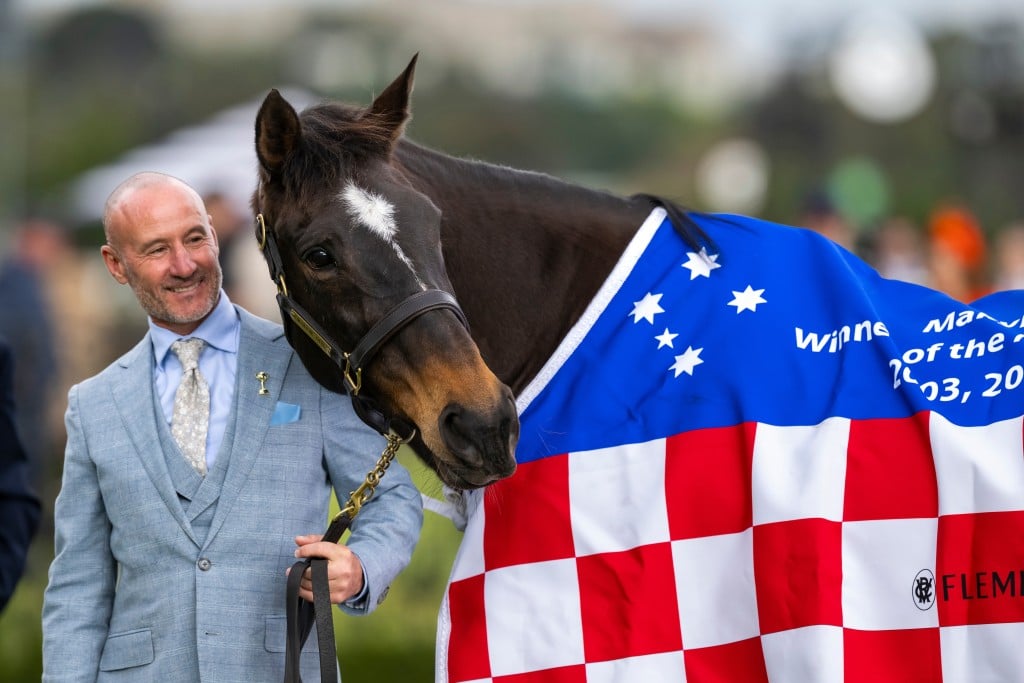
This is an edited excerpt from The Chosen Few, by Andrew Rule. Published by Allen & Unwin. This article is part of a sponsorship arrangement with the publisher.
CHAMPIONS are as scarce among sports writers as among racehorses. Charles Hatton was one of the few. The man who coined the term ‘the Triple Crown’ believed for fifty years he would never see a more perfect racehorse than Man O’War—but it took him only seconds to change his mind.
It happened at Saratoga in upstate New York in the summer of 1972. The old writer was sitting on a bench when a tall chestnut colt entered the saddling paddock. When Hatton saw him, he rose to his feet.
Hatton had seen thousands of horses in his life, thousands of two-year-olds, and suddenly on this July afternoon of 1972 he declared he had found the best of all of them.
The horse was Secretariat and Hatton never regretted making that lightning flash of judgement. The big chestnut colt went on to bewitch the world with feats that resonated far beyond the usual racetrack crowd of wealthy owners chasing a dream, shrewd insiders chasing an edge and anxious punters chasing luck.
The big red horse was astonishing—on dirt or turf, against all comers and distances from sprints up to a mile and a half (2400 metres), mostly run in blindingly fast time. It was after the colt ran the fastest one-and-a-half miles in history (2:24 flat) that Hatton wrote the line that is still quoted in sports of all sorts: ‘His only point of reference is himself.’
Maybe the original Eclipse was that much better than other horses in the 1770s when watchers yelled ‘Eclipse first, daylight second!’ Maybe Muhammad Ali was that much better than other heavyweights. But Hatton was certain that, among the thoroughbred racehorses of the 20th Century, Secretariat stood alone, as beyond compare as a mountain lion among stable cats.
They called him ‘The horse God built’.’ Everything about him matched his imposing physical presence. He burst out of the starting gates, most times, like Superman flying from the telephone box after changing out of his Clark Kent suit and tie.
Hatton’s definition of the champion has lingered in sport for half a century because it applies to the great ones in any field: His only point of reference is himself.
This brings us to the bloody-minded and possibly unanswerable question posed by the premise of this book: In Australia and New Zealand, how many horses have approached that level of dominance in two centuries of racing?
Champions in any field are as rare as Hatton’s diamond-in-the-dust and they turn up randomly or not at all.
They say racing is a disease curable only by death but some of the afflicted stay around long enough to find wisdom. These wise survivors of the game, hands-on horse people, tend to agree on the futility of concocting methods of identifying a wonder horse from among countless also-rans. This is bad news for pedigree buffs.
‘You don’t breed or buy champions,’ says one fourth-generation horseman whose family has trained thousands of horses since 1870. ‘You fluke them.’
Makybe Diva’s trainer Lee Freedman, who (with his brothers) trained five Melbourne Cup winners and is the great- grandson of a man who rode four, says the same thing. You buy them and try them until the day comes when a freak steps off the float, carelessly disguised as just another horse.
Racing lifers know there is only one lasting truth: they are part of a long numbers game played by people waiting for their luck to change.
Having established we are dealing with thoroughbred gallopers alone and not their standardbred cousins, we must face the question: How many truly great racehorses have there been in Australasia?
A safe and conservative answer is that there’s one horse from the late Victorian era, one from the Great Depression and one from the post-war racing boom: in other words, the immortals Carbine, Phar Lap and Tulloch.
Naming the Big Three is easy. After that, it gets harder; the closer we get to the present, the more our perspective alters and focus sharpens. That complicates things because facts and figures start colliding with mythology.
Elapsed decades can add lustre, the illusion of historical ‘fact,’ to legends resting on sepia images and jerky black-and-white newsreels and yellowed newspaper files, as remote from us as the childhood of our own great-grandparents. Then again, undermining that sentiment and nostalgia can be a ‘recency bias,’ favouring the feats of relatively modern times captured on film.
Choose any one of Kingston Town, Black Caviar or Winx, and it means the other two also get automatic entry because there’s no time machine equipped with a magic camera to help unpick that blanket finish. But to name those three moderns of the video age invites disagreement: diehard Bernborough and Rising Fast fans fire off outraged letters about ‘the best horse my grandfather ever saw’ and historians quite properly point to a genuine hero like Gloaming, the 1920s phenomenon who won 57 of 67 races in between crossing the Tasman fifteen times and who ran unplaced only once, when tangled in a starter’s tape.
Once Bernborough, Rising Fast and Gloaming get in, Ajax and Flight and Wakeful are kicking down the door. But the wonderful Shannon beat Flight comprehensively three times before beating up on the Americans, equalling two world records in big races over there. So surely he’s in, too. But hang on, someone will argue, was he really any better than Vain or did he just race for longer?
Anyway, that’s more than a dozen big names already. And there are plenty more where those come from, including at least one colonial hero who raced before Carbine did.
There’s a problem emerging here. Fifteen into ten doesn’t go . . . and 25 is even harder, which is why so many credentials will be raised and praised in the final chapter of this book when the doors of a very big stable are thrown open for the Take Your Pick Stakes.
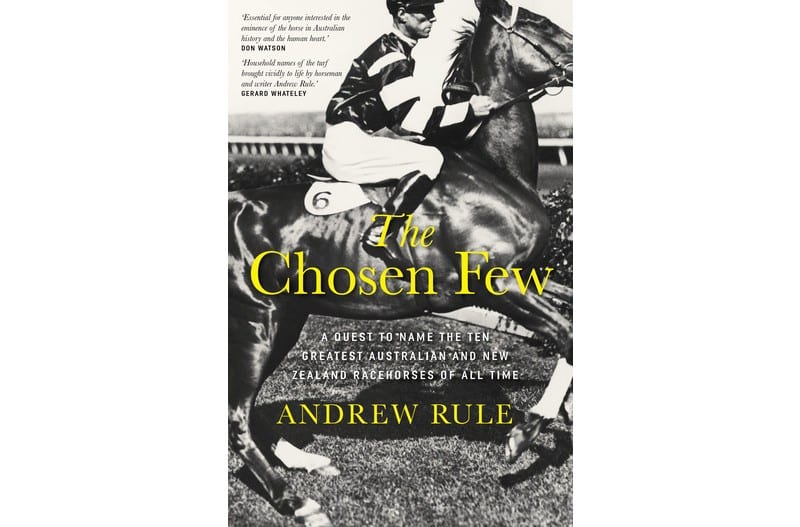
The Chosen Few, by Andrew Rule. Published by Allen & Unwin
***
THE wise warn against comparing the great. Bart Cummings, trainer of Light Fingers and Galilee and Saintly and So You Think and a record tally of Melbourne Cup winners, was as wise as anyone who ever made the unwise decision to train horses for a living.
Cummings was often asked to nominate the best of the hundreds of horses he had trained, many of them multiple Group winners.
Don’t compare champions, said the Irish mystic of Australian racing. ‘Celebrate them.’
Others had said something like it before Cummings coined that line, and plenty have echoed it since. But none have nailed the sentiment behind it more pithily than the late Grania Poliness, a school teacher, amateur historian and writer infected with a lifelong passion for horses and racing.
Comparing performances from different eras, she wrote 40 years ago, ‘is like comparing roast beef and ice-cream.’
Poliness might seem an unlikely source of racetrack lore. She stands to one side of racing’s broad church, which ranges from royalty and robber barons all the way down to desperates in the dole queue, taking in racing writers, horse whisperers, scientific veterinarians, superstitious breeders, degenerate gamblers, hot-headed jockeys and cold-blooded bookmakers.
Grania Poliness was none of those. She was a sane, sensible and private woman with no vested racing interests, just a lively interest. As an author she was relatively obscure, more talented amateur than hardened pro, a crossword buff who liked the puzzle of uncovering facts through diligent research.
For Poliness the jobbing writer, subjects varied quite some. She wrote a history of Australian souvenir china, another about a gracious country garden, and another on the story of Jimmy Watson’s wine bar. Those niche works would seem to make her an unlikely candidate to pull together an account of the great galloper (and international stallion) Carbine to celebrate the centenary of his birth in 1885. But she did. The result was a compact and competent history, published in 1985, that gathers, summarises and splices together contemporary accounts of that remarkable animal.
Poliness didn’t stray far from the acknowledged (or alleged) facts handed down from before the turn of the 19th century. And she had too much sense to stoop to sentimentality or to pose as a prose stylist, but she knew her stuff. On the folly of comparing champion horses of different eras, her ‘roast beef and ice-cream’ nails it completely.
As a metaphor for futility, comparing beef and ice-cream distils a view shared by realistic students of pedigrees, distances, times and form and everything else that goes into the fascinating, time-wasting business of calibrating one horse against another, decades or even lifetimes apart.
On the surface, racehorses appear easier to compare than paintings or songs, say, because racing seems as if it can be measured through a simple arithmetic of wins and losses, times and handicap weights. But it’s not simple and it’s not all arithmetic. Racing is more than statistics. Most sports are. Take cricket, for instance.
No one argues that Bradman and Warne weren’t both champions—but which is better? By their own stratospheric standards, one couldn’t bat that well and one couldn’t bowl much. So the two incomparables are literally incomparable, at least with each other. It’s like that with racing, comparing animals with abilities at opposite ends of a spectrum with blinding speed at one end and slogging stamina at the other. It’s all the harder when one was a champion in the steam age and the other is more Silicon Valley.
Specialists at opposite ends of the racing spectrum, pure stayers and pure sprinters, cannot earn the ‘champion’ title through the stopwatch alone.
The gulf between extreme opposites suggests we set parameters about what a racehorse has to do to be called a champion. In thoroughbred racing, as opposed to human athletes, prospective champions should be competitive in the middle ground—not in outlier events over 400 metres or 4000 metres—and consistently defeat the best of their contemporaries.
This tends to sideline all but the greatest sprinters and greatest stayers in favour of the most versatile middle-distance gallopers. And even then, we look for signs that (in racing’s pre-metric shorthand) the crack sprinters ‘could get a mile’ and that the great stayers were brilliant enough to win at less than two. Which, for our purposes, puts the middle ground between 1400 metres and 2400 metres.
While making up rules, let’s assert that for true champions, rather than brilliant specialists, certain qualities come into play: durability, versatility and the ability to beat high-quality opposition repeatedly over time.
The test of a champion galloper is to beat all comers at the top level, running good times for the conditions of the day, preferably over three seasons or more. As shrewd students of the game point out, a champion should beat top horses that frank that form by winning well at any time the champ isn’t running against them.
***
RACING is about horses and people. Everything else, the industry and the gambling revenue and the social whirl of the carnivals, runs second to the ancient connection between man and beast.
Without people, what’s a racehorse, after all? Merely an animal running uselessly in circles in between being fed and watered. It’s the people who value the spectacle and the animal that give racing whatever meaning it has—echoing a link between human and horse that goes back to prehistory, when nomadic hunters on the steppes tamed a trapped prey animal instead of eating it.
Like the invention of the wheel, if not the moon landing, the taming of the horse was a giant leap for mankind. Humans and horses have been entwined ever since. Modern racing is a footnote to that ancient connection.
From the stables of ancient Greece and Rome to the ones at Flemington and Randwick, some things haven’t changed much in a couple of millennia. People still cherish young, untried horses—the ones they handled a lifetime ago and the one stepping off the float tomorrow.
As to choosing a few champions from the many contenders, prize money is a measure so crude as to be almost useless, as subject to inflation a banana republic currency and debased by garish cash-splash innovations like the Everest.
There are champion stayers and champion sprinters, of course. But, leaving aside those exceptions, to be eligible as a bona fide champion, contenders probably should have won at middle distances consistently, against the best possible rivals, over three seasons or more. Versatility and durability under pressure isn’t everything but it’s close.
This opens up the market for fast stayers and tough sprinters who duelled in the middle of the range. And who defeated good horses while they were at it, preferably in fast time.
There are few certainties in racing but one is that there have been plenty more than ten champions to race in Australia and New Zealand over the last two centuries.
The list of eminent gallopers from Ajax and Amounis to Zabeel and Zoustar is longer than the alphabet and just as hard to cut. Even with Makybe Diva ousted on a passport technicality because she was foaled in the UK and arrived down under as a half-grown youngster, who’d want the job of splitting Manikato and Might And Power, for a start?
One was buried with honours at Moonee Valley, scene of his five wins in the William Reid Stakes. The other’s cult following has inspired a club of racing enthusiasts who meet four times a year and organise trips to overseas racing carnivals. The clue is that it’s named the ‘Might And Power Club.’
These two horses were 24-carat, rolled gold champions—but not the only ones. Besides, as a wise man pointed out, with a nod to Tolstoy’s unhappy families, each champion is a champion in their own way, so how do you compare them?
Some serious analysts with too much spare time might quit forensic accounting or competition bridge to work on reducing the mystery and myth of horse racing to a maths problem.
For the rest of us, it comes down to something less technical and more enjoyable, the Dennis Denuto test: ‘It’s the vibe of the thing.’
As racing lifers agree, champions impress those who were young when they were winning, an effect much like that of films and songs that are the soundtrack of our lives. Racing, like music, is big business but it’s not just business; it exists only because it’s intertwined with romance and with chance—and with character.
Good horses, like all aerobic athletes, need the character to push themselves when others fade. The people who race them tend to be characters to inhabit what Les Carlyon said wasn’t a conventional industry but ‘an addiction, a romantic quest and a certain sense of humour.’ Not to mention danger, bravery and a touch of conspiracy.
People who were old when Peter Pan and Phar Lap emerged in the 1930s still revered Carbine, just as oldsters in the 1890s harked back to The Barb in the 1860s. The same nostalgic instinct touches every generation.
Tulloch is a flickery figure on a newsreel or a yellowed newspaper clipping when you’ve seen Might And Power and Makybe Diva in the flesh. But those eyewitnesses who were young from 1957 to 1961 stick with the Tulloch camp, even if their parents couldn’t quite believe he was better than Bernborough.
The Black Caviar and Winx generation don’t remember much about anything that happened before the Sydney Olympics. And why would they?
Everyone is entitled to nominate a pin-up from their youth. No matter which horses are proposed as the tenth great galloper of the chosen few, there’ll be arguments as partisan, passionate and pointless as the ones about football teams or rock songs or religion.
Of course, the point of all sport is that it’s pointless. There’s no right and wrong. In this case, just shades of opinion and prejudice about a few racehorses, all of them good, most of them gone.
The nine champions who feature in this book are what might be called ‘the genuine freaks,’ each one the acknowledged giant of its own era from the late nineteenth century to the first quarter of this one.
This does not mean there are no other freaks apart from those meteoric ones who didn’t last long enough to get on the dais with the all-time heroes.
Mixed between are more conventional champions, the ones that overshadowed their contemporaries in their turn onstage. And apart from those dominant individuals are simply gifted racehorses, ‘champions’ to those who owned and trained and rode them because they did things that changed lives: bought houses and farms and new fencing and paid for weddings and operations and holidays and a new ute to tow the horse float.
In some ways, those horses are the heart and soul of racing in Australia and New Zealand, sometimes in America, too. Among them are the wonderful oddities that the track throws up.
***
CHAMPIONS defy convention and, to an extent, classification. We’re talking about the handful of ‘freaks’ who made their mark in bold strokes over time, as opposed to those anointed through some process of elimination to be voted the best of their age group or their year, like schoolkids grabbed from each each class to collect a ribbon on speech night to show mum and dad.
Real champions aren’t the hardest triers or the most-improved or the best mannered. They are one-offs, broke-the-mould, once in a lifetime visitors from another galaxy. They can be angels or cranky pigs. They come in all shapes and sizes. They can be 15-1 hand ‘polo ponies’ like Todman or 17-1 hand giants like Phar Lap, whose girth was about as big as any among elite gallopers.
‘Real champs weave magic so rare that no one can tell you honestly why or how it happens,’ Les Carlyon wrote in the 1990s. ‘They don’t look alike; they don’t win races the same way. There are no rules. Great racehorses outrun their pedigrees and their looks.’
Carlyon was careful not to fall for blunt comparisons. Like children, he reckoned, champions were best not compared directly. But it was clear which of the chosen few belonged in his private pantheon of pin ups. For Tulloch, he wrote, ‘the only point of reference is Phar Lap.’
And the only point of reference for Phar Lap was Carbine. And so it goes, all the way back to Eclipse.
This is an edited excerpt from The Chosen Few, by Andrew Rule. Published by Allen & Unwin. This article is part of a sponsorship arrangement with the publisher.
Related Articles
Mary Collier chosen to oversee sweeping reforms to Queensland racing
A generational reset of Queensland racing has moved into its implementation phase, with Racing Queensland appointing Mary Collier to oversee the rollout of the McGrath review’s sweeping, government-endorsed reforms.

Celebrations and setbacks – Chris Munce on racing’s fickle fortunes
Having experienced enormous highs and lows of racing as a jockey and a trainer, Chris Munce knows he can rebound from the injury setback to his star colt Cool Archie this week. The feeling is slightly different this time, shared with his children Corey and Caitlin, who are key parts of his training business.

ATC-Racing NSW court battle stretches into another day
The Australian Turf Club remains under the control of its directors, for now, with a key legal hearing in the NSW Supreme Court adjourned until Friday.