
Analysis: Three years of momentum – Inglis hitting back in the battle for yearling market share
Inglis has continued to claw back market share under CEO Sebastian Hutch, who has adopted a far more competitive stance against Magic Millions than his predecessor, and that public relations strategy was again to the fore at the Inglis Classic Sale.

Since joining Inglis in late 2018, after leaving the Coolmore safety net for the bloodstock auction house, Sebastian Hutch has made competing with Magic Millions central to his strategy.
That has played out not only in the sales ring but publicly, with pointed comparisons aimed at Inglis’ core audience of breeders, vendors and buyers.
It marks a clear shift from predecessor Mark Webster, who during his tenure from 2007 to when he stepped back and allowed Hutch to fully take charge in 2021, was far less inclined to draw direct contrasts, nor use them as part of its marketing and public relations strategy.
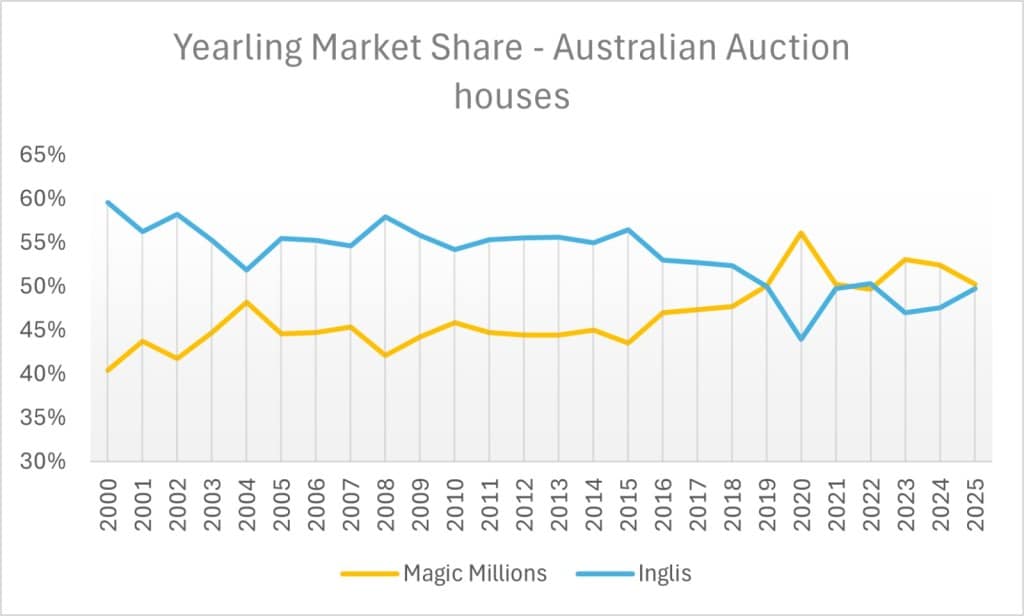
Inglis led the Australian market share until 2019 when Magic Millions edged ahead with 50.08 per cent of gross turnover.
The Gold Coast company retained momentum through the pandemic-affected 2020 sales season, with Inglis wounded by the heavy government-imposed restrictions and economic turmoil, particularly for its Easter sale, which had to be conducted virtually in two parts and three months apart.
In 2022, Inglis briefly regained the upper hand with a 50.32 per cent market share.
Magic Millions has held the advantage over the past three years, but Inglis has narrowed the gap from 46.97 per cent in 2023 to 49.75 per cent last year and is well placed to push beyond 50 per cent in 2026.
Market share comparisons are complicated. Magic Millions operates in four states, while Inglis focuses on NSW and Victoria.
Buoyed by strong 2025 results, Hutch has elevated the rhetoric in 2026, particularly in targeting Magic Millions’ January flagship sale, which competes directly for yearlings with Inglis’ select Easter, Classic and Premier sales.
“None of you will report it, but the first sale of the year was down $5.1 million in terms of turnover,” Hutch told the media after the Classic Sale in reference to Magic Millions.
“So, to sit here and be up $3-odd million is pleasing, but it’s not easy to make happen.
“Theoretically, you want certain things to work out certain ways, but there’s a huge number of moving parts to the mechanics of a sale.
“So, for it to come together and deliver a set of results that reflect an improvement year on year is satisfying.
“I’ve said this at the release of each catalogue, but the fact that we ran good sales in 2025 gave us good momentum into the spring.”
Classic’s $57 million aggregate was its third-best on record. But the Gold Coast picture is more nuanced.
Privately, it was asked whether Magic Millions budgeted for its January Gold Coast sale to be down. The Straight doesn’t know the answer to that question.
However, at the conclusion of the Book 1 sale on the Gold Coast in January, Magic Millions managing director Barry Bowditch told industry media that $200 million “was a real goal”, having hit $203 million at the end of the Friday Super Session.
“To have 40 less horses catalogued and 20-plus more withdrawals, and some significant withdrawals among them, it was pleasing to get close to last year’s gross,” he said.
“To increase the clearance rate, which is nudging towards 86 per cent and an average that is up on last year (is pleasing).”
It was the fifth consecutive year Magic Millions surpassed $200 million, albeit with its smallest Book 1 aggregate in that stretch.
With a median of $200,000 and an average of $273,180, a larger catalogue would have delivered a higher gross and possibly eclipsed the 2025 turnover figure.
Turnover drives commission revenue, as Hutch regularly notes, but catalogue management and vendor sentiment are equally critical in securing quality stock and ensuring there’s a competitive buying bench in attendance.
New Zealand Bloodstock has wrestled with similar dynamics. This year it presented Book 1 and Book 2 horses for inspection concurrently at Karaka, allowing buyers to assess the full offering at once. It worked.
“When we were on farms through the end of July, all of August and September talking about the Inglis sales series for 2026, there was very positive sentiment towards the sale series as a whole,” Hutch said.
“Certainly that’s borne out to some extent by the results here, but I think if my expectations are right it will be borne out more so at Premier, where it just feels like we have an improved catalogue, certainly in terms of quality, and we have a very good catalogue going to Easter.
“Better catalogues bring greater expectation on the part of vendors, so that’s a challenge to manage as well.”
Inglis has catalogued 472 lots for its Easter sale, 51 more than last year. To maintain its 2025 average of $451,913 and median of $360,000, turnover will need to rise by about $16 million on last year’s $150 million gross.
Magic Millions’ condensed January Book 2 sale reflected softer demand in the segment which Hutch described as the “zero to $80,000 or zero to $100,000” when asked about that bracket of the market at the Classic sale.
But some of that lost Gold Coast turnover will shift to March, where the QTIS-only restriction has been lifted and 490 lots are catalogued, up from 380.
Clearance rates across Inglis, Magic Millions and NZB sales have so far remained solid. Last year’s combined clearance rate across key Australasian yearling sales was 80.8 per cent, the lowest since 2013 and almost nine points below the 2022 peak.
The challenge for both companies is balance: maximising turnover without diluting quality or vendor confidence, particularly at their select sales.
Hutch can rightly feel sure-footed. His Magic Millions counterparts will be investigating ways to improve their January sale, and its calendar as a whole, but it’s far from doom and gloom north of the Tweed.
Author

Related Articles
Run The Numbers – Yearling market grows despite drops at biggest sales
Australia’s yearling market has grown in almost every key indicator to this point in 2026, despite the two major sales taking a step back. Run The Numbers takes the temperature after the Australian Easter Yearling Sale.
Record average, drop in aggregate leaves Inglis with mixed Easter feelings
Inglis marked a record Easter Yearling Sale average but Sebastian Hutch felt there was areas for improvement after a lower clearance rate and aggregate than 2025.
Too Darn Hot return on cards as $2.2m colt sets new southern hemisphere benchmark
Too Darn Hot’s anticipated return to Australia has delivered a timely boost for commercial breeders, underscored by the stallion setting a new Australasian yearling benchmark with a $2.2 million colt at Inglis Easter.