
How Tabcorp lost half its market share in just four years (and Gil’s plans for turning things around)
A four-year period cost Tabcorp its dominant position in the Australian wagering landscape, with chief executive Gillon McLachlan revealing the green giant had been punished by changing customer behaviours as well as for its own entitlement and inability to accept change.
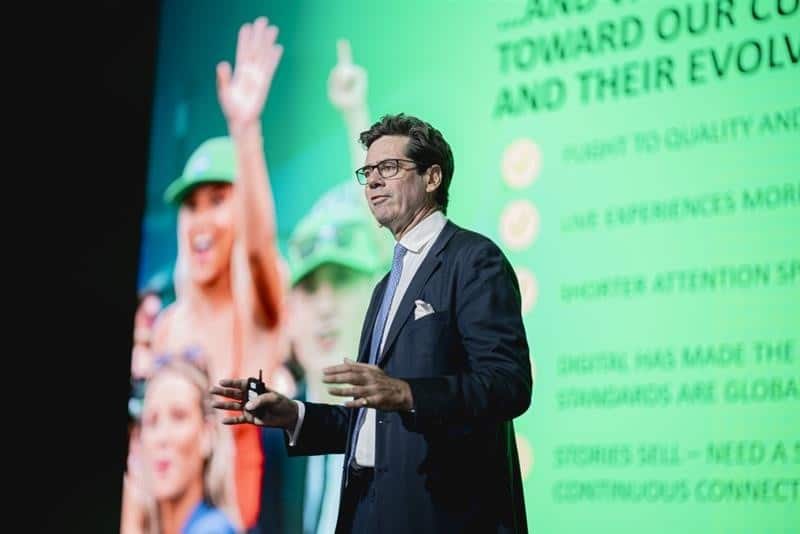
When Gillon McLachlan presented at the Asian Racing Conference in Saudi Arabia last month, he gave the most detailed dissection yet of how Tabcorp lost control of the Australian wagering industry.
In a disastrous period from 2018 to 2022, Tabcorp’s Australian market share of turnover across cash, retail and digital slipped from close to 60 per cent to around 30 per cent.
The frankness with which McLachlan spoke of that period was no doubt helped by the fact that it preceded his time at the publicly listed wagering giant.
His address to the audience outlined external factors where “we have been basically disrupted and been on the wrong side of every macro force in wagering in the last 20 years”, as well as the cost of inaction inside the company.
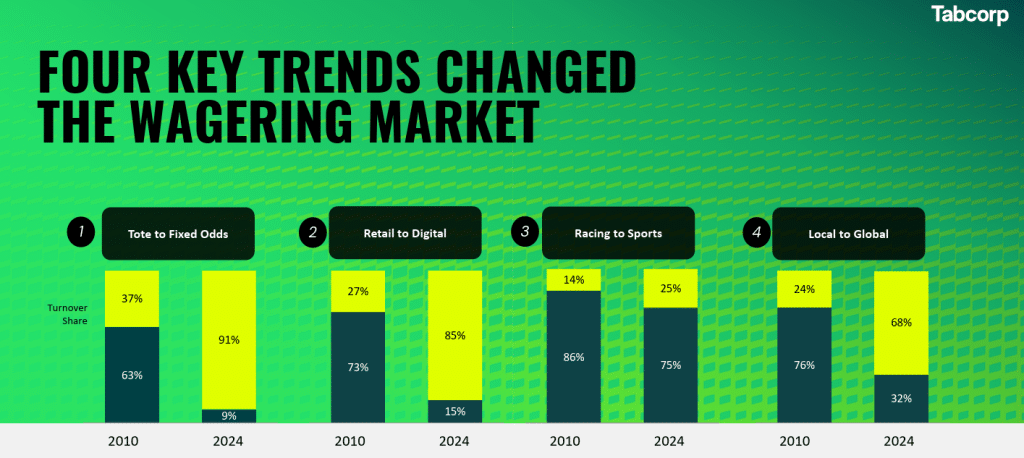
In McLachlan’s presentation, he highlighted changing customer behaviour between 2010 and 2024, which saw fixed odds turnover share go from 37 per cent to 91 per cent, retail turnover slump from 73 per cent of the market to 15 per cent and a growth in the share of the sports market from 14 per cent to 25 per cent.
“We were, I think, the perfect example to be speaking about a company that did not innovate and did not change and did not disrupt itself ahead of time,” he said.
“So our entitlement and our complacency and our inability to accept the changing market and the changing customer forces and the competition and what they were doing meant that we did not move and we paid the price.”
That made Tabcorp vulnerable to disruption from other parts of the industry. One slide from McLachlan pointed to the ongoing decline of the tote, and that much of it had been consumed by tote-derivative products offered by Tabcorp rivals.
That slide estimated the turnover of those tote derivatives to be approximately $6 billion, more than the $5.7 billion turned over through Tabcorp’s tote, which has exclusive licences in five of the six Australian states.
“I think ultimately you look at that and then there is our very worthy competitors in the space (who) have taken a lot of that money,” he said.
“We didn’t deal with competition, we weren’t equipped to compete and ultimately that cost of inaction cost us on the scoreboard.”
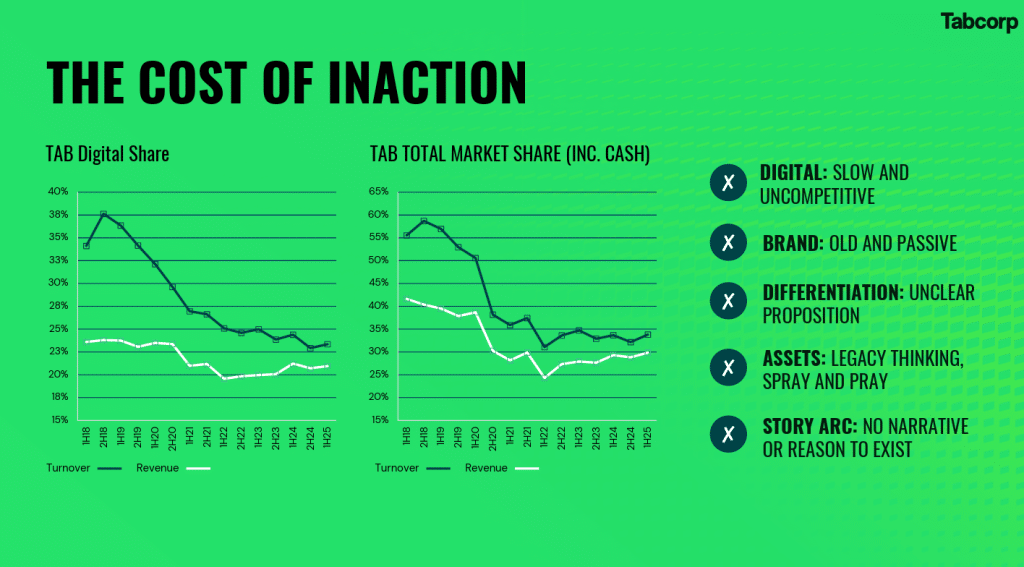
McLachlan’s presentation revealed that, up until the second half of 2018, Tabcorp’s market share of all wagering turnover remained close to 60 per cent, while its digital turnover share peaked at 38 per cent.
The trends listed above, plus the compounding effect of the pandemic, in which retail venues were shut, saw Tabcorp’s share price fall precipitously over the next few years as key rivals, including Sportsbet and Entain, grew significantly.
By the first half of 2022, Tabcorp’s total market share had nearly halved to close to 30 per cent, while its digital share hit 25 per cent.
The effects were not quite as dramatic on the share of total revenue, which dropped from 42 per cent at the start of 2018 to 25 per cent in 2022, but it was still a substantial shock.
“Our uncompetitive digital offer, our old and passive and entitled brand, our unclear proposition, our basic advertising, our lack of storytelling, our lack of a narrative, our lack of ability to say this is who we are in a competitive, cluttered market meant that ultimately we’ve lost share,” a brutally honest McLachlan told the conference.
He said that the cost of inaction and inability to pivot had eventually led to the wholesale changes that resulted in the renewed strategy he has undertaken since taking charge in August 2024.
In detailing that strategy, he described the renaissance as being brand-led.
“Brand is everything. We went younger, more energetic, louder, bolder, very un-TAB,” he said.
“And if I thought 18 months ago that I’d have young women on race courses wearing TAB merchandise proudly, I would have taken that every day of the week. We activated our brand consistently across all of our channels. Everyone knows what you get from us now.”
McLachlan’s retail-led strategy has yet to prove it is bearing fruit, but it has helped arrest the decline.
When it came to Tabcorp’s core product of racing, McLachlan told the conference he didn’t agree with the characterisation of the industry as being in a dire situation.
“Racing is an incredible sport with incredible opportunity and the point about it is it doesn’t matter what you think it is, it can be better,” he said.
“If you take that mindset, everyone will give you, if you talk about people, a view about how we globalise the product and how racing can grow.”
“It is the same stories, global brands, telling stories, tentpole assets, innovation, activation, alignment, global scheduling, all that stuff.”
“You have everyone in the room, all the major race courses, you have Churchill Downs, Flemington, Ascot, every peak authority, every person in racing who makes any sort of difference is here.
“In the end, it is the leadership of this room. Because in my view, transforming customer behaviours means transforming industry behaviours as well.”
Author

Related Articles
Senate inquiry to delay passage of gambling advertising law changes
The passage of reforms to gambling advertising laws through federal parliament has been put on hold, with opposition from the Coalition and the Greens prompting a Senate inquiry.

PointsBet punter denied $450,000 refund after using a sporting club card to bet
A key gambling regulator has thrown out a bid by a punter looking to recover $450,000 in betting deposits made from a third-party bank account, determining the “complaint is about recovering losses, not about compliance”.

Entain reshapes trans-Tasman leadership as Moncur exits
Wagering company Entain has appointed new managing directors in Australia and New Zealand as part of an ongoing restructure, with long-serving New Zealand-based executive Sam Moncur to exit the business.
