
McLachlan’s grand plan for Tabcorp has its ‘punch-in-the-mouth’ moment
Gillon McLachlan’s honeymoon as chief executive of Tabcorp has ended. With AUSTRAC having commenced an investigation into the wagering giant, his well-advanced plans for the company’s future may have to change course. The impacts will be felt well beyond the walls of the publicly listed company, writes Bren O’Brien.

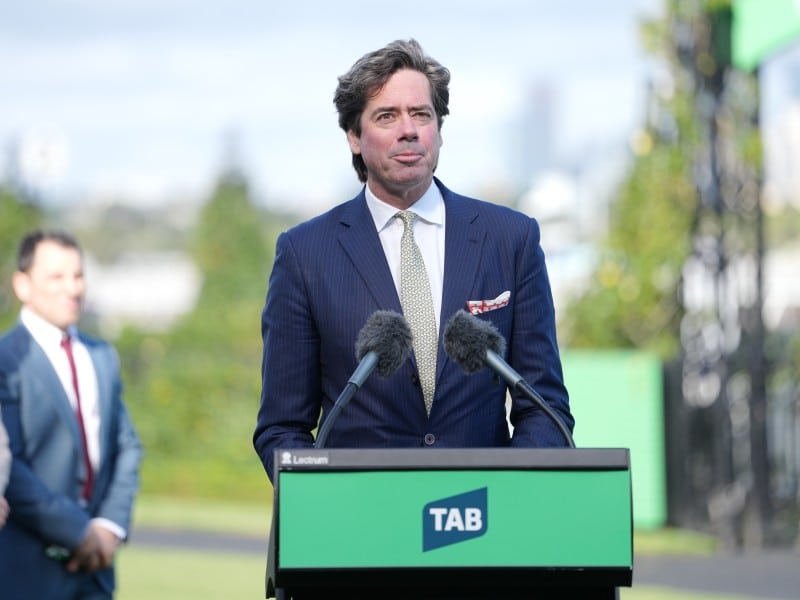
Analysis: Tabcorp chief executive Gillon McLachlan stood before the Macquarie Australia Conference in Sydney last week and continued to push his message of the upward growth potential of the publicly listed wagering company.
With shareholder sentiment giving him a significant wind at his back, he rolled through a 10-slide PowerPoint presentation on Tuesday, where he explained the progress that had been made since he took charge in August 2024
While market sentiment had powered the Tabcorp share price to $1,16, giving the company market capitalisation of over $2.6 billion, he said the journey was only halfway through.
Having come through the “getting fit” and “operationalising strategy” phases of the transformation, it was now time to “deliver strategic differentiation”.
It was the next stage of a plan that McLachlan had stayed on script with over the past 18 months. While he had brought on plenty of experience and expertise to help him deliver, it was “Gil’s plan”.
Boxer Mike Tyson is no philosopher, but his famous quote, “everybody has a plan until they get punched in the mouth”, must have been echoing around Tabcorp headquarters last week.
By Friday afternoon, Tabcorp’s share price had plummeted to 75 cents, down 35 cents, wiping $800 million off its value.
By context, it puts the company’s value back where it was in August last year, but the setback was more significant in terms of the sudden crash, rather than the crash itself.
Financial crimes regulator AUSTRAC had launched an investigation into Tabcorp’s compliance with anti-money laundering and counter-terrorism funding laws.
The consequences of a breach are potentially massive. In 2017, Tabcorp was fined $45 million by AUSTRAC for similar breaches, but this time around, enforcement action, if it proceeds, could run into the hundreds of millions.
But a possible financial penalty is not the chief concern of investors. The reality is that Tabcorp is now set for an extensive period of AUSTRAC looking through its books, a world of pain that makes “Gil’s plan” that much harder to deliver.
The surge in Tabcorp’s share price, from a low of 39 cents when McLachlan took charge to $1.16 last week, was driven, not necessarily by runs on the board, but by the potential upside of the groundwork being laid.
Initiatives like the national tote, TAB Live and the revival of in-venue/retail experience were taking shape, but had yet to deliver the intended commercial windfall.
AUSTRAC has not commented on its investigation, only confirming it has begun, but its stated aims target the use of cash to disguise the flow of money from illegal activities.
It is suspected that this is where AUSTRAC auditors will do much of their digging.
Tabcorp is uniquely exposed to cash due to its near-national retail monopoly. Its half-yearly report released in February showed cash-related revenue to be 48.8 per cent of overall domestic wagering revenue. That $511 million was derived from $2.8 billion in cash turnover.
By its own numbers, cash betting is more profitable for Tabcorp, with a revenue/turnover ratio of 18.1 per cent, compared to 12.3 per cent for digital betting.
In its last set of annual results in August last year, Tabcorp spruiked the 17.5 per cent growth in cash betting across the 2024/25 financial year.
It was a figure that raised eyebrows elsewhere in the industry, where it was seen as the best way to raise a red flag for AUSTRAC.
We don’t know if that led to increased scrutiny on Tabcorp, but the wagering company’s recent decision to ban several cash-oriented punters was also greeted with interest elsewhere.
You could see how the voucher system, where punters are given cash-equivalent tickets, might attract the attention of a financial regulator. The Straight understands that the use of vouchers to transfer credit between related betting parties was cited as a contributing factor in some of the recent bans on cash punters.
Two years ago, Tabcorp faced the possibility of retail cash betting through electronic betting terminals in Victoria being banned after a key regulator there found 72 instances of minors gambling, with one 16-year-old losing $100,000. While changes were made and supervision increased, cash betting survived and thrived.
Tabcorp’s access to cash betting has been seen as an unfair advantage by many of its wagering rivals, despite the fact that it pays a premium for its retail monopoly.
In a prescient message sent to The Straight when Tabcorp was granted its new Victorian licence in 2023, a rival senior executive predicted it would become a sore point for Tabcorp.
“Given digital operators have fully identified customer outcomes, the NSER (BetStop), responsible servive of gambling (RSG) intervention and activity statements, I can’t see the cash environment remaining ‘anonymous’ … in the near future,” they said.
At that stage, when under the previous chief executive, Adam Rytsenskild, Tabcorp’s mantra was achieving ‘a level playing field’.
Given Tabcorp’s cash advantage, rivals scoffed at that characterisation in what is a competitive industry. The same people raised eyebrows over Tabcorp’s cash figures last year and were barely sympathetic when AUSTRAC’s investigation threw a huge curveball at McLachlan’s revival.
The impacts don’t stop at the front doors of Tabcorp’s pending retail revolution. Principal racing authorities and race clubs around the country will be nervous as to what Tabcorp’s sudden requirement to focus on compliance may mean.
After several years of decline, especially in racing, recently released figures and anecdotal reports suggested that the slump in racing wagering was over.
The last part of the decline can be at least partly attributed to Entain, in its own battle with AUSTRAC, having made major changes to its philosophy and “risk appetite” since it was issued action in December 2024.
Chief executive Andrew Vouris might consider leasing out his “winning, but not at any cost” mantra to McLachlan in the next 12 months.
Now the second-largest player in the market, and one with an even greater presence in racing, has the AUSTRAC cloud hanging over it.
Depending on the outcome of the investigation, Tabcorp is likely to have to make further changes. That will mean, at least, forgoing turnover to demonstrate progress in compliance.
What that means is less money flowing back to the racing industry. Some, like the Australian Turf Club (ATC), whose wagering funding is reliant on Tabcorp, will be more vulnerable than others.
When Tabcorp dramatically ceded market share from 2018 to 2022, it led to a significant reduction in funding to the ATC. That then led to a need to consider the Rosehill proposal and all the fallout from there.
Then there are the ongoing sponsorships. If we can draw learnings from the Entain experience, it is that marketing is one of the first things considered surplus to requirements.
These aren’t things that will happen, but they are things that could happen and racing bodies and administrators will do well to war-game all the scenarios.
If the industry rumour mill is to be believed, Tabcorp is not the only operator in AUSTRAC’s immediate investigative sights.
The Straight has learned that TabTouch, the Western Australia government-owned betting operator which holds the retail monopoly in the state, has also culled customers deemed “high risk” and the impacts of that is a consideration of the current review of racing funding in the state.
Going back to Tabcorp, the other thing an AUSTRAC investigation does for McLachlan and his team is weaken its negotiating position on aspects such as the national tote, delivery of which the next executive has staked its reputation on.
Some of those talks are with its rivals after aspects such as co-pooling, while others are with racing administrators, such as Racing NSW chief executive Peter V’landys, renowned as a tough negotiator at the best of times.
None of this will concern AUSTRAC, which is empowered to do its job in what is a more complaint-focused environment. So too is ACMA, the communications regulator turned responsible wagering watchdog. In this context, plus greater state-based regulatory focus, the job of selling bets has not got any easier.
Tabcorp has not been found to have done anything wrong. It may well escape AUSTRAC’s attention with a clean bill of health, but the national reaction to the scrutiny has already done its share of damage.
As for McLachlan, he has had his “punch-in-the-mouth” moment. The question now is how he and Tabcorp respond to their first major challenge since he took charge.
Author

Related Articles

‘Clear and obvious error’ – Punter denied six-figure payment on winning bets
An Australian punter who was denied a windfall of more than $110,000 and subsequently had his account closed has failed in a bid to get a key industry regulator to get the bookmaker to stand by the winning bets.
‘Serious concerns’ – Tabcorp at centre of AUSTRAC investigation
Tabcorp has become the latest Australian wagering company to be investigated by AUSTRAC, as the financial crimes regulator increases its focus on corporate bookmakers’ compliance with anti-money-laundering and counter-terrorism funding laws.
Sportsbet’s fortunes rise as Flutter makes executive change
Sportsbet defied the ongoing decline in the Australian racing market to post a jump in revenue in the first quarter of 2026, as its under-pressure global parent company confirmed a series of leadership changes focused on its American business.