
Letter to the Editor: Rob Waterhouse on the future of the Victoria Derby
Bookmaker Rob Waterhouse writes a stern defence of the current conditions of the Victoria Derby, but believes the race needs a significant prize money boost.
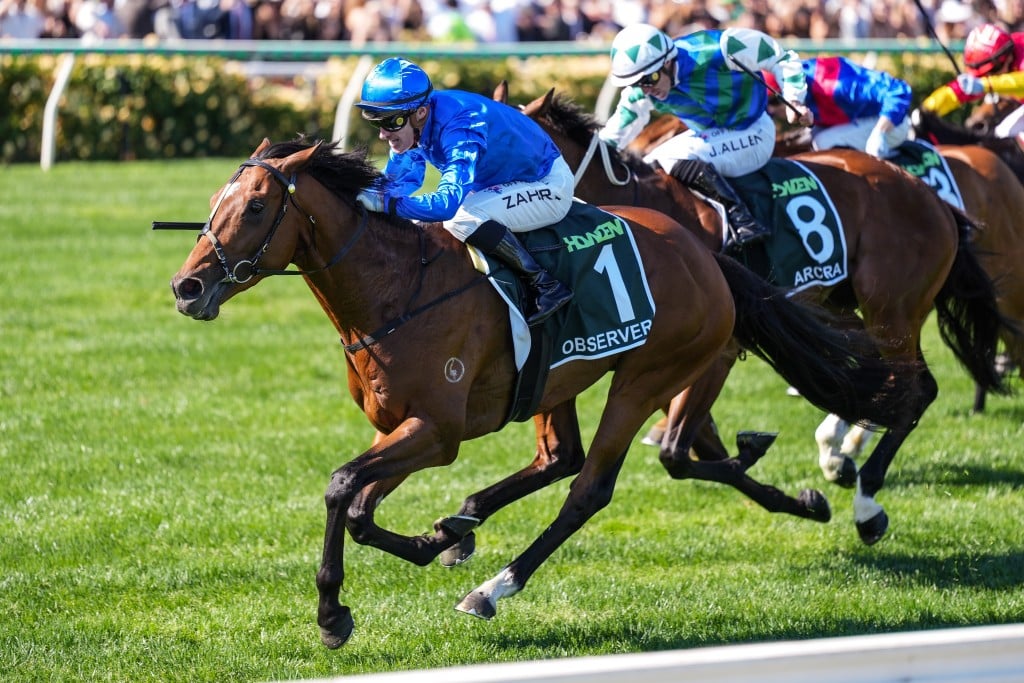
The Derby at Epsom has existed since 1780. The Victoria Derby has been part of Australian racing since 1855 and, from its second running, was established over the classic mile and a half, or half a furlong more.
For nearly 170 years its purpose has been understood: to identify the best precocious staying three-year-old of the season.
There is now a suggestion that the Victoria Derby should be shortened, effectively moving it towards the territory already occupied by the 2000-metre Spring Champion Stakes. Some might say this argument is the infamous “Dunning-Kruger Effect” at work.
I believe that would be a serious mistake.
Both the Victoria Derby and ATC Spring Champion have suffered a decline in racing’s estimation. Three arguments are usually advanced:
- their winners have supposedly performed poorly subsequently;
- official ratings have tended to undervalue their performances; and
- commercial studs have relatively little interest in their winners.
None is a persuasive reason to shorten the Derby.
1. A Derby winner does not need to prove itself twice
The Victoria Derby is a target race. It asks a particular question at a particular moment in a horse’s development: which of this generation’s three-year-olds can run 2500 metres best on Derby Day?
That is the examination. The winner has passed it.
It makes little sense subsequently to downgrade that performance because the horse fails to reproduce it over 1400, 1600 or 2000 metres. We don’t mark down the best mathematics student because he subsequently performs less well in English.
Nor is the subsequent record of Victoria Derby winners nearly as poor as sometimes suggested.
Last year’s Riff Rocket went on to win the CS Hayes Stakes, Rosehill Guineas and Australian Derby. Year before’s Goldrush Guru subsequently placed in the Australian Guineas. Before that Observer has already won an Australian Guineas. And before that Manzoice subsequently won the Tattersalls Cup.
Compare that with winners of the 2000-metre ATC Spring Champion Stakes—the very model towards which some apparently want to move the Derby. Recent winners include horses which either failed to win again, took a considerable time to do so, or did little subsequently: 2025 El Castello no wins; Tom Kitten took 18 months to win again; 2024 Sharp ‘N’ Smart didn’t win in Australia again; 2023 Profundo failed thereafter; 2022 Montefilla did win a Ranvet.
In other words, shortening a three-year-old staying championship to 2000 metres provides no guarantee whatsoever of producing more successful horses.
We already have a Spring Champion Stakes. Why would we want another one?
2. The ratings are measuring the wrong thing
I also question the relatively low official ratings routinely attached to Derby performances.
If the methodology effectively says that a Derby winner must subsequently demonstrate comparable superiority under quite different conditions before its Derby rating can be taken seriously, then the methodology—not the Derby—is the problem.
I repeat, imagine ranking students in mathematics and subsequently marking down the mathematics champion because he was less successful in English.
A Derby should be rated on the performance required to win the Derby.
The combination of age, distance and timing is precisely what makes the examination valuable. A three-year-old capable of running 2500 metres at Flemington in early November is demonstrating an unusual combination of precocity, stamina, soundness and class.
Remove the stamina test and you haven’t improved the examination. You have changed the subject.
3. Racing is creating the breeding problem it complains about
The argument that commercial studs aren’t interested in Derby winners gets cause and effect backwards.
Australian breeding has become increasingly concentrated on speed because that is where racing increasingly puts the money.
If Australia offered more valuable staying races, breeders and owners would have greater reason to produce and purchase staying horses.
The breeding industry responds to the racing programme. The racing programme should not surrender to the breeding industry’s existing commercial preferences.
If we continually shorten races because studs favour speed, we create a self-perpetuating cycle: fewer staying races produce fewer commercial stayers, which is then cited as justification for having still fewer staying races.
The bigger problem
There has been a persistent—and, in my view, pernicious—force in Australian racing towards shorter distances, compressing handicaps and more weight-for-age racing.
That may suit certain breeding interests. It does not necessarily suit racing, and it certainly does not necessarily suit punters.
Punters want interesting races: races in which horses are tested at their limits; races involving uncertainty over distance, weight, pace and stamina; races where there are genuine differences of opinion.
That is why handicaps and staying races remain such compelling betting contests. And produce more turnover.
Consider the same Saturday in October: despite the extraordinary prize money and publicity surrounding The Everest, betting interest in the Caulfield Cup demonstrates the enduring attraction of a large-field 2400-metre handicap. In 2024 I wrote down the turnover figures for the Caulfield Cup and The Everest:
Caulfield Cup v Everest
Caulfield Cup: Betfair $1.6m (Caulfield Cup), NSW Tote $2.4 million
The Everest: Betfair $0.993m, NWS Tote: $2.1m (much less outside NSW)
If race prize money were determined principally by wagering generated, rather than fashion or industry politics, I suspect the supposed case for relentlessly shortening races would look very different.
If racing Committees and Boards were answerable to shareholders, the Derby wouldn’t be shortened, they would be less concentration on WFA races and less compression of handicap weights.
What should we do?
Not shorten the Victoria Derby.
Strengthen it.
The Victoria Derby is presently only around the 38th-richest race in Australia. For one of the oldest, most historic and most recognisable races in Australian racing, that is extraordinary.
Increase its prize money.
Build more valuable staying races around it.
Give owners a reason to buy staying-bred horses and breeders a reason to produce them.
Create a programme through which the best Derby horses can progress into valuable four-year-old and open staying races.
And above all, preserve the characteristic that gives the Derby its meaning.
There will be more than 80,000 people at Flemington on Derby Day this year. That fact alone should cause administrators to think very carefully before concluding that the Victoria Derby is somehow broken. There won’t be 80,000 at the ATC Spring Champion Stakes!
Racing has spent 170 years building the Derby’s history, prestige and identity.
Don’t shorten the Derby to make it more like other races. Make the Derby valuable enough that other races aspire to its importance.
One other argument would make this considerably stronger: Australia already has an abundance of lucrative 1600–2000m races for three-year-olds, whereas genuine staying tests are scarce. Shortening the Derby therefore doesn’t fill a gap in the programme; it removes one of the few remaining distinctive tests.
Rob Waterhouse
The views and opinions expressed in this article are those of the author and do not necessarily reflect the opinion or positions of The Straight.
The Straight opts to publish such letters at its discretion, where they concern matters of public interest and seek to discuss these issues in a reasoned professional context.
Related Articles

Year-long ban imposed on Grant and Alana Williams after Starry Heights’ ADHD drug positive
Prominent Perth trainers Grant and Alana Williams face 12 months on the sidelines after stewards penalised them following a positive swab after the 2025 Kalgoorlie Cup.

🔒 🔒 Racing Queensland posts lower surplus but growth in wagering powers a profitable year
Growth in returns from wagering helped keep Racing Queensland in the black in 2025/26, with a $6.6 million profit excluding government grants.

Does Racing NSW’s rapid executive baton change help or hinder Graeme Hinton?
In the four days since Peter V’landys confirmed his departure, Racing NSW’s board has already chosen the man to replace him as chief executive. Graeme Hinton was the obvious choice, but Bren O’Brien questions whether the haste of his appointment might undermine how his leadership is perceived.
