
Rowe On Monday – A fruitful Femme for Murray, Monds’ time to reflect, Hutch hails new investment and a Libyan dream lives on
In this week’s Rowe On Monday, Peter Murray on owning a sudden blue hen, Linda Monds reflects on the state of the industry, Sebastian Hutch on where the new investment is coming from and Dr Ahmed’s Australian flavour to his Libyan thoroughbred renaissance.
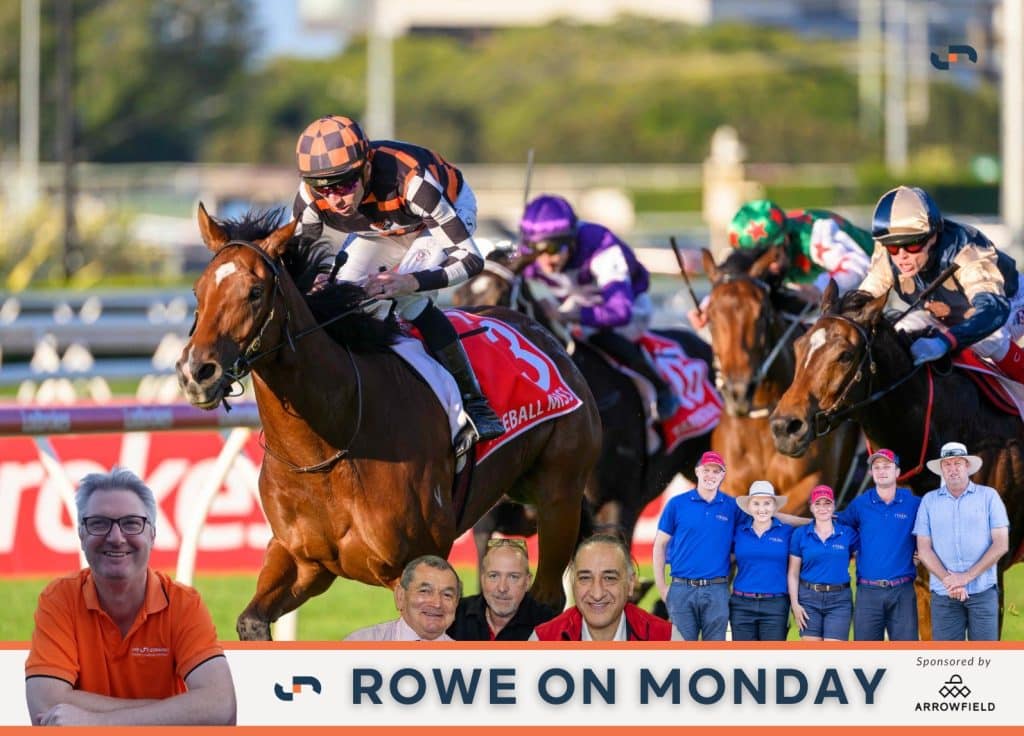
A year ago, Thoroughbred Breeders Victoria president Peter Murray and Three Bridges Thoroughbreds’ Toby Liston had already resolved that quality over quantity was one of the key planks to commercial success.
And for that reason the pair – along with their respective agents, Boomer Bloodstock’s Craig Rounsefell and Kiwi Paul Willetts – stumped up $900,000 for Pierro mare Femme Fireball.
Just weeks earlier she’d produced South Australian Derby winner Femminile, an OTI Racing-owned, Phillip Stokes-trained filly by Dundeel.
Femminile made $1.5 million at the Gold Coast on the first day of the Magic Millions National Broodmare Sale.
Little was Liston and Murray to know that Femme Fireball’s second foal, Bivouac filly FIreball Miss, would a year later win the Group 2 The Roses and the Queensland Oaks.
Femme Fireball, who was sold by IT entrepreneur Simon Delzoppo at the Gold Coast in foal to Anamoe, is now in rare company, having produced two foals to race for two Group 1 winners.
“We just wanted to get something with a lot of quality, and instead of having quantity, we wanted to go more to quality,” Murray told this column.
“It’s very hard to get these sorts of mares on your own, so together Toby and I did it, and so far it’s turned out to be a good (investment).”
The Anamoe filly, Femme Fireball’s fourth foal, will be offered at this week’s Inglis Great Southern Sale in Melbourne and the emergence of Fireball Miss hasn’t altered the pair’s plan to sell the weanling.
Murray has 15 mares based at Three Bridges as well as four mares at Stone Farm in Kentucky with Arthur Hancock.
A successful businessman, Murray and Liston have chosen to swim with the tide, rather than against it, thus focusing on higher-end mares.
“That’s just where the market’s headed, and in a lot of (The Straight’s) own reports that you’ve written about breeding and sales, I think you’ve always alluded to a polarisation of quality versus inequality,” Murray says.
“It’s getting harder down the bottom, it’s compressing more at the top, so that’s our thinking, really.
“We want to be at the major sales, and we want the sales companies wanting our stock instead of us pleading with them to take it.”
It’s no secret that breeding horses commercially is a tough game, and racing them can be just as hard (and equally as satisfying when you get a good one).
The contraction of the industry, in terms of the number of breeders and the declining foal crop, but in part on the cost of production and the ability of people to afford racehorses.
“It’s a tough industry, and the cost of living problem, I suppose, if you want to call it that, is really taking a lot of people out of the game, unfortunately,” Murray says.
“It is a business, and there are business problems, and you can’t be in it if you can’t afford it.
“I’m not trying to say that from any other angle, that it is very difficult. I’m not trying to say only the people with money should be in it, but it’s a very tough business.”
To illustrate his point, Murray used house prices as an example (and we won’t touch on the federal government’s proposed tax changes here, we promise).
“Twenty years ago, you could buy a house for four or five times the average wage, now it’s 11 times the average wage,” he says.
“If you were breeding 10 or 15 years ago, you could fit it into your budgets, and sure, it was expensive, but it wasn’t the multiple that the economy is now, if you’re making sense of what I’m trying to say.”
Monds says industry needs reset before more good times
As Peter Murray and Toby Liston consider how to manage Femme Fireball and the other mares on the Victorian farm as part of a commercial operation, NSW breeder Linda Monds confirmed last week that she and her husband Laurence were taking a step back from the day-to-day grind of thoroughbred breeding.
Tyreel will maintain a small broodmare band, which will be agisted elsewhere, and Monds remains positive about the longer-term outlook for the industry.
“We’ve had good sales this year and we’ve had some ordinary sales this year, but I think that’s the sales for the next period of time,” Monds says.
“I think whatever’s happening out in that big wide world outside of our industry will have an enormous effect on what’s happening inside our industry and for the future years.
“But it’s an amazing industry, it’s full of a lot of very good people, and I have faith that the industry will remain at a level and then we’ll start to see it go back up again.
“It can’t always be good. I think we need tough times, we need hard times, everyone does, because it just resets everything and it makes those good times well worth it in the end.”
Australasian industry still healthy on world stage
Despite the economic rollercoaster, the Australasian industry remains relatively appealing on the global stage.
The Straight wrote last week that New Zealand could be on the verge of finalising new investment, particularly surrounding The Oaks Stud.
The article caught the attention of Inglis chief executive Sebastian Hutch, an avid reader of all manner of things including this publication, who was quick to make the point that there had been a number of new investors in the Australian yearling market this year.
He noted that at the Inglis Easter sale, the US-based The Flying Dutchmen’s Payton Boersma and bloodstock manager Hunter Rankin were in attendance, buying an I Am Invincibile-Shoals filly for $750,000.
Agent Will Johnson in partnership with Sumbe’s Nurlan Bizakov bought an Ole Kirk filly, adding to the European owner-breeder’s investment Down Under.
Sumbre is also shuttling Group 1-winning miler Charyn to Cambridge Stud, with Bizakov keen to increase his bloodstock portfolio in Australasia.
“Lady Lloyd Webber attended Easter with Simon Marsh and Johnny McKeever, buying the second highest-priced lot of the sale. It’s not their first yearling, but by far their biggest investment,” Hutch says.
“Charlie Budgett, a bloodstock agent from the UK, also attended Easter, and on behalf of a significant UK investor, who wishes to remain anonymous, invested in three yearlings.”
Hutch also referenced the attendance of Chester Liang and his two sisters who were at Riverside in late March for the Easter sale.
The Liang name is well-known in Hong Kong racing circles, with their late father Howard often buying yearlings in Australia to either race here or in Asia with the assistance of agent Marie Yoshida.
Many of their horses carried the “California” moniker.
“While their father, Howard Liang, was a major investor, this is the first time that Chester and co had been to a sale and they purchased two yearlings,” Hutch said.
Libyan breeder adds to broodmare band at Magic Millions
At the recent Magic Millions National Sale, Libya-based owner and breeder Dr Ahmed Ashaab was a prolific buyer of mares, purchasing 13 lots to take back to his homeland.
They will likely be served by Golden Slipper winner Vancouver or more recent acquisition Power, two stallions Dr Ahmed has acquired from Australia to replenish his stallion roster at Al Shaab Stud at Tripoli.
Dr Ahmed’s name has featured previously in The Straight, with Jess Owers’ retelling of Al Shaab being attacked by Libyan militia, leading to 59 of its horses stolen, among them six stallions.
They included Australian-breds Brut Force, who was Libya’s leading sire, and Churchill Downs. They were never seen again.
After the setback, Dr Ahmed says Libyan racing and breeding was on an upward curve.
“Libya has established a new racing authority, so we now have a big race, the Libya Cup, which will also be open internationally,” Dr Ahmed says.
“The prize money for the Libyan World Cup is 5 million Libyan dinars or about US$1 million. So it’s improving very well now and quickly.”
Dr Ahmed’s La Sabbia Bloodstock’s Magic Millions-purchased mares ranged from $2000 to $26,000 in price.
Author
Related Articles
Rowe On Monday – Inglis finds right size for breeze-up sale, a Magic path emerges, Hutch to stay hands-on and Arrowfield’s treble to remember
In this week’s Rowe On Monday, Tim chats to Sebastian Hutch, Bruce Slade and Merrick Staunton about the dynamic of the Australian breeze-up market, hails the emergence of a key Gold Coast two-year-old race and reflects on an unforgettable Saturday for Arrowfield.
Rowe On Monday – Digging for diamonds, Pinatubo’s strong spring and session plans for Magic Millions
In this week’s Rowe On Monday, G1G’s Gary Diamond on buying, selling and trading future and current stars, some second-season spring joy for Pinatubo and some food for thought as Magic Millions prepares its January catalogue.
Rowe On Monday – Next stop Flemington for Cunningham, the dash to Dubai and Marine One anticipation for Brown
In this week’s Rowe On Monday, Tim is back in the hotseat and chats to Phil Cunningham about star colt The Next Episode, looks ahead to the Dubai season and profiles a Western Australian stallion poised to make an immediate mark.
