
Run The Numbers – Tron Bolt and the almost lost legacy of Fanfreluche
After a week where the fate of the famous Shergar yet again hit the headlines, the legacy of a more fortunate kidnappee, Fanfreluche, continued to build as Tron Bolt became the eighth Australian Group 1-winning maternal descendant of the champion Canadian mare.
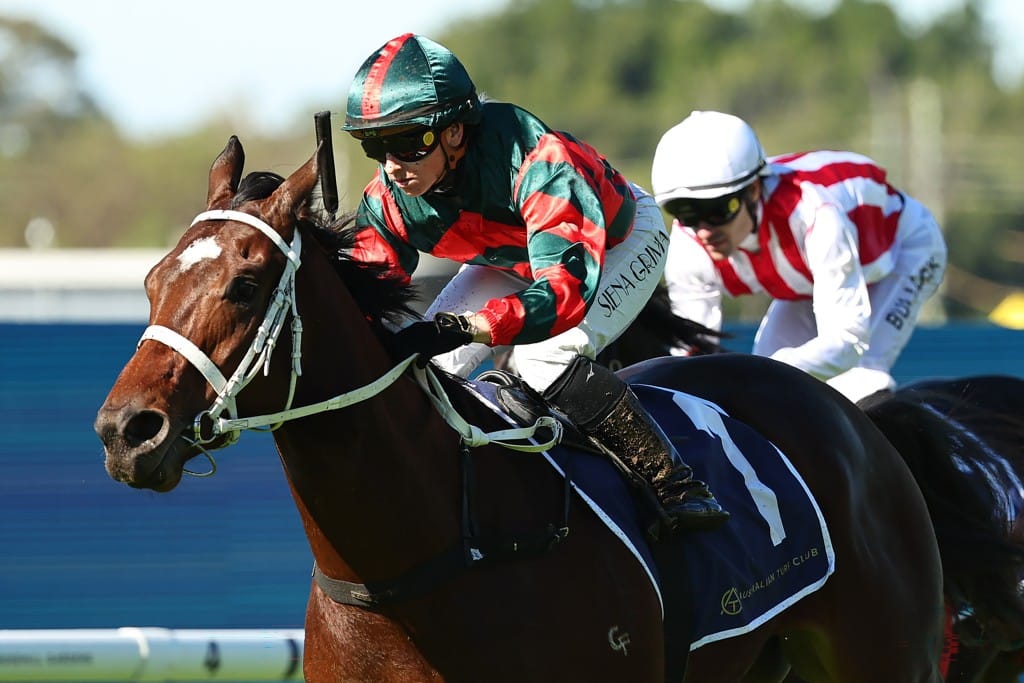
One of two second-crop champions of the legendary Northern Dancer, Fanfreluche’s extraordinary life as a racehorse and broodmare only becomes more remarkable with every Group-1 winning descendant that emerges.
On Saturday, Tron Bolt, the dominant winner of the JJ Atkins, became her eighth in this country and 20th overall, counting the Canadian blue hen as his fifth dam.
There are now 122 global stakes winners from 2235 maternal descendants of the mare, with 29 of those being in the past five years,
It is a list that includes champion stallions Flying Spur, Encosta De Lago, Lode and Holy Roman Emperor, champion first-season sire Russian Revolution and champion freshman sire-in-waiting Home Affairs.
They are just six of the 48 stallions with runners around the globe who are descendants of Fanfreluche. Tron Bolt, a son of Toronado, will no doubt be lining up to join them at stud at some point.
Fanfreluche actually features twice on Tron Bolt’s pedigree, given his dam, Baccarat Baby is a granddaughter of Flying Spur. It’s a repeat of a pattern that produced Home Affairs, whose dam is also by Fanfreluche great-grandson Flying Spur.
Maternal descendants of Fanfreluche
Source: arion.co.nz
But while those numbers all add up to one of the most telling genetic influences of any mare of the past century, it is the story of Fanfreluche which turns it from a statistical standout into a genuinely remarkable tale.
Being the second Group 1 winner of Northern Dancer, a Canadian Horse of the Year and champion three-year-old in both the United States and Canada, would have been enough to make her famous.
But it was in 1977, when the then 10-year-old mare carrying her sixth foal, a colt by Secretariat, hit the headlines again. She had mysteriously disappeared from a paddock at Claiborne Farm in Kentucky.
Up until that point, no horse had ever been kidnapped in Claiborne’s famed 75-year history. But, apparently lured through a gap in the fence, the valuable mare was spirited away in the night.
Just how valuable? That was shown by the interest of both the Kentucky State Police and the FBI in establishing her whereabouts. A $25,000 reward was posted, although that was only a fraction of her true worth.
Five months of intense investigation turned up a few suspects but no sign of Fanfreluche.
Then a farmer called Larry McPherson who lived 175 miles away revealed he had come across a mare he called Brandy, loose in a paddock and had brought her in for shelter soon after Fanfreluche’s disappearance.
He had taken care of her and had even ridden her around the property, unaware she was pregnant to the most valuable stallion in the world. When investigators came across Brandy, they checked her lip tattoo and confirmed her and Fanfreluche were indeed one and the same and brought her back to Claiborne.
She would foal down the Secretariat colt, to be named Sain Et Sauf, French for Safe and Sound by her French-Canadian owner Jean-Louis Levesque, while a local petty criminal was convicted over the theft and sentenced for four years jail.
The drama had clearly taken its toll on Levesque and the following year he put her up for auction, again in foal to Secretariat. Bertram Firestone secured her with a then world record price for a mare of $1.3 million.
Remarkably, Fanfreluche would produce another 12 foals after her kidnapping and live to the ripe old age of 32.
The last of her 18 foals was a filly by General Assembly called Red Luce. She never raced but is the source of the line of the family which produced not only Tron Bolt, but multiple Group 1 winner Duais, as well as her stakes-winning siblings Philia and Baccarat Baby.
Red Luce’s Flying Visit arrived in Australia in 2002 and was purchased by Emirates Park for $110,000 in 2003. The unraced mare produced six winners, including Meerlust, who was secured by Matthew Irwin for $22,000 at the 2009 Inglis Scone Yearling Sale.
Trained by Sue Grills at Tamworth for an ownership group that included Irwin and Peter Harris and his family, Meerlust would win one of her five starts before knee injuries ended her career.
Irwin and Harris bred on with her, despite no black-type in the three generations back to Fanfreluche and Meerlust has proven herself her own major influence, with three stakes winners herself and now a Group 1-winning grandson.
The first of those stakes winners, Casino Prince’s Baccarat Baby, won eight races including the Sunshine Coast Guineas for David Vandyke. Purchased firstly by Spendthrift Australia for $650,000, she then went to Gilgai Farm thanks to a $900,000 buy via Dermot Farrington in 2022.
It has proven a successful decision with the mare then mated to Toronado. The colt secured $250,000 at last year’s Inglis Easter Yearling Sale by Liam Ruddy and Hunter Lodge, then $900,000 at the Inglis Ready2Race Sale, thanks to Hermitage Thoroughbreds.
Tron Bolt not only created history as yet the latest chapter of the Fanfreluche story, his victory also saw James McDonald set a new mark for most Group 1 winners by a jockey in an Australian season, with 17.
Author

Related Articles
Run The Numbers – The elevated state of the global yearling market
With US$536 million spent across 12 sessions, the recently completed Keeneland September Sale was the highest-grossing yearling sale in history. Run The Numbers looks at whether it speaks only to the American market or reflects a broader global demand for elite bloodstock.
Run The Numbers – An influence runs Deep into the next generation
Legendary Japanese sire Deep Impact made a major mark on Australian racing from less than 50 runners. Does the emergence of Sheza Alibi point to that influence continuing to his sire sons as well? Run The Numbers takes a look.
Run The Numbers – What has become of the American shuttle stallion?
After a major decline in trans-Pacific shuttling of stallions, there are no stallions standing in Australia in 2026 that have shuttled directly from the United States. Fifteen years ago, 23 made the annual trip. Run The Numbers looks at how this trend has evolved.
