
State of optimism – Bawden targets SA racing revival as data points to growing contribution
Six months into his tenure as Racing SA CEO, Nick Bawden is seeing numbers which suggest a brighter future for racing in South Australia.
According to a recent report commissioned by the three codes, the South Australian thoroughbred racing industry has experienced year-on-year growth, underscoring its importance to the state’s economic health.
Prepared by IER, a company that specialises in measuring the impact of major events and evaluating the social and economic importance of sporting, cultural and entertainment sectors, the report found that racing made a value-added contribution of $727 million to the SA economy.
Thoroughbred racing accounted for more than $515 million of the overall impact in a report that outlines the economic and employment benefits of the three codes of racing to SA in 2023/24.
This was a 9 per cent increase on 2022/23. Greyhound racing rose 8 per cent from $125 million to $135 million while harness racing remained steady with a 2.7 per cent increase from $74 million to $76 million.
The 2022/23 report was the first SA economic impact study in racing released in seven years and Bawden says it is in the industry’s best interests to have a more consistent approach to data analysis.
He cited the SA government’s decision to increase a point of consumption tax (POCT) pass-through from 10 to 20 per cent as having add-on benefits for the state.
“We can now say to government that an investment in racing is actually good for the economy and here’s the numbers to back it up,” he told The Straight.
“(The) $8 million extra through POCT has seen $24 million additional direct economic impact and $45 million in value added to the economy.
“I think that shows investment in racing is a positive investment for the economy.”

IER has been compiling economic data and social impact studies for the Australian and New Zealand racing industries for three decades.
More recently, it has worked closely with the Asian Racing Federation and Bawden says the company is well-positioned to identify trends in racing.
“We understand that if we’re talking to government or whether we’re talking to participants about selling our vision, we need data to back it up,” he said.
“Whether it’s the economic impact or participation levels and all those key metrics, we can actually say ‘here’s the data to point to our growth’ and all of these result in our strategic plans and decision-making.
“It’s a unique industry and a unique landscape. So clearly to have people (like IER) who understand that is helpful.”
IER found that the economic output generated by the SA racing industry was directly responsible for sustaining 2825 full-time equivalent (FTE) jobs across the state.
“When flow-on employment impacts are considered, the total FTE impact generated by the South Australian racing industry rose to 5002 jobs,” the report said.
“This total represents the employment sustained within the industry, as well as the employment that is sustained in supply industries who meet the demand created by racing industry activity.”
In 2022/23, 2419 people were employed directly by the industry with an extra 2552 involved in sectors directly related to racing for an overall total of 4971.
The thoroughbred code is responsible for providing the most jobs, with 3462 workers during 2023/24.
Greyhound racing had a workforce of 949 while harness racing provided for 591 jobs.
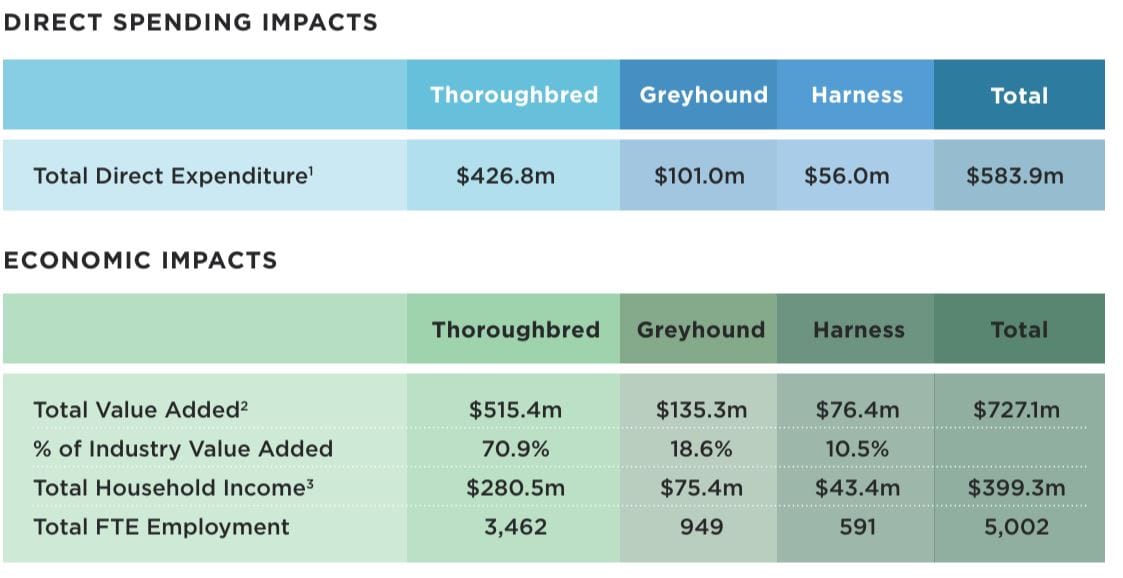
Racing employees had a combined total household income of nearly $400 million, up from $380 million in the previous year.
From Bawden’s perspective, there are two key takeaways from the report.
It confirmed for him that the industry is heading in the right direction on economic and participation metrics.
“We’re by no means a finished product and we’re trying to grow and get better all the time, but it’s good to see the numbers back that up,” he said.
“I think the challenge for us is really to take that big next step in terms of putting racing in South Australia back on the national landscape.
“That’s certainly something I’m passionate about and something I’m wanting to do. That doesn’t happen overnight.
“But if we talk about the size and scale of the industry, it’s on us as custodians of the industry in South Australia to make it grow and make it prosper. And I think the time’s right to really try and accelerate that.”
“I think the challenge for us is really to take that big next step in terms of putting racing in South Australia back on the national landscape.” – Nick Bawden
Separately, South Australia has been able to expand its average number of runners per race in recent seasons, with this increase helping to combat wagering turnover issues that are a pinch point for principal racing authorities nationwide.
“We’re seeing essentially flat turnover year on year, which is a result of our field sizes and I think that is giving punters confidence in our product,” Bawden said.
Bawden said SA’s carnival in April and May was not immune to wagering challenges but $1 million purses introduced in 2024 for the Australasian Oaks, Robert Sangster Stakes, South Australian Derby and The Goodwood had breathed new life into Group 1 racing in Adelaide.
“I think it puts them back in the conversation for that time of year,” he said.
“We understand that racing is also about grassroots, but what we need to also be mindful that our place on the national stage is critical, and those three days with the four $1 million Group 1s are key in doing that.
“A clear part of the strategy is there’s a window between the end of Sydney and the start of Brisbane, which gives us our own place.
“We can be the spotlight for a period of time to show that quality of racing that can be in South Australia … it’s where we can put ourselves forward as a place for quality racing, and there’s a lot of advantages in that.”
More than 272,000 racegoers attended thoroughbred, harness and greyhound race meetings throughout South Australia during 2023/24.
Fifty-five per cent of those crowds were at racecourses within the Adelaide metropolitan areas, with the Murraylands (11.1 per cent) and South East (11.1 per cent regions representing the largest volume of attendances outside Adelaide.
“Participants are the lifeblood of the racing industry. They provide the investment, time, skills and passion that underpins horse and greyhound racing in the state,” the report said.
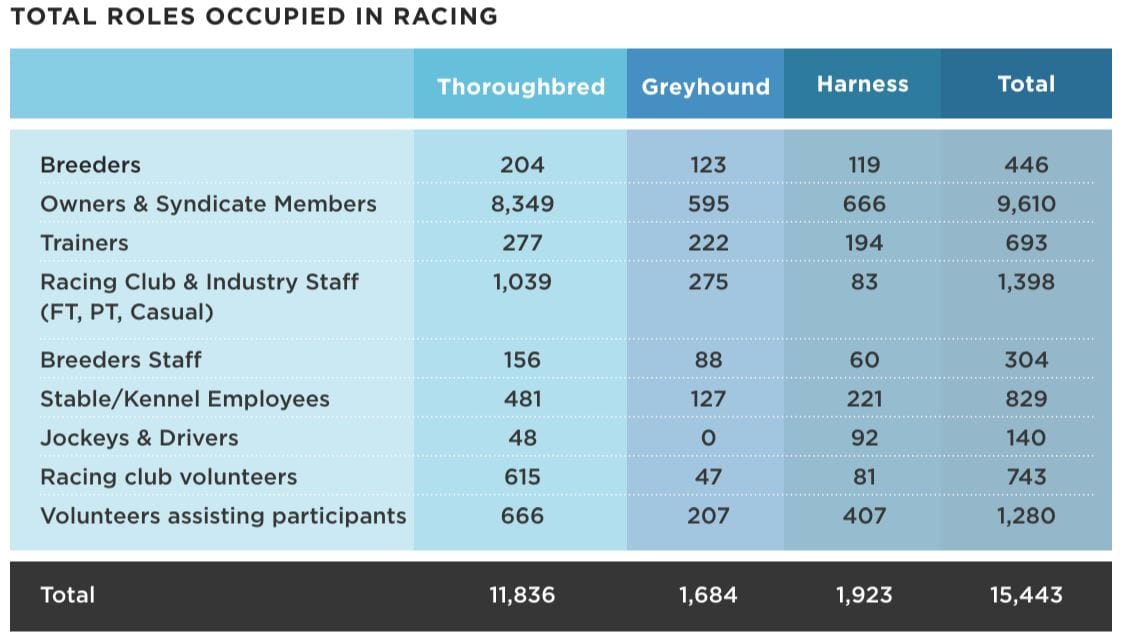
The report stated that many people directly involved in racing held more than one position within an industry that relies on more than 2000 volunteer roles, which require their time and resources.
“For many of these people, local racing clubs and participants are an important part of their community and provide valuable opportunities to stay active and engage with their community,” the report said.
Related Articles
🔒 🔒 Canberra wagering returns break four-year slide
Canberra Racing Club has lifted wagering returns by 4 per cent despite the ACT’s high wagering taxes, with securing a sustainable government funding agreement now a priority.
Betr lifts first-quarter turnover 19 per cent and holds FY27 earnings guidance
ASX-listed bookmaker betr believes it is taking market share from rivals after lifting its September-quarter turnover by 19.1 per cent and reaffirming its FY27 earnings guidance, with its net win margin rebounding in the first three weeks of October.
Australian buyers land select group at Tattersalls as Saudi money drives top end
Australian and New Zealand buyers secured eight horses at Newmarket on the second day of the Tattersalls Autumn Horses in Training Sale, led by the 220,000-guinea purchase of High Degree by Paul Moroney, Catheryne Bruggeman and Armando Duarte.
