
🔒 🔒 The Classic factor: Guineas quinella out to end three-year-old Cox Plate drought
Three-year-olds have always added an extra dimension to the Cox Plate. Warwoven and Blind Raise give the Caulfield Guineas quinella a Cox Plate start for the first time since 2021. But what does the current drought in three-year-old success, the longest in the race’s history, tell us about the changing shape of the race?
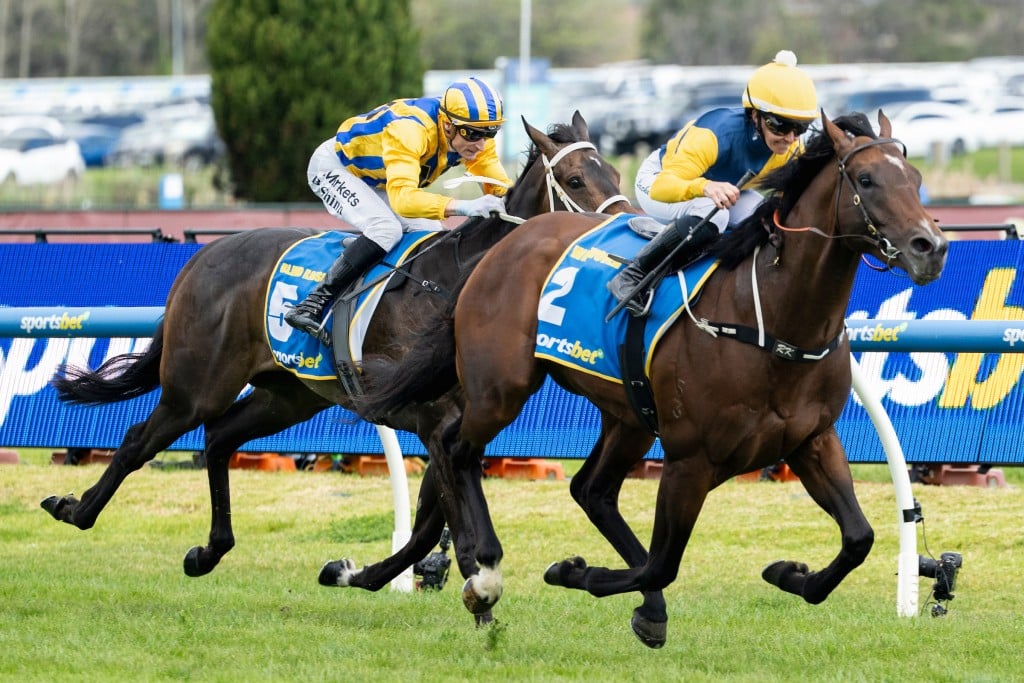
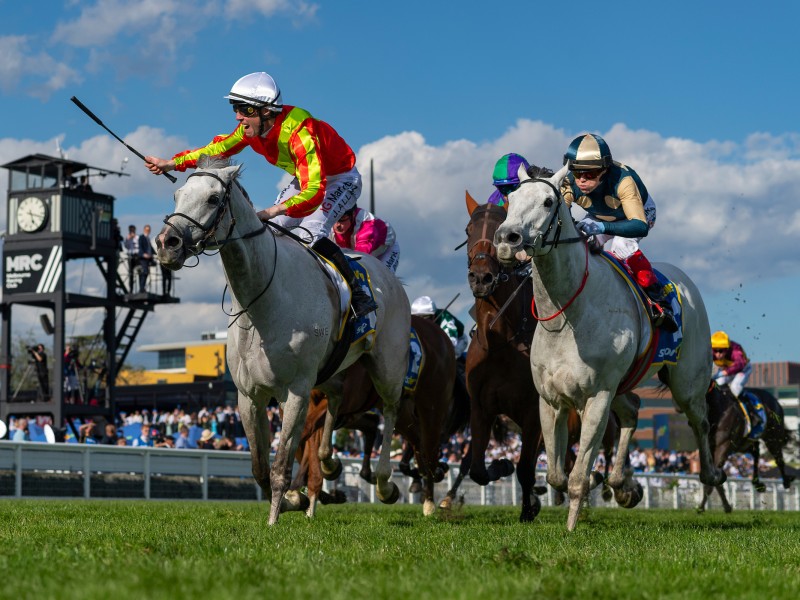
For the fourth time since 2000, the first two home in the Caulfield Guineas will run in the Cox Plate, with Warwoven and Blind Raise looking to become just the fourth three-year-old this century to win the Group 1 weight-for-age race.
Boom three-year-olds have often driven the narrative in the build-up to the Cox Plate, but the three that have won, Savabeel, So You Think and Shamus Award, did so without considerable market expectation.
The last two Guineas quinellas to compete in a Cox Plate each produced a Cox Plate runner-up but no winner. In 2012, All Too Hard and Pierro reproduced their Guineas order in the Cox Plate, finishing second and third behind Ocean Park.
In 2021, Anamoe beat Captivant by half a length in the Guineas, then ran second at Moonee Valley while Captivant finished eighth.
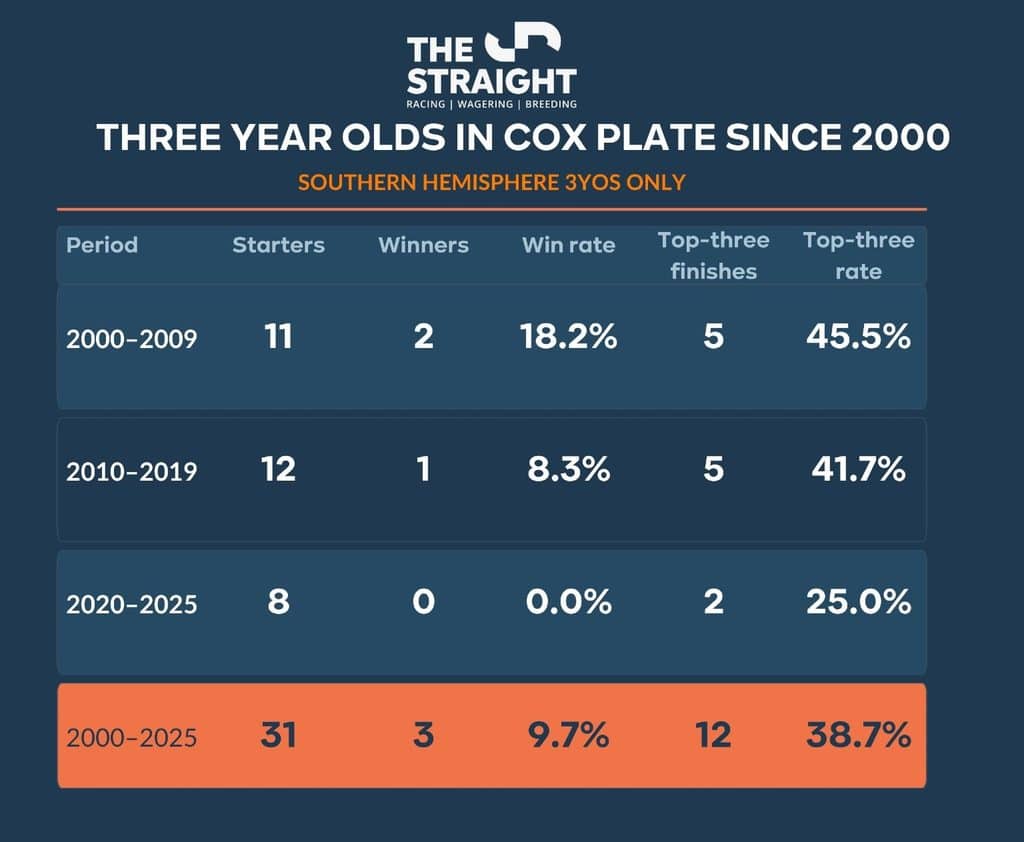
Across the 26 Cox Plates from 2000 to 2025, 31 Southern Hemisphere three-year-olds started. Three won, four finished second, and five finished third.
That is a winning strike rate of 9.7 per cent and a top-three rate of 38.7 per cent. Three-year-olds filled 12 of the 78 placings available in the period, or 15.4 per cent.
At least one three-year-old has run in 20 of the 26 renewals, while none ran in 2003, 2007, 2010, 2015, 2018 or 2022.
The decline in their strike rate can be charted by decade.
From 2000 to 2009, the age group won at 18.2 per cent per starter and placed at 45.5 per cent. From 2010 to 2019, those figures were 8.3 per cent and 41.7 per cent. Since 2020, eight three-year-olds have produced no winners and two placings.
Shamus Award remains the most recent three-year-old winner. Since that win, 14 have tried. Four finished in the top three: Yankee Rose in 2016, Castelvecchio in 2019, Anamoe in 2021 and Broadsiding in 2024. That is a top-three rate of 28.6 per cent.
Looking further back, we can see the evolution of three-year-old involvement in the race.
Historical analysis recorded an average of 4.6 three-year-old starters per Cox Plate in the 1970s and 4.3 in the 1980s. The average fell to 2.5 in the 1990s, then 1.1 in the 2000s and 1.2 in the 2010s. In the 2020s, that figure has been 1.33 to date, though it will increase with this year’s dual representation.
The 1990s provide a comparison with a larger cohort. Twenty-five three-year-olds started in the Cox Plate that decade for one winner, Octagonal, and two thirds, Canny Lad and Slight Chance. That is a 4 per cent win rate and a 12 per cent top-three rate.
Fewer three-year-olds have run since 2000, and their overall strike rates are higher than in the 1990s. Within that smaller modern cohort, however, both wins and top-three finishes have become less frequent.
The 21st-century winners have not been the obvious candidates on either market confidence or Guineas finishing position. All three winners since 2000 started at double figures. Savabeel paid $15, So You Think $13 and Shamus Award $21.
The well-backed three-year-olds have tended to run well without winning. Anamoe was second as the $3.50 favourite in 2021. Pierro was third at $5.50 in 2012, and All Too Hard was second at $9. Others missed the placings altogether. Helmet started at $2.75 in 2011 and ran eighth. Long John started at $7 in 2013 and ran ninth.
Significantly, no Caulfield Guineas winner has won the Cox Plate as a three-year-old since Red Anchor in 1984.
So You Think was fifth in the Guineas and Shamus Award third. Octagonal, the three-year-old winner before them in 1995, had also run third in the Guineas. Savabeel instead came through the Spring Champion Stakes over 2000 metres.
Anamoe came closest for a Guineas winner. He was beaten a half-head by State Of Rest, and his protest was dismissed.
State Of Rest and the 2014 winner Adelaide were Northern Hemisphere three-year-olds. In Australian terms, they raced as four-year-olds, carrying 56.5kg and 56kg.
For Southern Hemisphere three-year-olds, history shows the shared advantage is weight relief, not any particular lead-up result or starting price. October’s weight-for-age scale gives colts and geldings 49.5kg and fillies 47.5kg. By the Queen Elizabeth Stakes in April, three-year-olds carry 5kg more.
Winning three-year-olds have tended to use that relief from the front. So You Think and Shamus Award both led throughout with 49.5kg. Shamus Award became the race’s only maiden winner. Savabeel raced close to the speed carrying 48.5kg.
However, leading is no guarantee. There have been 13 three-year-olds who led the Cox Plate early between 1986 and 2025. Two won, two placed. Grandslam in 2020, Captivant in 2021 and King Colorado in 2023 led and finished last.
For this year’s pair, the test is whether they can turn that weight relief into success beyond a mile against older horses. Warwoven and Blind Raise will both race beyond 1600 metres for the first time on Saturday.
Blind Raise led the field in the Caulfield Guineas but his co-trainer, Trent Busuttin, expects a strong tempo from elsewhere. Jamie Melham replaces Blake Shinn, who cannot make 49.5kg, and rides him from barrier nine.
The New Zealand-bred Ace High gelding cost $70,000 privately after passing in at Karaka. He has won four of his six starts, including the Guineas Prelude. At $13, he shares the double-figure odds of the three winners since 2000 and, like So You Think and Shamus Award, comes to the race beaten in the Guineas.
Beyond the race itself, the stakes differ. Warwoven, a colt, has a stallion career ahead of him; for the gelded Blind Raise, there is no stud value to enhance.
Savabeel, So You Think and Shamus Award all went on to make a major mark at stud after their Cox Plate wins. Savabeel became a ten-time champion New Zealand sire, with 36 individual Group 1 winners among his progeny.
So You Think twice finished runner-up in the Australian sires’ premiership and has sired 12 Group 1 winners, while Shamus Award has sired multiple Group 1 winners.
For Warwoven, Saturday is a chance to add to a commercial record already built over shorter distances. Managing owner Mitch Cunningham told The Straight before the Guineas that the colt’s sprinting record had already secured his stud value.
“The mile may be his ceiling, but who knows beyond that? We’ll just take it race by race,” Cunningham said.
Bjorn Baker said a Cox Plate win would further enhance Warwoven’s standing, although his stud future was already assured.
“If he happened to win the Cox Plate, it would really make him one of the best, if not the best horse in the country,” he told NZ Racing News.
“Win, lose or draw come Saturday, he’s got a good home.
“I think the owners and myself, we haven’t collected on the lottery, but we’re sitting on the ticket.”
Author

Related Articles
Geelong victory propels import Point Of Law into Melbourne Cup reckoning
Formerly raced by King Charles III, Point Of Law has rocketed to Melbourne Cup favouritism after winning the Geelong Cup at his first Australian start for Ciaron Maher.
🔒 🔒 Bathurst meetings moved and track proper shut amid safety concerns
Bathurst’s course proper will remain closed until at least early 2027 after a series of falls raised safety concerns, prompting Racing NSW to investigate remedial work on the track’s notorious home turn.
No jockey at fault for Caulfield Cup fall
Racing Victoria stewards have closed their inquiry into the Caulfield Cup fall, finding no jockey at fault after contact between Green Spaces and Kings Valley caused Half Yours to fall near the 300m.
