
What will be the five biggest racing stories of 2026?
Bren O’Brien provides an insight into the major issues confronting the Australian industry from a racing perspective in 2026 while on the racetrack, one horse will be expected to generate more headlines.
The complex and challenging commercial model of the Australian racing industry makes for what could politely be described as a dynamic environment.
While there hasn’t quite been the procession of executive and board changes at the major racing bodies and clubs in 2025, there has been plenty of fodder for The Straight to feed off.
Some of this will flow into 2026, such as the Australian Turf Club’s fight to stay out of administration and the implementation of Queensland’s The Next Lap strategy, while other stories will no doubt erupt from nowhere, fuelled by the flammable nature of racing politics.
Picking out five stores we think will dominate racing headlines in 2026 is not an easy task, but there are enough pointers to give an idea of what to expect.
5. The Autumn Show
We will start off with something on the track. Autumn Glow, the four-year-old mare unbeaten in eight starts who won both the Epsom Handicap and the Golden Eagle, is arguably the most exciting homegrown Australian racing star since Winx.
She has been handled with kid gloves by Chris Waller, who has steered her through her career with ultra-care, picking off her targets and building an unbeaten streak.
It is that unbeaten aspect that creates a lot of the intrigue. Just how good is she? When will she be fully tested against the next opposition?
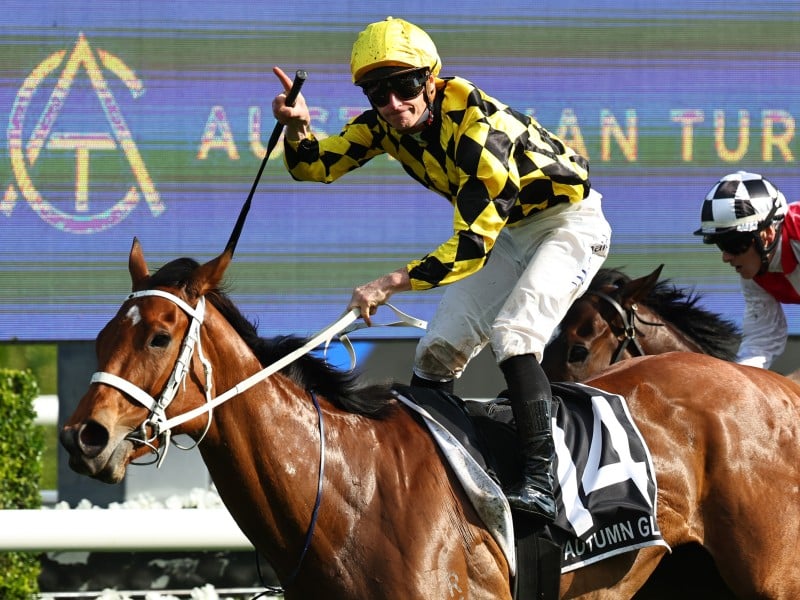
Winx put together 33 consecutive wins, a pressure that almost grew unbearable for Waller and his team, but Autumn Glow is different again, as she has never been beaten. Every step she takes towards Black Caviar’s magic mark of 25 will create its own headlines.
Arrowfield, in whose colours she races, has a significant double stake in the outcome of her career. Every victory adds to the record of her Arrowfield-based sire The Autumn Sun, a champion in his own right (who incidentally raced in the colours of Autumn Glow’s other owners, Hermitage), who John Messara and his team believe can become a champion stallion.
He leads the Australian sires’ championship, thanks to a sizable contribution from Autumn Glow.
4. Mega stables
Chris Waller vs Ciaron Maher is expected to be a headline narrative in Australian racing for some time. While others seek to imitate their scale and success, that pair are furlongs ahead of the rest of the country’s stables.
As things stand, Waller has banked $42 million in the racing season to date, while Maher has $27.8 million. The next best is Lindsay Park on $10.5 million.
Waller already had 141 winners for the season, with six Group 1 victories, with Maher second on 116.5 of which four have been at the elite level.
Both are at the top of their game, enabling them to build considerable scale. Waller has already had 1061 runners for the season, with Maher not far behind on 936.
Third is Annabel and Rob Archibald on 659, while the Hayes brothers have 634. No other Australian stable has over 500.
It inevitably raises the question. How big is too big? Is the domination of these two mega stables a threat to the viability of other training models?
With the pair becoming even more powerful, especially when it comes to share of prize money, it would appear 2026 will only be a continuation of the theme, and the continued raising of the same questions as to the desirability of such scale.
3. Queensland’s The Next Lap
When the Crisafulli Government came to power in late 2024, racing minister Tim Mander targeted the racing industry for substantial change. Earlier this year, he appointed former Australian Turf Club chair Matthew McGrath to spearhead a wide-ranging review that produced 110 recommendations.
Mander accepted 105 of the 110, either up front or in principle, and charged Racing Queensland with overseeing the biggest overhaul of the industry in a generation.
This is the same Racing Queensland, which currently doesn’t have a chairman because it is still two short on numbers on its board heading into 2026, and doesn’t have a permanent chief executive. Lachlan Murray has been acting in that role since February, with the likelihood that no appointment is made until the vacancies on the board are sorted out.
Experienced racing administrator Mary Collier has been brought in to focus on an action plan for Mander’s The Next Lap plan, among which is $200 million in infrastructure funding, including Albion Park being developed into a new Racing HQ, a new grandstand will be constructed at Eagle Farm and upgraded regional infrastructure for all three codes.
Observers have noted that the budget seems a little optimistic, given what was outlined in The Next Lap. No doubt, there is more to play out in terms of politics, given that we are talking about different clubs and different codes getting a slice of the pie.
Politics and racing are arguably more intertwined in Queensland than in any other state, with nearly every member of parliament having a racetrack in their electorate. It will be interesting to see not just what gets funded, but who has to sit where in the line for that funding.
2. The Hazzard Review
In making that observation about Queensland racing politics in the last section, it is probably worthwhile noting that politics and NSW racing has been the main headline driver for the industry in the past two years.
From the moment the Rosehill proposal was announced by Premier Chris Minns in December 2023, the NSW racing industry has been under intense spotlight.
Now, a man whose career is steeped in politics, former NSW Health Minister Brad Hazzard, has been charged with reviewing the Act under which the industry in Australia’s most populous state operates.
The Hazzard review has its genesis with the Rosehill proposal. That joint announcement with the Australian Turf Club created a wealth of political and media scrutiny, which in turn led to a Select Committee inquiry.
That inquiry shone a light in a few areas of concern, not just for the ATC and the state government, but also Racing NSW.
Out of that inquiry came a recommendation to review the Thoroughbred Racing Act, with Hazzard’s appointment following four months after that recommendation was made public in March.
Hazzard’s remit was limited in a couple of key areas, but this has not prevented a flood of submissions from industry participants with their concerns about how the NSW industry operates.
He is contracted to continue his work until April, but given the volume of submissions, it would not surprise to see that timeline extended. It will be fascinating to see what recommendations he puts forward.
1. Racing NSW vs Australian Turf Club
The 2025 year ended with Racing NSW and its biggest race club at loggerheads in the Supreme Court of NSW over the former’s intention to put the latter into administration.
It was the culmination of a dramatic year for the ATC, which saw the Rosehill proposal rejected, chairman Peter McGauran step down, chief executive Matt Galanos depart, and two other directors exit, citing major misgivings.
A Racing NSW show cause notice followed, and while there was an entente during the spring carnival, the regulator was adamant that its concerns as the ATC’s solvency were well justified, appointing administrator Morgan Kelly in December.
The ATC, which now has only four directors, fought back and successfully sought a stay of that administration order. The court case, which will be heard on February 19 and 20, will challenge the administration on several grounds, including Racing NSW’s authority to impose it in the first place under section 14 of the same Thoroughbred Racing Act Hazzard is currently reviewing.
But there are broader implications at play, including the ongoing viability of the race club model. The outcome of the case will speak to who actually conducts and owns racing in the state.
Again, this harks back to the Rosehill issue, which looked settled in the negative by members in May, but which raised a whole host of other issues that need to be addressed.
A Supreme Court hearing is an expensive way to settle some of those arguments.
Author

Related Articles
RWWA’s sustainability front and centre in major industry review
The future financial sustainability and governance of Racing And Wagering Western Australia are firmly in the sights of a key review by the Roger Cook-led state government, which has released its terms of reference for the inquiry.
A voice for all ages – how John Tapp became a podcast pioneer in Australian racing
The Australian thoroughbred industry has gradually found its voice in the digital age. But it is not an influencer or a Gen Z star who is leading the way. Instead, it’s one of the industry’s most recognisable and enduring personalities who is proving it’s never too late to learn something new.

Ex-greyhounds chair, prominent businessman fill vacancies on Racing Victoria board
Two vacancies on the Racing Victoria board have been filled by the state’s racing minister, with Jonathan Hardwick and Peita Duncan appointed to the Tim Eddy-led body.