
🔒 🔒 The world in one pool – from New Caledonia to Alderney
World Pool has created an international wagering network, but while racing clubs welcome the financial benefits, Australian punters remain divided over its unpredictable dividends.
New Caledonia and Alderney are unlikely bedfellows in any discussion about international horse racing.
One is a French territory in the South Pacific, more than 17,000km from Paris, where the tiny racing industry has relied on the French wagering giant Pari Mutuel Urbain (PMU) for funding.
The other is a speck in the English Channel, an island of barely eight square kilometres and about 2200 inhabitants, whose name is more likely to come up in a geography quiz than in a discussion of the world’s biggest racing markets.
Yet both appear on the international commingling map maintained by the Hong Kong Jockey Club (HKJC), which lists more than 60 commingling partners across 26 countries and jurisdictions, indicating the quirky geographical reach of its World Pool operation.
New Caledonia’s connection is through PMU, which established a local subsidiary in July 2014 after an agreement with the territory’s government and racing authorities.
The arrangement was designed to give residents access to the French operator’s extensive wagering product while directing 20 per cent of local betting revenue to the territory’s horse racing industry.
At its launch, the network was expected to comprise about 50 retail outlets, with the government anticipating an annual financial return of between 70 million and 80 million Pacific francs, or $1 million to $1.1 million at today’s exchange rates.
PMU Nouvelle-Calédonie subsequently expanded its offering to include Australian gallops, with its own website confirming that customers have been able to wager on those races since 2018.
Its international reach therefore extends beyond New Caledonians betting on French racing: it is part of a much larger distribution network connecting customers with overseas events.
The Hong Kong Jockey Club’s relationship with PMU dates to 2019, when the two organisations established outbound commingling arrangements on French races, allowing Hong Kong customers to participate in PMU’s pools.
In April 2026, the partnership was extended under the ‘World Pool by PMU’ branding, although the underlying arrangements remained unchanged, with the respective pools continuing to be operated by PMU under French regulations.
Alderney presents a different proposition.
Its appearance on the HKJC’s map shows that the international wagering business is not necessarily organised around population size, racing history, or the number of horses competing each weekend.
The island has developed a reputation as a licensing jurisdiction for international gambling businesses, with a regulatory framework that accommodates companies operating wagering platforms and associated services.
One historical connection is Totepool Alderney, the licensed entity associated with the British Tote’s international distribution operation.
In 2017, Australian wagering technology company TopBetta announced an agreement involving its Global Tote subsidiary and Totepool Alderney to distribute betting pools on Australasian racing through UK and European outlets.
The arrangement was expected to reach more than 10,000 betting outlets and international wagering websites.
It offers a fascinating example of how a tiny offshore jurisdiction can become part of the distribution infrastructure supporting international tote betting.
However, the precise operator and contractual arrangement responsible for Alderney’s current appearance on the HKJC commingling map have not been publicly established.
A distinction needs to be drawn because a jurisdiction listed on a commingling map does not necessarily represent an independent national betting pool or establish that every local wager is transferred directly into the World Pool.
The two examples nevertheless help explain the commercial architecture underpinning one of racing’s most ambitious international wagering initiatives.
For a quick history lesson, World Pool is essentially a collaboration of totalisator operators, allowing customers in different countries to contribute to common betting pools on selected international races.
The concept grew out of two earlier HKJC initiatives.
The club began importing major overseas races for its Hong Kong customers in 1989, initially operating separate domestic pools on those events.
In 2013, it reversed the arrangement, allowing international partners to bet into its own substantial Hong Kong pools.
The next logical step was to combine the two ideas, with the first World Pool meeting staged at Royal Ascot in June 2019.
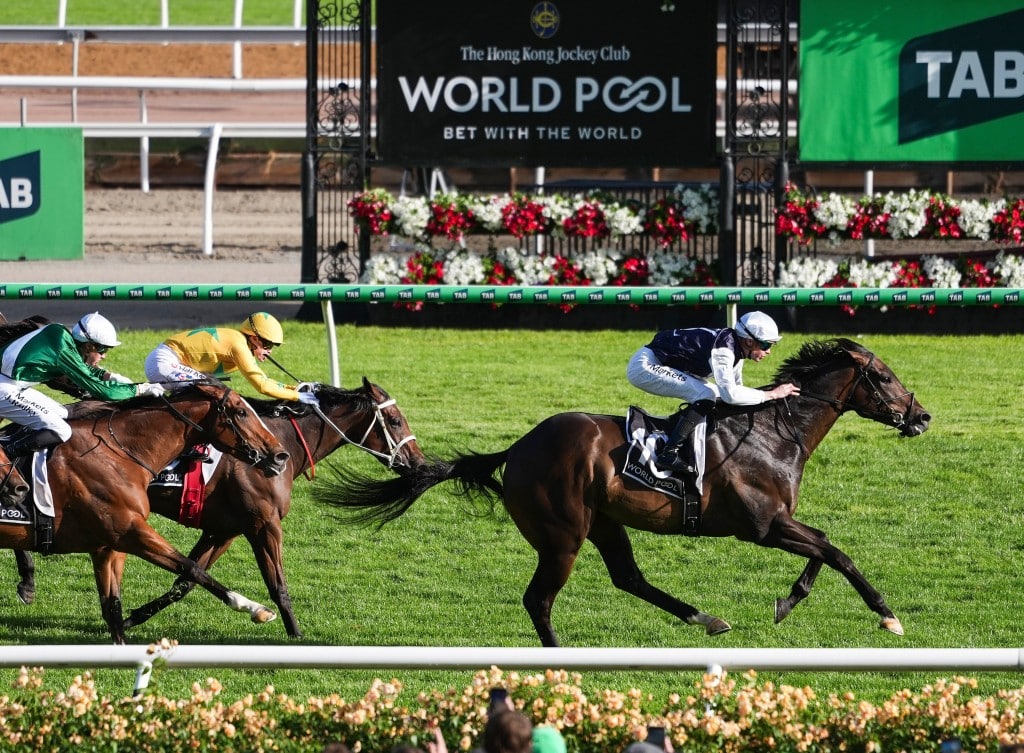
Australia joined in February 2023, when Flemington’s Black Caviar Lightning meeting became the first domestic fixture to feature World Pool.
The subsequent expansion has been considerable, if unpalatable from an Australian perspective.
During 2025, HK$9.3 billion was wagered in World Pool-operated pools across 57 overseas race days, a 20 per cent increase on the previous year.
The Everest, featuring Hong Kong superstar Ka Ying Rising, established a single-race record with HK$83 million in turnover, demonstrating the attraction of international competition to customers in different markets.
For host racecourses, the financial implications are significant.
British and Irish clubs have collectively received more than £75 million since the initiative began, with Royal Ascot alone generating substantial international wagering business.
Australian clubs also benefit financially through their World Pool arrangements, although individual payments are not routinely disclosed.
The Australian Turf Club has emerged as a major beneficiary, with Sydney hosting three of the highest-turnover World Pool race days since the operation began.
But the growing pools have not been universally welcomed by Australian punters.
The attraction of greater liquidity is obvious, but frustration comes when international money changes the complexion of a pool in the closing stages of betting.
There is also a higher deduction: World Pool win and place bets carry a 17.5 per cent takeout, compared with 14.5 per cent on Tabcorp’s One Pool.
As the return on this year’s Everest winner Tempted revealed, a dividend displayed before the jump is indicative, not guaranteed, and substantial late support from overseas customers can produce a final return markedly different from the price a local customer had anticipated.
HKJC executive director of racing Andrew Harding says increased revenue streams for racecourses and rights holders are a principal benefit.
The next challenge is to broaden the network while maintaining confidence among customers who ultimately provide its liquidity.
There is considerable scope to include additional international operators, racing jurisdictions and feature meetings, while technological improvements could eventually make it easier to combine a wider range of betting products.
For the HKJC, the ambition is to make the totalisator relevant again in an era dominated by corporate bookmakers and fixed-odds wagering.
As its chief executive Winfried Engelbrecht-Bresges previously put it: “In principle, the whole World Pool concept is to revitalise the tote.”
New Caledonia and Alderney might seem unlikely contributors to that ambition, but their presence illustrates the complexity of how international wagering has evolved.
The bigger question is whether World Pool can turn its geographical footprint into a genuinely sustainable alternative for racing and its customers.
Australian punters aren’t so sure.
Despite all the additional money flowing into the pools, suspicion remains among customers.
The prospect of a larger pool is attractive, but so too is knowing where a dividend stands before committing to a wager.
That tension is unlikely to disappear as the international operation grows, particularly while local customers remain unfamiliar with the betting patterns and timing of overseas markets.
World Pool will be available on the CF Orr Stakes at Sandown on Saturday and will close out its Australian offering for 2026 with the Winterbottom Stakes fixture in Perth on November 28.
If the 2027 schedule mirrors this year, World Pool coverage of Australian racing will go into recess until the Lightning Stakes at Flemington in February.
Depending on whether you are a racing administrator or a punter, that recess might be viewed rather differently.
For clubs, the appeal is difficult to ignore.
World Pool brings additional wagering revenue, international exposure and access to customers who might otherwise have little involvement in Australian racing.
For punters, the calculation is less straightforward. Greater liquidity is welcome, but not if the price of that opportunity is an increasingly unpredictable dividend and the feeling that the goalposts can move just as the race is about to start.
There promises to be an enduring curiosity about the future of World Pool. It can bring together the wagering interests of Hong Kong, Australia and the major European racing markets, all the while allowing money to flow through places as disparate as New Caledonia and Alderney.
They are racing outposts which have found themselves in an international wagering space challenging traditional racing markets.
Australian punters, however, may take some convincing that they should be kept in the same company.
Related Articles

🔒 🔒 Offshore adventures – Five Australian wagering brands that went abroad and how their overseas bets paid off
Centrebet, Tabcorp’s Sun Bets, PointsBet, BlueBet’s ClutchBet and Dabble each took an Australian betting business overseas by a different route. Their outcomes range from a takeover to costly closures, depending on the market they chose, the competition and the capital required.

🔒 🔒 Flutter sets aside $157.5 million for Sportsbet Fast Code class action
Sportsbet’s parent company Flutter remains confident in its position in the Fast Code class action but has provisioned A$157.5 million towards a potential resolution and confirmed Australian revenue fell 4 per cent in the September quarter.
The Melbourne Cup betting phenomenon – 70,000 bets a minute and $250 million in turnover
The Melbourne Cup remains Australian racing’s unrivalled betting event, generating turnover figures that dwarf every other race and reinforcing its status as the nation’s biggest day for punters.
