
Run The Numbers – Breeze-up market powers ahead, as sales competition heats up
The dynamic of the Australian and New Zealand breeze-up market is changing, with data from the trio of 2026 sales pointing to growth in investment, consistent medians and averages, and, in Australian dollar terms, a new market leader.
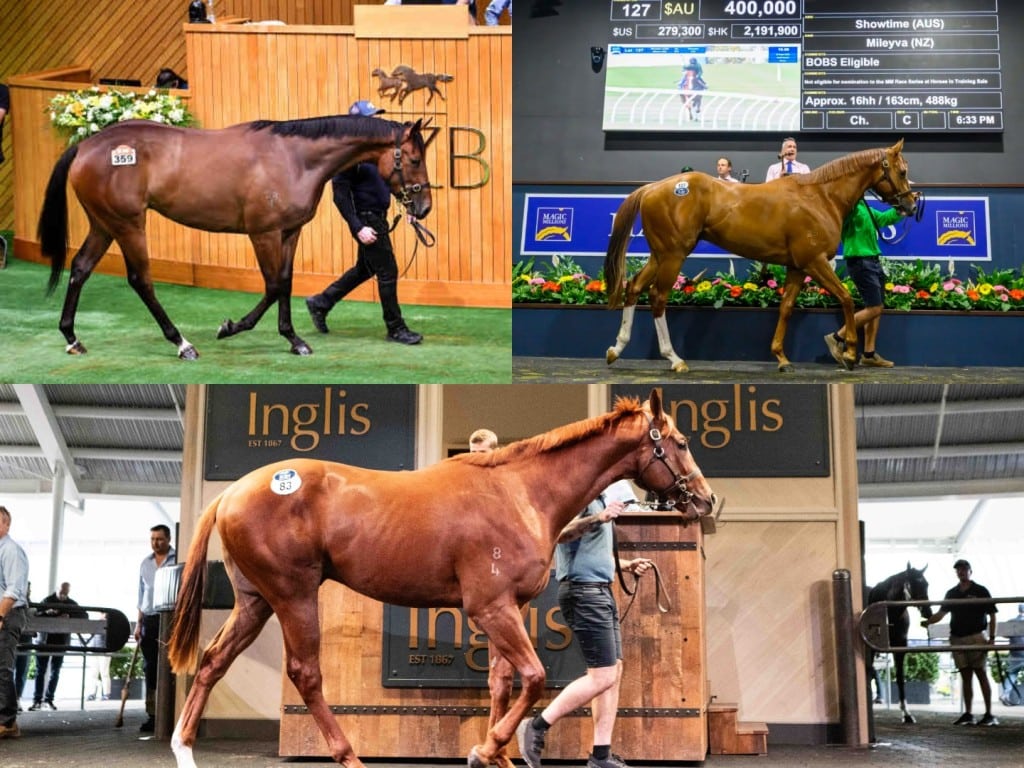
Investment in Australasia’s breeze-up market continues to grow, with the 2026 total across the sales at Magic Millions, Inglis and New Zealand Bloodstock (NZB) increasing by 8.2 per cent (in $A terms) to $68.87 million.
That growth came from selling more horses, not from a higher average price. The three sales sold 43 more two-year-olds than a year earlier, even as the combined average edged lower and clearance fell to 73.6 per cent from 76.3 per cent.
To put that growth in context, the Australian and New Zealand market has grown by 64.8 per cent in Australian dollar terms from A$41.8 million in 2019, the last two-year-old sales season before the pandemic.
A quick look back at last week’s NZB Ready to Run Sale at Karaka shows the NZ$37.6 million turnover generated was 9.2 per cent lower than last year.
It was the first time the sale’s aggregate had fallen year on year since 2020, but it was still the third-highest aggregate in the sale’s history. The average price stood at NZ$144,606, about NZ$11,650 less than last year, and the lowest since 2022.
Despite cataloguing 20 fewer horses, NZB increased the number offered for sale by 13, resulting in a larger proportion of the catalogue reaching the ring. The number of offered lots that failed to sell rose to 106 from 88. Its tally of 260 lots sold is second only to the 2025 tally in the post-pandemic period, while the 71 per cent clearance rate is the lowest.
The number of horses sold fell 1.9 per cent, but the average fell 7.5 per cent. The losses came in the middle of the market. Lots from NZ$100,000 to under NZ$400,000 generated NZ$4.6 million less turnover than a year earlier, more than the sale-wide fall, while spending rose at both the top and the bottom. The median was unchanged at NZ$100,000.
Local conditions may have played a part in the drop in turnover at Karaka, but the fall also came after Inglis took a considerably larger share of the market with its October sale.
It has been traditional in our market analysis to assume parity between the New Zealand and Australian dollar, but the disparity is now such that we have opted to convert the figures for historical comparisons. For the 2026 figures, we used the rate of 82.359 Australian cents to the New Zealand dollar on November 19, the final day of the Karaka sale. The NZ dollar recently dipped below 80 Australian cents.
We feel this is an important distinction because the NZ dollar discount is becoming a significant factor in Australian investment in that sale, as New Zealand Bloodstock (NZB) managing director Andrew Seabrook noted last week.
Across the three sales, there were 543 horses sold in 2026, 43 more than a year earlier, and all of the growth came at Inglis.
Inglis Ready2Race sold 65 more two-year-olds than in 2025. NZB’s Ready to Run Sale at Karaka sold five fewer, and the two-year-old session of the Magic Millions Gold Coast Horses in Training Sale sold 17 fewer.
Measured as each sale’s share of lots sold across the three sales, Inglis’ trans-Tasman market share rose to 36.3 per cent from 26.4 per cent while NZB’s fell to 47.9 per cent from 53 per cent and Magic Millions’ to 15.8 per cent from 20.6 per cent.
On a common currency basis, Inglis led the market by turnover for the first time. Its gross of A$31.6million exceeded NZB’s NZ$37.6 million, equivalent to approximately A$30.96 million.
Across the two Australian sales alone, Inglis took 83.4 per cent of combined turnover, up from 72.1 per cent, as the Australian gross rose 36.4 per cent to A$37.91 million from A$27.78 million.
In 2023, Inglis’s Ready2Race sale grossed just $10.9 million, but its turnover has grown by 190 per cent in three years, with the number of horses sold increasing from 103 to 197.
That sale’s average of $160,541 was the second highest in its history, below the $164,289 recorded in 2024. Inglis sold twice as many horses as in 2024 and took in twice as much.
Magic Millions moved its sale to Monday, October 12, three days before Inglis, so overseas buyers could attend both auctions on one trip. For the first time, eligible two-year-olds could be paid up for the Magic Millions Race Series.
The Gold Coast catalogued 26 fewer two-year-olds and offered 23 fewer. Clearance held at about 74 per cent, the median rose 18.8 per cent and the average fell 3.1 per cent.
Magic Millions’ two-year-old session sold 102 horses for A$7.75 million in 2024 and 103 in 2025 before dropping to 86 this year. Clearance was about 74 per cent in both 2026 and 2025, up from 70 per cent in 2024. The 2026 median of $47,500 was up from $40,000 in both previous years.
The combined figures across all three sales companies make for interesting reading. As mentioned, more horses were sold, and the overall combined aggregate, in Australian dollar terms, was as high as it has ever been.
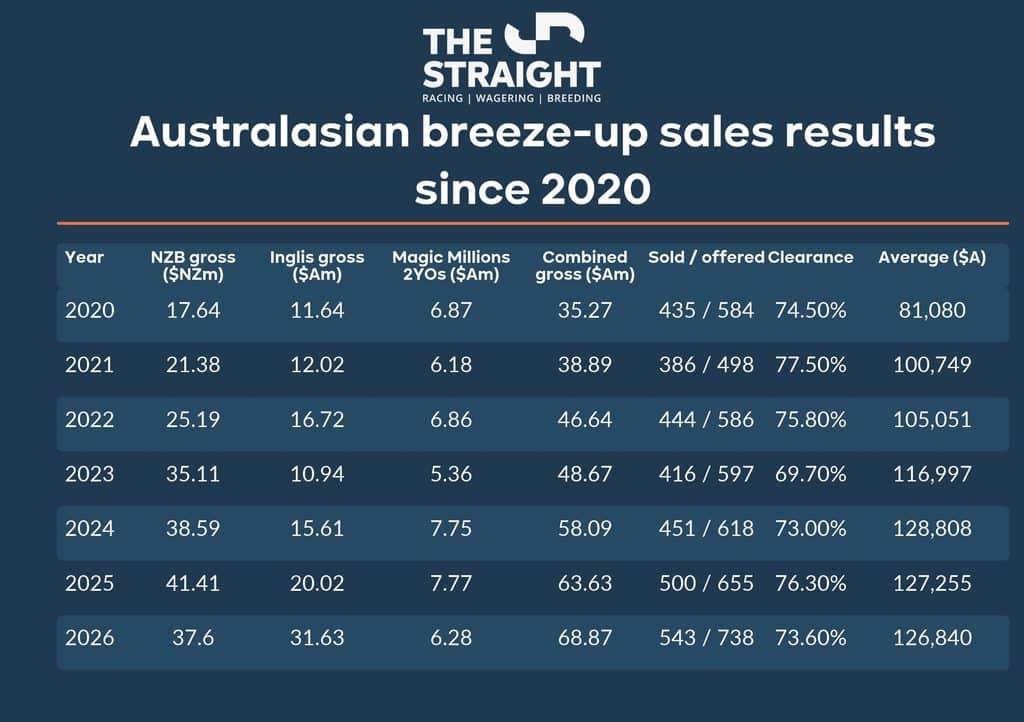
Clearance across all three sales fell to 73.6 per cent from 76.3 per cent last year, although more horses were offered and more were sold. The 2026 rate is also in line with the sector’s average clearance rate over the past six seasons.
The combined average, in Australian dollars, across the three sales has been remarkably steady over the past three years. In 2024, it was $128,808, while it was $127,255 last year.
The average dipped slightly to $126,834 in 2026, but given the much larger offering, that indicates a very consistent market valuation across the period.
Karaka still sold more horses, but Inglis’ lead on Australian-dollar turnover gives New Zealand vendors another result to weigh when deciding where to send their best two-year-olds.
That makes the contest for better drafts a more telling measure of the rivalry than catalogue size alone. Inglis has already made inroads with New Zealand vendors; the test in 2027 is whether it can persuade more of them to send their best lots across the Tasman.
Sales summaries (2025 figures in brackets):
Inglis Ready2Race (A$)
- Catalogued 321 (224), offered 256 (163), sold 197 (132)
- Clearance 77 per cent (81 per cent)
- Average $160,541 ($151,644)
- Median $100,000 ($100,000)
- Turnover $31.63 million ($20.02 million)
NZB Ready to Run (NZ$)
- Catalogued 460 (480), offered 366 (353), sold 260 (265)
- Clearance 71 per cent (75 per cent)
- Average $144,606 ($156,255)
- Median $100,000 ($100,000)
- Turnover $37.6 million ($41.41 million)
Magic Millions 2YOs (A$)
- Catalogued 161 (187), offered 116 (139), sold 86 (103)
- Clearance 74.1 per cent (74.1 per cent)
- Average $73,017 ($75,388)
- Median $47,500 ($40,000)
- Turnover $6.28 million ($7.77 million)
Author

Related Articles

Run The Numbers – Scale rewarded as Waller and Maher snare over 20 per cent of Australian prize money
Chris Waller and Ciaron Maher have won 17 of the first 29 Group 1s of 2026/27 and their runners have claimed 21.6 per cent of Australian prize money to date. Run The Numbers gives historical context to their current dominance.
Run The Numbers – The statistical case for the preservation of the Victoria Derby
The Group 1 status of the Victoria Derby could be the biggest casualty yet of a ratings-driven era, but Run The Numbers data questions whether the race’s true impact is being measured, or whether certain data is being used to reinforce pre-existing perceptions of the traditional Classic.

Run The Numbers – King’s latest successes put female jockeys on brink of 50 Australian Group 1 wins
As Rachel King builds her own formidable Group 1 record, she is also helping female jockeys power towards a significant milestone: 50 Group 1 wins in Australia. Run The Numbers dives into the major contributors from Diane Moseley to Siena Grima.
