
Rowe On Monday – Godolphin builds second-season plans, a Ready-made Group 1 result and a new take on an old bull
In this week’s Rowe On Monday, Godolphin’s Andy Makiv outlines expectations ahead of the second season of its public training model. Sebastian Hutch on why Tron Bolt’s victory could be a game-changer for the Inglis Ready2Race Sale, and how a stallion auction format reprises an old formula.
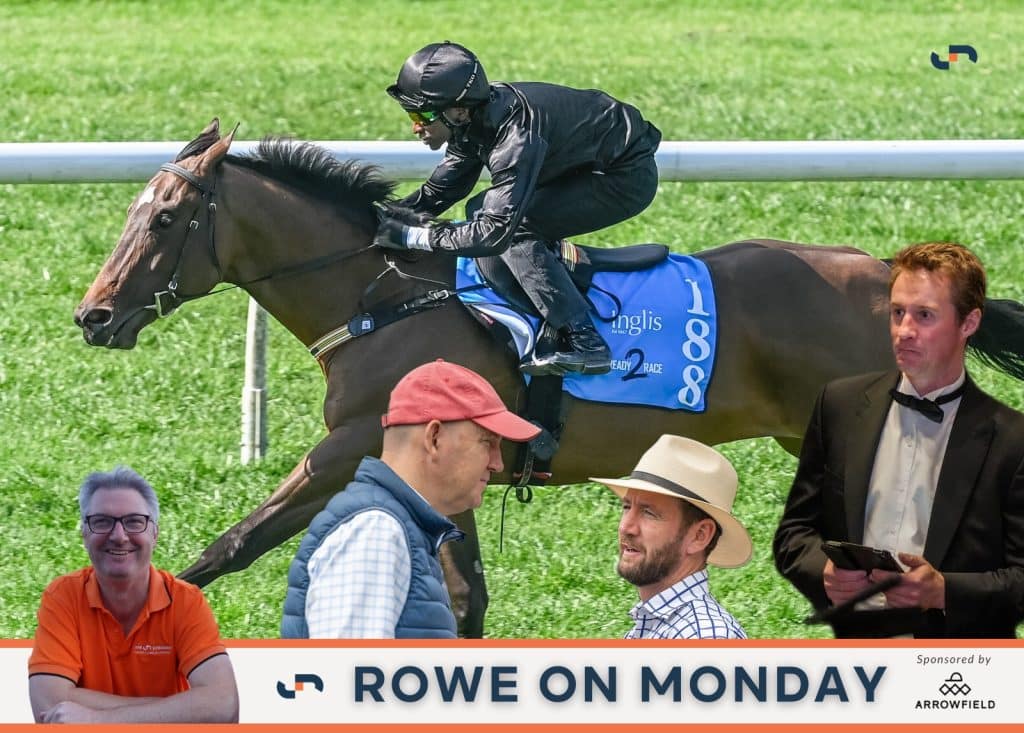
Godolphin sets platform for new season
This time last year, Godolphin Australia and its then private trainer James Cummings were in the final throes of a successful partnership that delivered 48 Group 1s.
With Godolphin dispersing its large racing team across nine stables, Tempted would join Ciaron Maher, as did Observer, Beiwacht went to Chris Waller, Pericles joined Bjorn Baker while Tom Kitten moved to Anthony and Sam Freedman.
The Freedmans already trained valuable colt Tentyris and the six horses all won Group 1s in season 2025/26.
“We’ve certainly enjoyed some good success. I think we’ve had over 30 stakes wins, including 11 Group 1 wins, so it’s been a big year,” Godolphin Australia managing director Andy Makiv told this column.
“We’ve put a gun colt like Tentyris onto the breeding roster as well as Observer. So, two amazing colts, who have won four Group 1s between them.
“We couldn’t have asked for any more success and I think whoever’s training them, the quality goes back to the bloodstock, it goes back to the way they’re raised, goes back to our people on the farms.
“That’s the strength in our stallion roster … how good the mares are, how good our properties are and how good our people are that are raising them. It’s certainly been a pleasing year.”
Makiv also confirmed that Godolphin had 95 rising two-year-olds under its ownership.
“I think 75 of them have hit their trainers at some stage. They get broken in at home at Kelvinside and about 75 of the 95 have been through for a look in their yards,” he said,
“At least three-quarters of them had a bit of a look around (their trainers’ stables), so it’s exciting.
“Hopefully, there’s a good horse amongst them. I’m sure there is.”
Ready to Race Sale ‘explosion’ for Inglis
Prior to Saturday, Inglis boss Sebastian Hutch was confident about forecasts for the company’s Ready to Race Sale in October.
As Hutch’s (not private) plane was taxiing to the runway on its way to London, he was able to watch $900,000 breeze-up sale graduate Tron Bolt win the Group 1 JJ Atkins at Eagle Farm.
The horse wore Hermitage’s dark green and red chevron silks, the same colours adorned by five-time Group 1-winning colt The Autumn Sun, a leading stallion at Arrowfield these days.
Hutch says there’s been an “explosion of success for graduates” of the Inglis’ two-year-old sale from last year.
“The nature of the horses, the profile of the people that are presenting them, there’s too many good horse people who are involved in the sale for it not to eventuate that a series of good horses would emerge,” Hutch said.
“But I’m probably pleasantly surprised that a Group 1-winning two-year-old colt has come out of last year’s two-year-old sale.
“He looks unbelievably exciting, but underneath him, there’s a range of really, really, really nice horses.
“There’s been very few runners out of the sale so far and the majority of horses that have come out of the sale from 2025, they are showing promise.
“I expect that this is probably a preface to real momentum continuing behind the sale.”
To illustrate Hutch’s point, just hours before Tron Bolt’s victory, the $300,000 two-year-old Mbube won impressively at Sandown, with trainer Lloyd Kennewell immediately signalling the Rubick colt would be set for the Coolmore Stud Stakes in the spring.
Lindsay Park’s Hard Kick had won the Listed Talindert on debut in February, signalling the All Too Hard gelding has a bright future
“The profile of the sale really appeals to international investors and inevitably some of the better potentialled horses end up overseas, whether it’s in Hong Kong, China, Malaysia, or whatever international jurisdiction,” Hutch said.
“But there are going to be more and more horses that win very good races that are graduates of this sale.
“And I can say that definitively that the profile of the horse going to the sale in 2026, certainly in terms of those that are being traded from weanling or yearling sales looks the best that we’ve had.
“I keep using the word momentum, but it really does feel like it’s got incredible momentum behind it as a sale format.”
Hutch confirmed that the likes of Newgate Farm, which has sold horses at two-year-old sales for a number of years through other people’s drafts, will have its own line-up at Inglis this year.
“Henry (Field, Newgate) has been an advocate for the sale for a number of years, but to the extent that he believes that there’s further benefit to be gained by having a draft of the sale,” he said.
“I know a number of entities who are associated as major consignors to the yearling sale series are looking to have consignments of the two-year-old sale.
“Obviously, it’ll be subject to things working out in terms of those people who are breezing the horses, but having a farm like Newgate supplementing what already is a very strong vendor base (is a positive for the sale).”
Last year’s Ready to Race Sale was conducted at Inglis’ Riverside Stables complex at Warwick Farm on the Thursday before The Everest race meeting at Randwick.
Hermitage’s Eugene Chuang purchased Tron Bolt with the assistance of trainer Chris Waller and agent Guy Mulcaster while ringside at Inglis. Chuang was in Sydney to watch his mare Lady Shenandoah run in The Everest.
Chuang bought six two-year-olds at last year’s sale headed by Tron Bolt.
“We’ll be opening the sale for entries in the coming weeks and the intention is for the same or similar format to last year,” Hutch said.
“Inglis as a sales company has invested a lot of time and money and effort into developing this format and we’re starting to reap dividends now.
“Anybody who wasn’t taking it seriously before Saturday will really have their attention drawn to it by results.”
The Bull Ring’s Danehill genesis
The Inglis Bull Ring, effectively an auction process for the private market, will officially launch this week with the sale of The Goodwood-winning stallion prospect Reserve Bank.
For all intents and purposes, the Reserve Bank auction won’t be held in a public manner, with details of who is bidding and for how much, remaining private by Inglis.
That is, of course, unless participants in the auction want to reveal details.
To be involved, interested parties must register and if they are idle for an extended period of time, they will be removed from the process so they cannot continue to monitor the bids.
It’s a unique concept, brought about by Inglis Digital’s Nick Melmeth, which has its origins dating back more than three decades.
In many ways, the Bull Ring is based on the high-profile private sale of champion dual-hemisphere stallion Danehill.
With Danehill’s breedshaping prowess there for all to see in the northern and southern hemispheres, the stallion’s co-owners, Coolmore and Arrowfield, could no longer agree on how to manage the sire’s stud career.
It led to a silent auction, which lasted more than four-and-a-half hours, with Coolmore’s John Magnier eventually winning the duel with a bid of US$18.228 million to secure Danehill.
The sale of Arrowfield’s 23 shares and six breeding rights in Danehill allowed principal John Messara to buy the property that is now home to Arrowfield, according to an Australian Financial Review article at the time.
“We went as far as we were able to within the ability of the syndicate to pay for the horse and as high as we could justify to our shareholders,” Messara told the AFR in January 1995.
Coolmore Australia’s then manager Michael Kirwan told the same publication that he “was absolutely delighted to secure Danehill and to further Coolmore’s commitment to the Australian thoroughbred industry”.
And Coolmore (and Arrowfield) certainly has in the 31-plus years since the Danehill sale.
Author
Related Articles
Rowe On Monday – Inglis finds right size for breeze-up sale, a Magic path emerges, Hutch to stay hands-on and Arrowfield’s treble to remember
In this week’s Rowe On Monday, Tim chats to Sebastian Hutch, Bruce Slade and Merrick Staunton about the dynamic of the Australian breeze-up market, hails the emergence of a key Gold Coast two-year-old race and reflects on an unforgettable Saturday for Arrowfield.
Rowe On Monday – Digging for diamonds, Pinatubo’s strong spring and session plans for Magic Millions
In this week’s Rowe On Monday, G1G’s Gary Diamond on buying, selling and trading future and current stars, some second-season spring joy for Pinatubo and some food for thought as Magic Millions prepares its January catalogue.
Rowe On Monday – Next stop Flemington for Cunningham, the dash to Dubai and Marine One anticipation for Brown
In this week’s Rowe On Monday, Tim is back in the hotseat and chats to Phil Cunningham about star colt The Next Episode, looks ahead to the Dubai season and profiles a Western Australian stallion poised to make an immediate mark.
