
The Tron Bolt effect – Two-year-old traders up stakes at Inglis Ready to Race Sale
The Inglis Ready to Race Sale has attracted a record 321-Lot catalogue and a 33 per cent rise in the average yearling cost, with vendors betting on the emergence of another Tron Bolt to justify their increased investment.
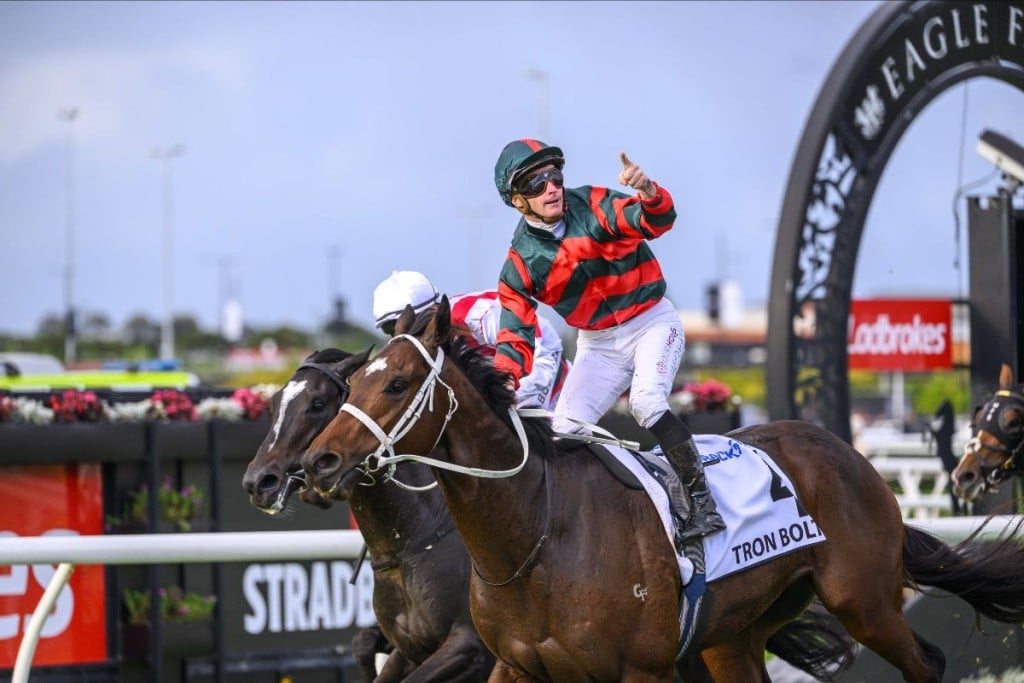
Graduate success will ultimately determine if this year’s Inglis Ready to Race Sale is the best catalogue of two-year-olds the auction house has put together.
On the back of Group 1 JJ Atkins winner Tron Bolt, Talindert and Vain Stakes-winning sprinter Hard Kick, Woodlands Stakes winner Queen’s Regent and last Saturday’s first-up Sandown winner Buggsy have all emerged from last year’s sale.
Inglis Bloodstock chief executive Sebastian Hutch, in announcing a 321-Lot catalogue for the auction house’s 2026 breeze-up sale, declared that he was “confident that buyers will find even more high-quality stock at the sale this year”.
Of course he’d say that. Hutch isn’t going to talk it down. After all, it’s his job to promote the sale’s prospects to buyers, even amid competition from Inglis’ rivals Magic Millions and New Zealand Bloodstock.
But the numbers indicate Hutch has cause to be optimistic his sales pitch could, in the seasons ahead, be proven to be on the money.
The size of the catalogue, up 97 Lots on last year’s record sale, is one thing but interestingly the average yearling price of the horses to be sold at Inglis’ Riverside Stables complex on October 15 is also up considerably.
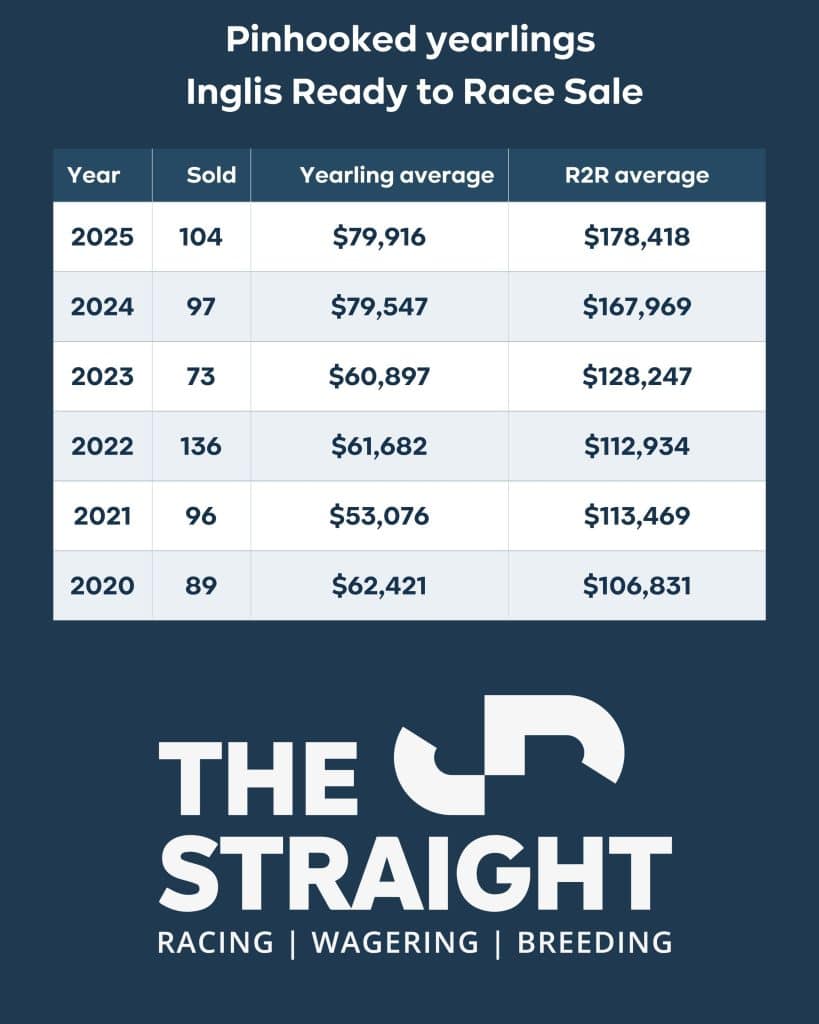
Data compiled by The Straight shows that of the 222 horses catalogued this year who were sold at an Australasian sale earlier in 2026, their average cost increased 33 per cent year-on-year.
The highest average for an Inglis sale, this year’s $106,484 yearling sales figure is up on last year’s $79,916 yearling average for the 104 two-year-olds catalogued.
The average subsequent sale price for those pinhooked two-year-olds last October was $178,418.
Buoyed by last year’s results, in which seven two-year-olds sold for $500,000 or more, including the $900,000 sale-topping colt Tron Bolt, pinhookers in what could be considered to be a specialist field raised their sights in terms of yearling spend and numbers.
The sale will be held two days before The Everest race day, as it was last year, with the date seen as one factor in last year’s success.
The Magic Millions Horses in Training Sale will be held on Monday, October 12, with the Gold Coast-based auction house hoping to attract many of the same international buyers from countries such as Hong Kong and Malaysia to attend its sale as well as Inglis’s.
For overseas buyers wanting to attend both sales, the rival auction houses are working cooperatively to accommodate those owners and trainers. The catalogue for the Magic Millions sale is yet to be released, nor has NZB’s for its November two-day offering.
The willingness of traders betting on Inglis being able to again attract the big-spending buyers, such as Tron Bolt’s owner, Hermitage Thoroughbreds’ Eugene Chuang, is demonstrated by the presence of a number of expensive yearlings being reoffered in Sydney.
The top 10 highest-priced Lots sold for between $350,000 and $540,000, led by a Harry Angel colt who is a brother to Group 2 winner Stretan Angel and a half-brother to last season’s Silver Slipper winner Stretan Ruler.
He will be offered by Hawthorne Lane’s Shane McGrath, who partnered with Equine Growth Fund, Blueblood Thoroughbreds and SP Bloodstock to buy the colt at the Inglis Classic Yearling Sale in February.
Fellow experienced breeze-up vendors Hannover Lodge, Matt Vella Racing and Fernigg Farm also have horses featuring in the top 10.
Newgate Farm (five Lots) and Yulong (24 Lots) will have two-year-old consignments under their own banner at the Sydney sale for the first time.
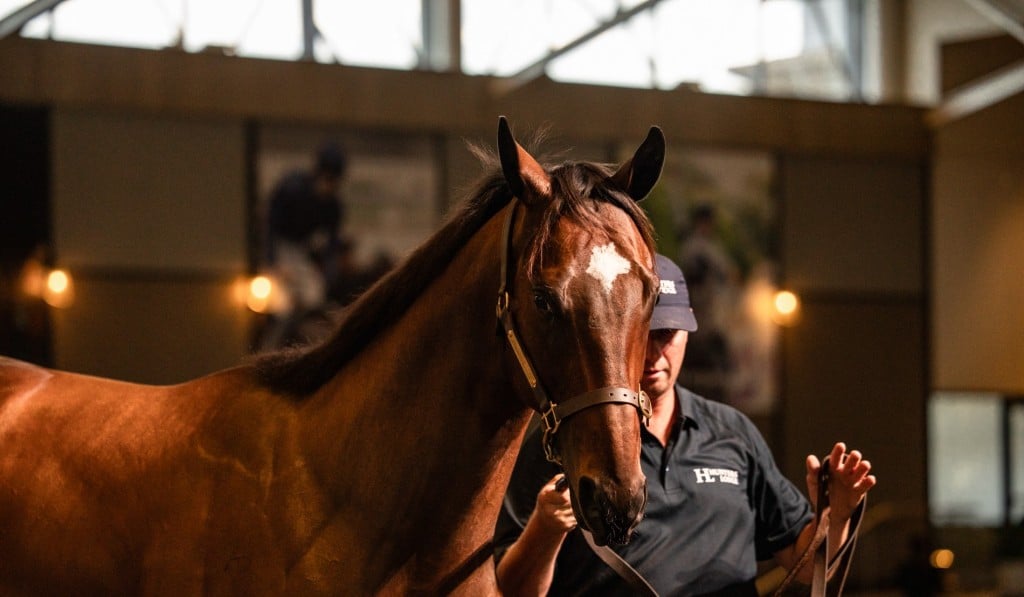
Baystone Farm’s Dean Harvey, a long-time vendor in partnership with Group 1-winning trainer Troy Corstens, has a draft of 17 two-year-olds heading to Sydney.
“I probably should be more calculated, but I’m not. We don’t have a set number we’re going to buy,” Harvey admitted this week.
“We probably bought a couple more than we were going to, but sometimes you see value like when we were at Easter and there were two fillies that we liked that we bought at value.
“We’ve got five fillies and I think that fillies market’s on its way up.”
Corstens and Harvey’s decision to go against convention by selling fillies at the two-year-old sales has paid off.
Two years ago, Baystone sold subsequent stakes-placed filly Signature Scent for $1 million and last year they traded Rachini for $500,000.
Rachini ran fourth in last season’s Group 1 ATC Sires’ Produce Stakes while another Baystone graduate from 2025, Harry Angel colt Seraphox, is accepted for the McNeil Stakes at Caulfield on Saturday.
“In terms of the sale, Hong Kong’s been a massive market, but we’re also seeing Mick Price get a few really good results out of last year’s sale and Gai (Waterhouse) has been buying and you see Darby Racing there,” Harvey said.
“The spread of buyers is getting bigger, but it’ll want to be this year because we’ve got so many more horses.
“And I think Tron Bolt’s been a massive reason for that. With such big owners like Hermitage, I’d say they’ll be back in force to see what they can get and I think it’s important for the local buying bench to get involved, too.
“As we know, Hong Kong was the be-all and end-all. If you missed Hong Kong, you were scrapping around a bit, but now there’s another avenue into it.”
The racecourse over the next two to three years will be the arbiter as to whether vendors, buyers and Inglis got this year’s Ready to Race Sale right.
Author
Related Articles
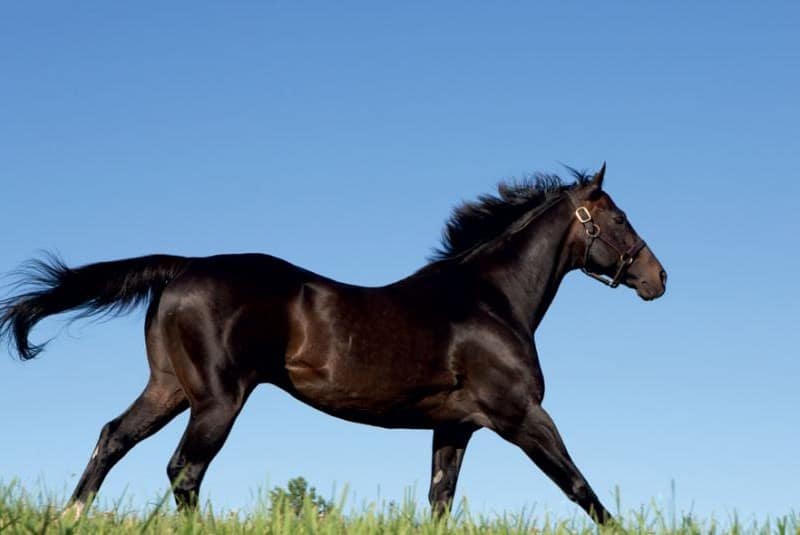
Influential sire Medaglia d’Oro dies aged 27 in Kentucky
Former Darley shuttler Medaglia d’Oro has died in Kentucky after an influential breeding career which included five Group 1 winners from his Australian crops.
From a flip of the coin to The Everest summit – Ka Ying Rising’s unlikely beginning
The remarkable story of Ka Ying Rising begins not on the racetrack, but with a sub-fertile stallion, a $500 mare and a mating where the odds of success were far longer than those he faces at Randwick on Saturday.
🔒 🔒 Galileo’s Cup curse lives on at Caulfield, but his influence remains
For the first time since 2015, Galileo has no direct representative in the Caulfield Cup. Yet while he has never sired a winner of Australia’s great handicaps, his descendants continue to leave an increasingly powerful imprint on both the Caulfield and Melbourne Cups.
