
Turning Point – Tax revenue surge delivers $4.5 million boost to racing industry’s bottom line
Despite Point of Consumption Tax revenue falling for the second straight year, NSW Treasury is expecting an additional $51 million from the wagering tax over the next three years in what could prove an unexpected bonus for the state’s racing industry.
An unexpected revival in Point of Consumption Tax (POCT) revenue over the past six months could mean a boost in government funding flowing into the New South Wales racing industry, as the state government bolsters its future revenue projections from the wagering tax.
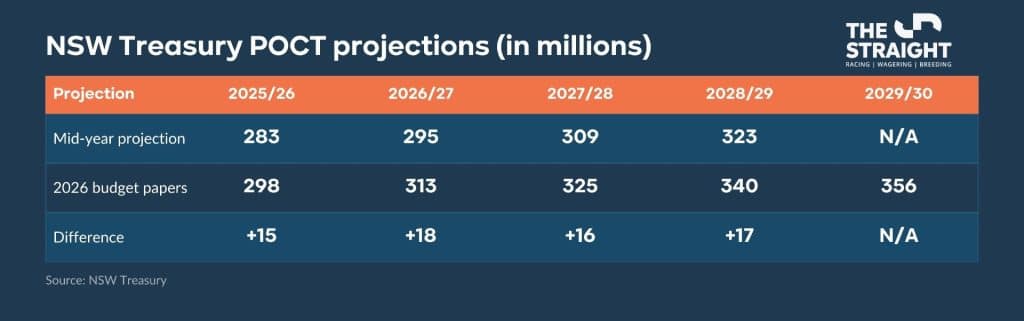
This week’s New South Wales budget revealed that while POCT revenue fell slightly year-on-year to $298 million, it was $15 million more than had been projected at the half-yearly review in December.
Based on the pass-through rate of 30 per cent to industry in NSW, that would mean $4.5 million more funding than had been anticipated for the thoroughbred, harness and greyhound industries to split.
While the raw distribution would have fallen from $90 million to $89.4 million year-on-year, the positive returns over the past six months have improved Treasury’s outlook.
It has more than doubled its annual growth forecast for the tax revenue from 1.9 per cent to 4.5 per cent.
In real terms, that means that compared to six months ago, the NSW government expects POCT revenue to increase from $295 million to $313 million in the coming financial year.
Furthermore, it expects 2027/28 revenue to be $325 million, $16 million more than it had projected only six months ago, while in 2028/29, POCT receipts will reach $340 million, $17 million higher.
That means across the next three years, Treasury expects an additional $51 million from POCT, which would, in theory, add another $15.3 million for the three codes than had previously been expected.
The POCT projections in the budget, which comes ahead of next March’s state election where Premier Chris Minns is seeking a second term, is in stark contrast to last year’s Treasury modelling, which dramatically downgraded growth in POCT.
On that occasion, POCT forecasts were cut by an average of $42 million across the four years, or $170 million in total, slashing forecasts of pass-through revenue by $51 million in that period.
However, the three-year trend of a decline in wagering appears to be over, with wider reporting in the wagering industry of modest growth in key metrics, such as turnover.
New South Wales racing is less reliant than other states on POCT revenue as a source of revenue, with its 30 per cent pass-through rate lower than Victoria, at 50 per cent, and Queensland, at 80 per cent.
However, both those states have revised their deals with Tabcorp, which have changed their funding structure.
NSW Treasurer Daniel Mookhey had announced a review of the NSW Tabcorp deal in June 2024, prompting speculation of a rise in the state’s POCT rate to 20 per cent, from its current 15 per cent.
However, discussions with Tabcorp, which also involved Racing NSW chief executive Peter V’landys, were called off last year at the behest of the wagering company’s CEO Gillon McLachlan.
Author

Related Articles
The advertising carve out – What does it mean for racing, wagering and media?
Having spent three years fretting about where the federal government may land on wagering restrictions, thoroughbred, harness and greyhound racing have received a host of specific carve outs which explicitly exclude them from the definition of a ‘sporting event’, but there are still a couple of unanswered questions.

Novig joins regulated prediction market surge
Sports-focused prediction market Novig has become the latest company to receive a CFTC licence in the United States, as the challenge to fixed-odds bookmaking continues to grow.
No Tote – Fixed odds only as King Charles field size cuts out Aussie punters
Asfoora and Overpass contest Tuesday’s Group 1 feature at Royal Ascot, but Australian punters won’t be able to back them either via World Pool or the local tote.
