
Run The Numbers – The sire categories we don’t talk about
Each season, the champion general, broodmare, first-season, second-season, two-year-old and three-year-olds sires are celebrated, but there are other ways to cut the cake when it comes to sire influence. This week’s Run The Numbers takes a final look back at the 2025/26 Australian racing season through that lens.
The suitability of using progeny earnings to determine champion sire status has been much debated over the last decade, as Australia’s biggest races have rocketed in value.
The supercharged prize money offered by The Everest, twice as much as any other race, plus a slotholder element which divides return to owners in an unknown way, causes consternation among traditionalists, who feel it unfairly shapes stallion rankings.
In the nine years since the first edition of the race, only one champion sire title has been impacted by The Everest’s outsized prize money influence.
It was in the second edition, when Redzel banked $6.55 million in winning the world’s richest sprint, while Trapeze Artist collected $2.1 million for finishing second. Their sire, Snitzel, defeated I Am Invincible by $6.51 million in the 2018/19 sires race.
Last season, Shamexpress finished 31st in the Australian sires table, despite only having 14 runners for the season. One of them was Ka Ying Rising, The Everest winner who banked $7.6 million at Randwick in October.
In contrast, what was also interesting was that Snitzel’s highest earner this season, Lady Shenandoah, did not win a race across 2025/26, despite collecting $2.5 million.
So, if not prize money, then how should we look at the best-performed sire of the season?
If we were to judge by the most winners, then it would be Newgate’s Capitalist, while if it was judged on stakes winners, Snitzel was a more-than-comfortable victor.
But both of those categories afford greater opportunity depending on progeny participation. The top six on the stallion table as judged by winners in 2025/26 were the top six in terms of total runners.
Alternate ways could be to look at winners-to-runners rates, which would measure success in relation to opportunity. It is also an imperfect measure but does give some insight.
Filtering out stallions that had fewer than 20 winners, we find that the top six ranked stallions by that measure either don’t stand in Australia or have stood here but no longer shuttle.
Top of the rankings is New Zealand-based Rich Hill Stud’s Ace High, with 24 winners from 38 starters, or 63.2 per cent. Next is Justify, who shuttled to Coolmore Australia for four seasons across five years, and last season recorded 73 winners from 123 Australian runners, a W/R rate of 62.4 per cent.
Calyx, who shuttled to Coolmore for two seasons, had a seasonal W/R rate of 60.9 per cent, while Time Test, who formerly was resident at Little Avondale Stud in New Zealand, had a seasonal W/R record of 60.5 per cent.
The leading active Australian-based sire on those rankings was Newgate’s Brutal, whose 65 winners from 113 starts gave him a W/R rate of 57.5 per cent, putting him seventh overall.
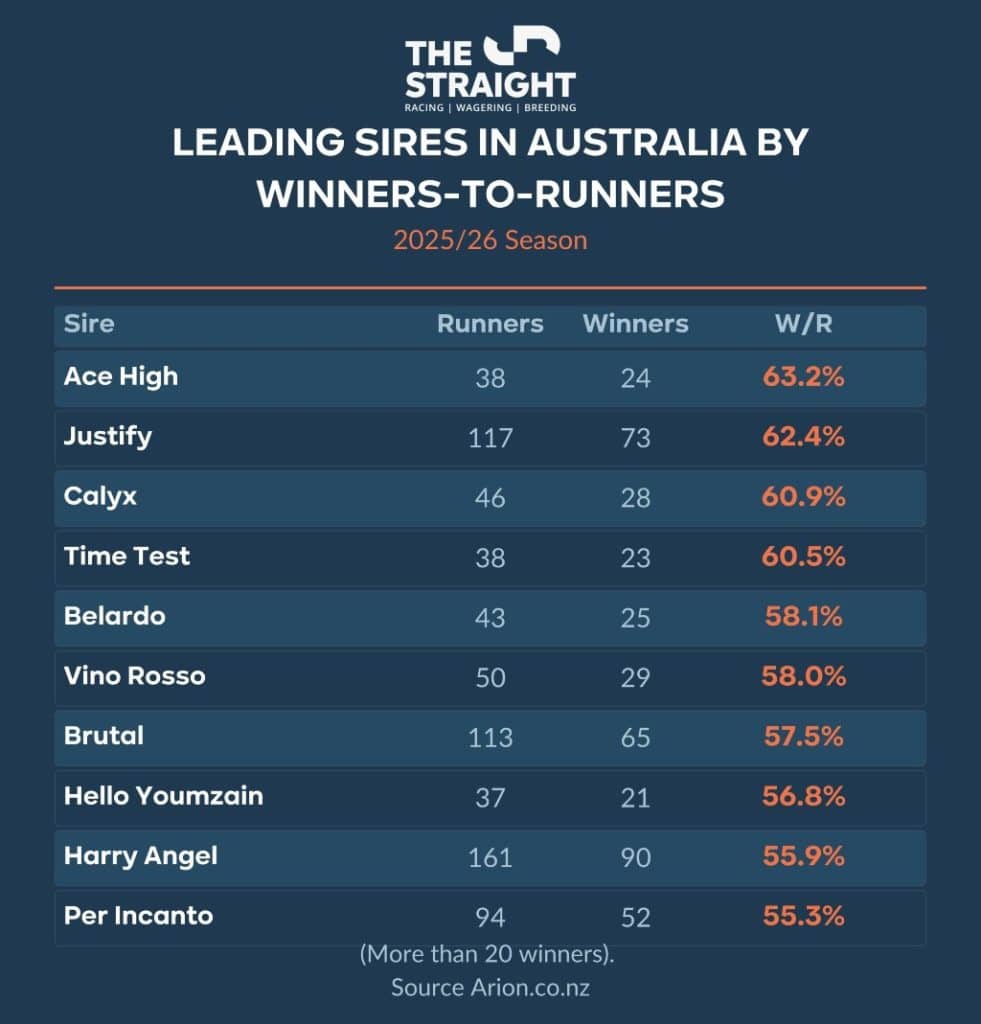
Darley’s Harry Angel is ninth overall, and the second active Australian stallion on 55.9 per cent.
Active Australian sires Pierro (55.3 per cent), Russian Revolution (55 per cent) and Stratosphere (54.7 per cent) also rank inside the Top 15 on W/R percentage.
Snitzel finished the season on exactly 50 per cent winners-to-runners, ranked 28th in that category. The median rate of the 172 sires we looked at was 44.8 per cent.
Ranking sires by their stakes winners-to-runners rate, and, again, filtering out sires with fewer than 20 winners across the season, we see Darley’s Ghaiyyath ranks highest with 8.6 per cent, (five SWs from 58 runners).
Ace High is second on 7.9 per cent on SW/R, with three from 38 runners, while his former Rich Hill barnmate Vadamos, who hasn’t been back to New Zealand since 2023, struck at 6.1 per cent, with three stakes winners from 49 runners.
Snitzel is fourth with 17 stakes winners from 292, a SW/R rate of 5.8 per cent. Fifth on that list is the late Coolmore stallion Wootton Bassett on 5.6 per cent, while Frankel has 5.5 per cent, Extreme Choice 5.3 per cent, Time Test 5.3 per cent, Too Darn Hot 5.2 per cent, Bivouac 5.1 per cent and Tavistock 5 per cent.
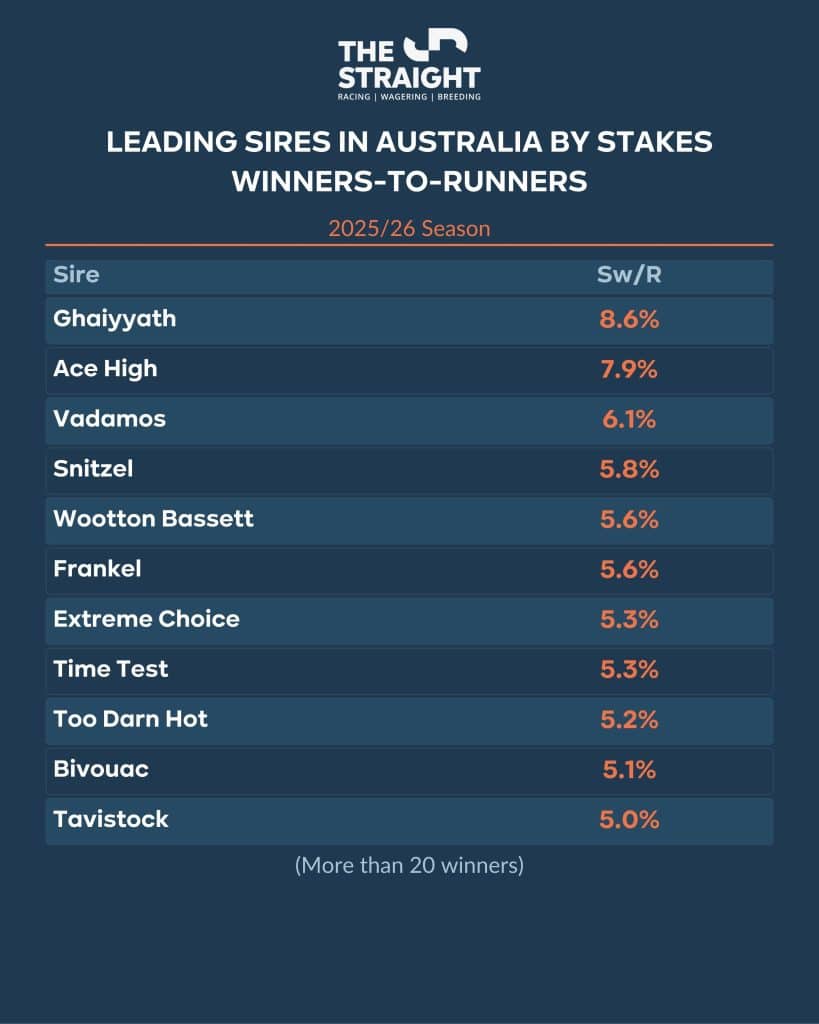
Removing that 20-winner filter, Roaring Lion (60 per cent) and Fast Company 50 per cent both have sky high rates, but with small numbers of runners of five and two respectively. Incidentally, the late Cambridge Stud stallion Roaring Lion had a perfect record in Australia of five winners from five runners last season.
The other category which is not widely measured is the impact sires have with their progeny aged four and over.
Given around 63 per cent of prize money won in Australia is by horses aged four and over, it is an interesting category, which is available through excluding two and three-year-old progeny earnings from overall sire earnings.
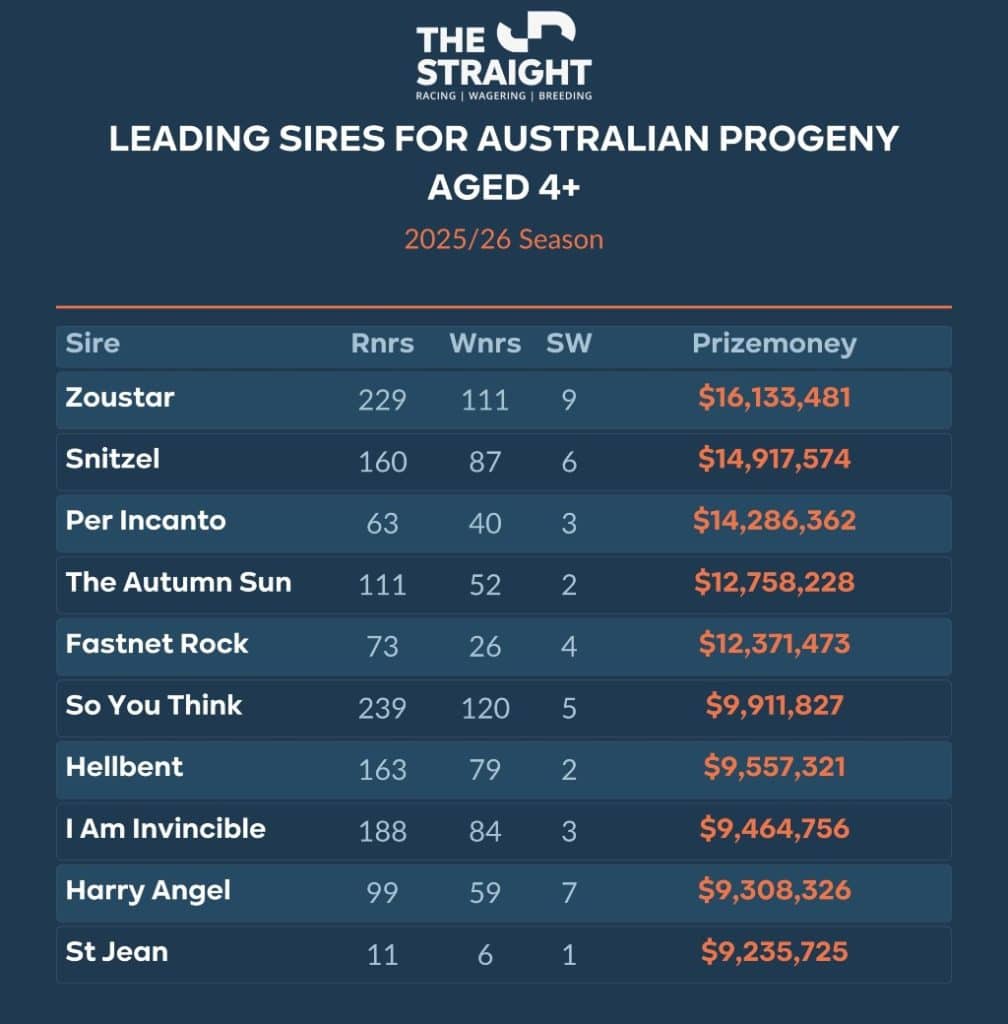
In 2025/26, Zoustar was clearly the leading sire in Australia ranked on prize money in this regard. His progeny aged four and older accrued $16.1 million, $1.2 million more than second-placed Snitzel.
In third place is Per Incanto, with $14.3 million from his older horses, led by Jimmysstar. The Autumn Sun is fourth on $12.8 million, while Fastnet Rock is fifth on $12.4 million.
When it comes to ranking on stakes winners for horses aged four and older, Zoustar also leads that count with nine, ahead of Harry Angel on seven, while Snitzel had six and So You Think and Written Tycoon have five apiece.
Swettenham’s Toronado is the top Australian stallion when it comes to winners aged four and over with 122, two more than So You Think and 11 more than Zoustar. Capitalist (110), Russian Revolution (103) and Dundeel (100) also ranked highly.
Author

Related Articles
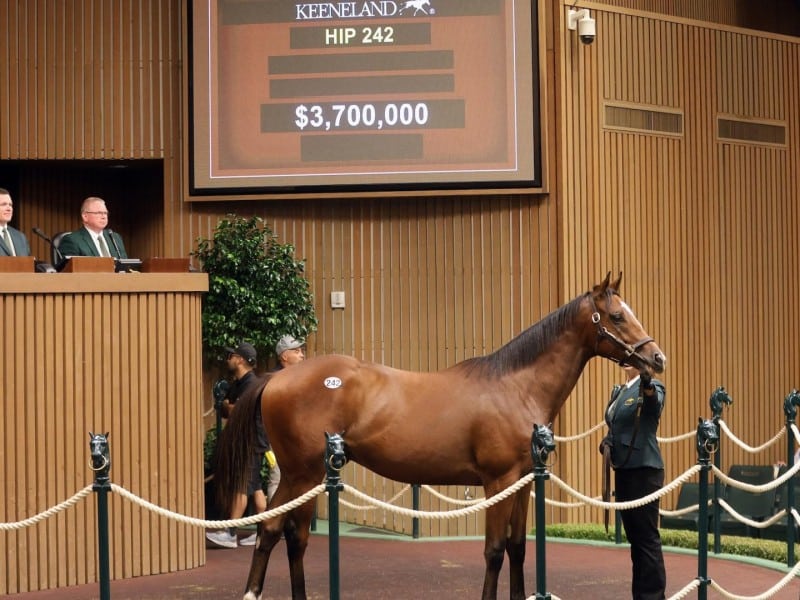
Run The Numbers – The elevated state of the global yearling market
With US$536 million spent across 12 sessions, the recently completed Keeneland September Sale was the highest-grossing yearling sale in history. Run The Numbers looks at whether it speaks only to the American market or reflects a broader global demand for elite bloodstock.
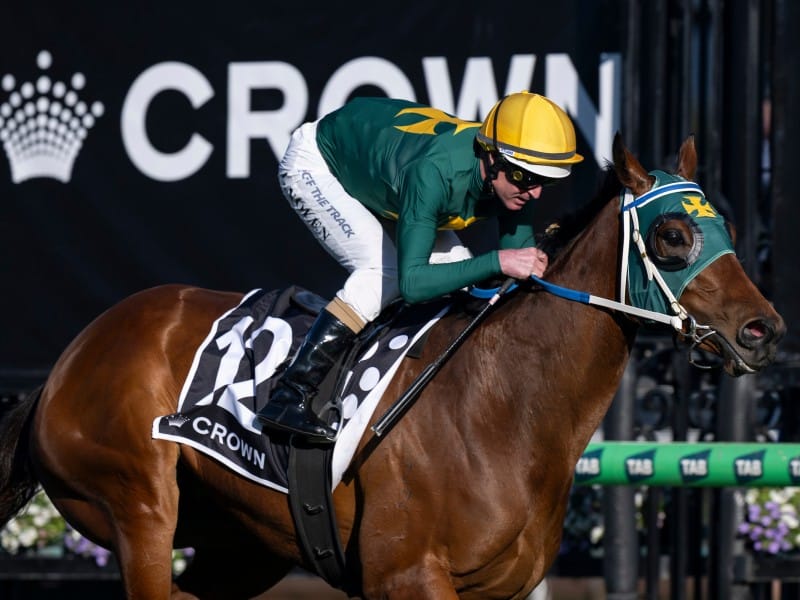
Run The Numbers – An influence runs Deep into the next generation
Legendary Japanese sire Deep Impact made a major mark on Australian racing from less than 50 runners. Does the emergence of Sheza Alibi point to that influence continuing to his sire sons as well? Run The Numbers takes a look.
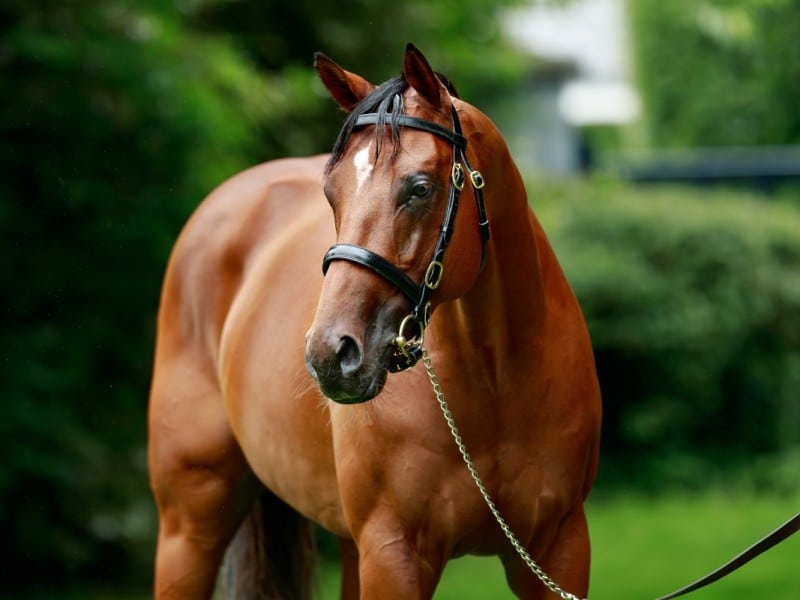
Run The Numbers – What has become of the American shuttle stallion?
After a major decline in trans-Pacific shuttling of stallions, there are no stallions standing in Australia in 2026 that have shuttled directly from the United States. Fifteen years ago, 23 made the annual trip. Run The Numbers looks at how this trend has evolved.
