
The workforce behind Flemington’s biggest Melbourne Cup crowd in a decade
Flemington drew nearly 100,000 racegoers to Melbourne Cup Day, its largest crowd since 2016. The VRC’s most recent workforce figure, more than 14,000 accredited staff across the 2024 carnival, gives the scale of the caterers, builders, security, cleaners, turf staff and broadcast crews behind the event.
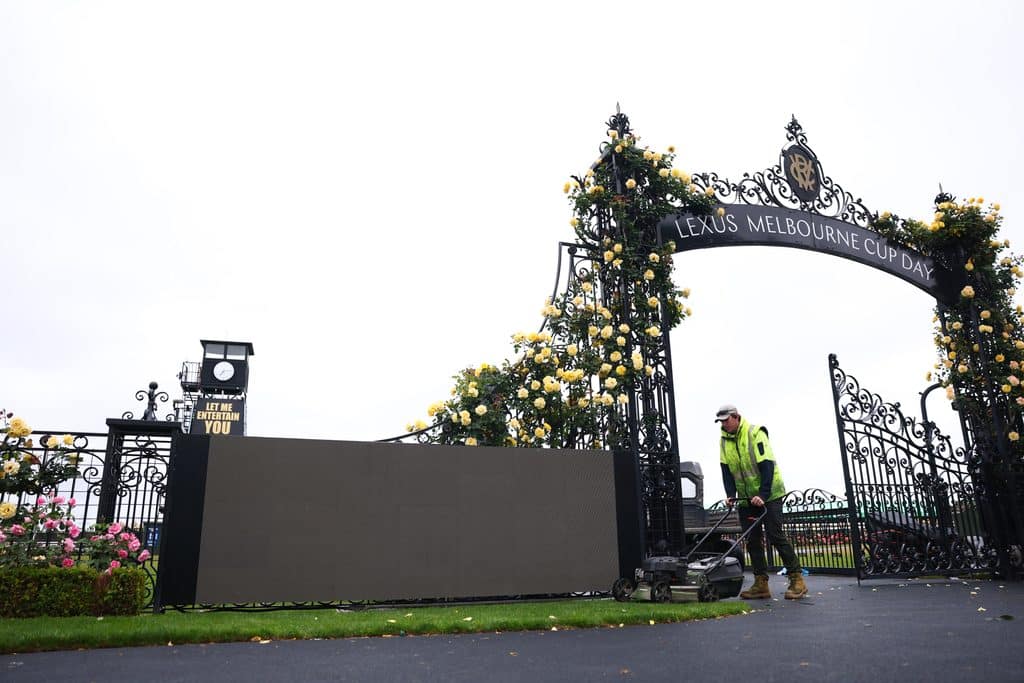
Flemington hosted 97,112 racegoers on Tuesday, the largest Melbourne Cup Day crowd since 2016.
Racegoers passed through staffed turnstiles, drank at bars that someone set up and will pack down, and watched a race run on a track whose spring preparation began in August.
The Victoria Racing Club’s (VRC) best measure of the people behind that is its count of more than 14,000 accredited staff across the four-day carnival in 2024.
Hospitality and catering
Atlantic Group’s recruitment advertisement for this year’s carnival sought front-of-house staff committed to all four race days.
The duties covered setting sections with cutlery, crockery and glassware, setting up and packing down bars, mixing drinks and taking money, serving guests, then clearing and resetting tables.
In 2018, uniform supplier UrbanBar Design said Atlantic Group’s front-of-house workforce in the carnival’s marquee areas numbered close to 600. A year later, Good Food reported that Peter Rowland had planned 140,000 plated meals and more than one million canapés for VRC member areas.
Its dedicated sandwich crew had served more than 200,000 chicken sandwiches at Flemington in 2018. In 2019, The Big Group catered eight of the Birdcage’s 14 marquees.
Building, service and cleaning
The Birdcage itself is a construction project. In 2024 the VRC recorded a 15-week build that started in July and finished on Derby Day eve. It covered an 18,000-square-metre enclosure, including more than 4,500 square metres of multi-level structures.
More than 2,500 people were involved in building and servicing it. The VRC had planned to expand this year’s Birdcage to more than 25 companies and sponsors.
On race days, event staff work the turnstiles and the course, and cloakrooms operate across all four days.
Cleaning runs around the clock. In 2018, Craig Lovett, who ran cleaning contractor Incognitus, said the operation involved about 750 people working through the day and into the night.
Grounds, racing operations and security
Under Liam O’Keeffe, the VRC has previously described a team of 25 turf managers, labourers and apprentices. Their work runs from mowing, watering and moving rails to filling divots between races.
“Our number one goal for both track work and race day is to prepare a safe track for rider and horse,” O’Keeffe said in 2023.
The spectator-free 2020 Cup Day gives a sense of the racing-side workforce.
Neil Wilson, then VRC chief executive, said around 1,500 essential workers were still on course despite the absence of spectators, with security and operations staff alongside jockeys and trainers.
Then grounds manager Mick Ryan, responsible for 16,500 rose bushes, told the ABC that pandemic rules had split his gardeners into separate teams at opposite ends of the course. In a normal year, security staff also run bag checks at every entry point.
Gravity Media, in its 25th year facilitating the host broadcast, announced plans for more than 30 hours of live coverage across the four days.
The host production was to use 48 cameras, together with a pair of outside-broadcast trucks, distributing to more than 220 territories. Nine’s separate production was to use another 12 cameras and Gravity’s UHD 11 truck to support its Birdcage studio.
Beyond Flemington
The work extends well past the course. The VRC put the 2025 carnival’s gross economic benefit to Victoria at $533 million. It attributed a separate $848 million national uplift to Cup Day, tied to functions and hospitality venues around Australia. Visitors who travelled to Victoria for the carnival spent $46.6 million on accommodation across 248,500 commercial bed nights, and $35.9 million on food and beverages.
The carnival is part of a much larger racing workforce.
Racing Australia’s 2025 Fact Book estimates that thoroughbred racing provides jobs for approximately 75,000 Australians. In Victoria, IER’s 2024/25 study put thoroughbred racing’s employment footprint at 24,618 full-time equivalent (FTE) jobs, including flow-on employment, as previously reported by The Straight.
Related Articles
🔒 🔒 Racing NSW maintains surplus as fresh challenges remain for new leadership
Racing NSW recorded a $13.63 million operating surplus for 2025/26, but as Peter V’landys bids farewell, flat wagering figures point to ongoing regulatory and market challenges in the wagering industry that fuel racing’s commercial strength.

🔒 🔒 Ciaron, the King, the Cup and the kicker
Except for a British law prohibiting monarchs sharing ownership of horses, King Charles would have been a Melbourne Cup-winning owner on Tuesday, but Ciaron Maher’s bloodstock manager Will Bourne revealed there is some reward headed back to England.

Bettering Bart: The lessons from a master that set Maher on a path to his own history
In the backstory of Ciaron Maher, who on Tuesday became the first trainer in the Melbourne Cup’s 166-year history to train the first three horses across the line, lies a brief period of learning all he could from the man whose achievements in Australia’s greatest race surpass all others, Bart Cummings.
