
Run The Numbers – Scale rewarded as Waller and Maher snare over 20 per cent of Australian prize money
Chris Waller and Ciaron Maher have won 17 of the first 29 Group 1s of 2026/27 and their runners have claimed 21.6 per cent of Australian prize money to date. Run The Numbers gives historical context to their current dominance.

Melbourne Cup week provided the clearest illustration yet of the growing dominance of Australia’s two biggest training operations, with Chris Waller and Ciaron Maher combining to win six of Flemington’s eight Group 1 races.
Since the start of the season, they have now won 17 of the 29 Group 1s contested, or 58.6 per cent, which, as we will discuss later, is a level of dominance never seen at the top of the training ranks.
It is important to note that there are varying opinions on the desirability of having success so concentrated among the top two stables. While some see it as an example of rewarding the best of the best when it comes to trainers, others believe the system is increasingly designed to reward scale.
This article does not make a judgment on that. Its purpose is to provide historical context and determine whether that success and prize-money distribution is becoming more concentrated.
The evidence points strongly in that direction.
Their combined total of 17 Group 1 wins has already surpassed the 16 Group 1 wins the leading two trainers averaged across full seasons between 1996/97 and 2010/11.
But the pair’s grip extends well beyond the top level.
Since August 1, their runners have earned 21.6 per cent of all prize money distributed in Australia. That is from 3.9 per cent of overall runners and 4.5 per cent of winners.
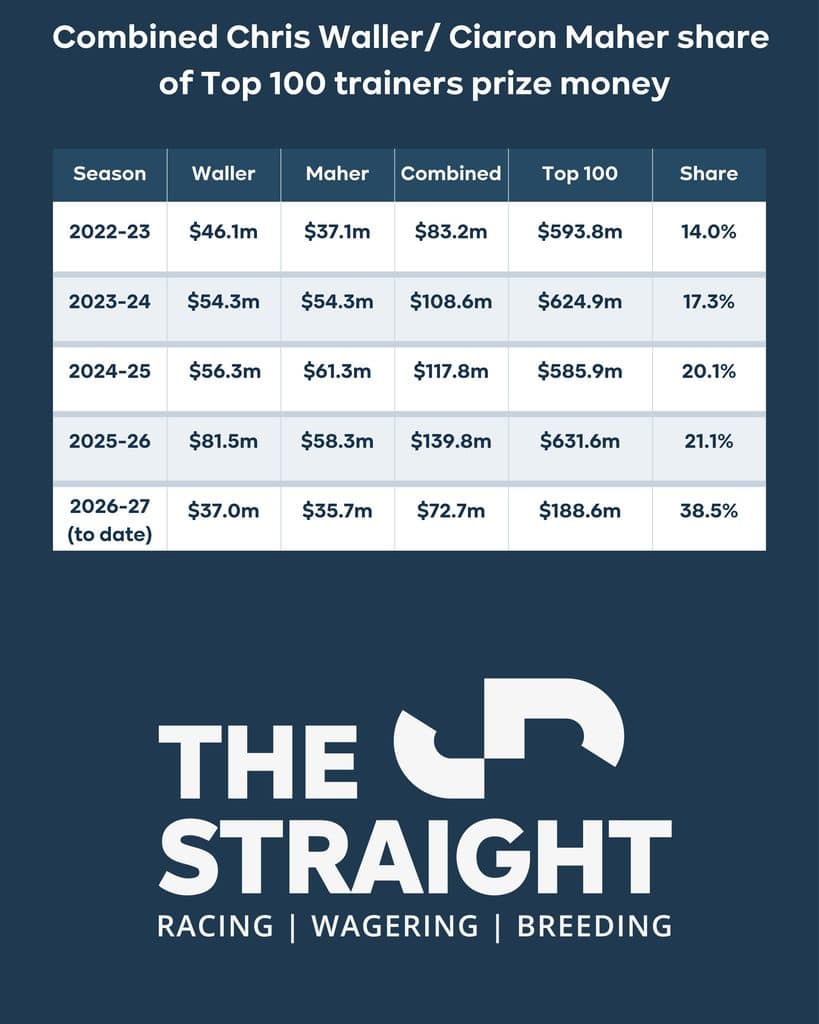
When filtered to the Top 100 trainers, their dominance of the season so far becomes even more pronounced.. Over the past two completed seasons, Waller and Maher have won 20.7 and 22.1 per cent of the prize money claimed by the Top 100 trainers in Australia.
So far in 2026/27, that figure is 38.5 per cent.
That is influenced by Maher’s success in both The Everest and the Melbourne Cup, which together supply 39 per cent of his 2026/27 prize money total.
Tempted’s win in The Everest was worth $7 million to Maher’s stable. A week ago, Maher became the first trainer to prepare the first three home in the Melbourne Cup. Point Of Law earned $4.5 million, Zahrann $1.11 million and Juja Kibo $560,000, and the stable’s seven runners collected $6.83 million between them.
Waller’s biggest cheques have come from Autumn Glow, who earned $2.95 million for winning the King Charles III Stakes, and from Joliestar, who picked up $2 million for running third in The Everest. Autumn Glow’s Champions Mile and Birdman’s Champions Stakes then returned a combined $3.6 million in winning prize money.
Saturday was a particularly lucrative day for Waller, with his 21 runners across Australia banking $4.85 million. The trainer’s cut is traditionally 10 per cent of that number.
Each trainer leads his home metropolitan premiership. Waller has 43 NSW metropolitan winners and $19.58 million in earnings, while Maher has 41 Victorian metropolitan winners and $20.46 million.
Meanwhile, Maher’s 94 NSW metropolitan starters have produced 17 winners, an 18.1 per cent strike rate, and $12.24 million, or about $130,000 per start. Waller’s 135 Victorian metropolitan runners have won 18 races and $14.6 million.
Nationally, Maher’s runners are averaging about $47,900 per start from a 16.0 per cent strike rate, and Waller’s $42,850 from 12.5 per cent.
Moving back to the Group 1 metric, we see Waller, with 11 elite successes, is currently on track to better his record mark of 22 set last season. Only 37.7 per cent of Group 1 races have been run this season.
Based on his current run rate, he is on track to win 29 Group 1 races in 2026/27, while Maher will end up with 16.
As a historical comparison, in the decade to 2005/06, the top-two Group 1 total never rose above 19, a mark set by Gai Waterhouse and Bart Cummings in 1996/97. It fell as low as 13 twice.
Lee Freedman, the leading trainer of that era, never won more than 10 Group 1s in a season over that stretch.
The average rose to 17.6 over the next five seasons, then changed sharply in 2011/12. That season Peter Moody won 17 Group 1s and Waller 10, taking the top-two total to 27. Waller has been one of the two leading Group 1 trainers in every season since.
In 2024/25 Waller won 19 Group 1s and Maher 10, a combined 29, while last season it was 30.
That figure is almost twice the 15.4-win average in the decade to 2005/06, and the highest since 2016/17, when it was 33.
While the number of Group 1s has increased, it has risen by only 10-15 per cent.
The same concentration of success does not imply the same business strategy.
Waller’s stated ambition is to improve an operation he considers large enough, while Maher’s business spans multiple locations and a substantial annual investment in yearlings.
Their common outcome matters more to their rivals than the differences between their models. Waller completed a record $80 million season in 2025/26 and won his 16th consecutive Sydney premiership.
In July, his listed active horses numbered 460, 40 fewer than at a similar point in 2024. “I think I’m maxed out in terms of numbers. I want to just stay at this number and not get any bigger. I just want to do the little things better,” Waller told The Straight in August.
Maher’s operation runs out of seven different facilities, including Cranbourne, Ballarat, Bobs Farm and Warwick Farm, and employs 225 staff.
As things stand now, Waller has 488 horses listed under his stable, while Maher has 553. It is noteworthy that Waller has more runners this season, 856, as compared to Maher’s 741.
The advantages of scale are clear, and prize money increases over the past 10-15 years have fed this cycle. That figure of 21.6 per cent of Australia’s prize money feeding back to just two stables is stark.
Whether you view that trend as a reward for excellence or a consequence of a system that increasingly favours scale, the numbers point in one direction. The dominance of Waller and Maher is not simply continuing; it is intensifying.
Author

Related Articles
Run The Numbers – The statistical case for the preservation of the Victoria Derby
The Group 1 status of the Victoria Derby could be the biggest casualty yet of a ratings-driven era, but Run The Numbers data questions whether the race’s true impact is being measured, or whether certain data is being used to reinforce pre-existing perceptions of the traditional Classic.

Run The Numbers – King’s latest successes put female jockeys on brink of 50 Australian Group 1 wins
As Rachel King builds her own formidable Group 1 record, she is also helping female jockeys power towards a significant milestone: 50 Group 1 wins in Australia. Run The Numbers dives into the major contributors from Diane Moseley to Siena Grima.
Run The Numbers – The elevated state of the global yearling market
With US$536 million spent across 12 sessions, the recently completed Keeneland September Sale was the highest-grossing yearling sale in history. Run The Numbers looks at whether it speaks only to the American market or reflects a broader global demand for elite bloodstock.
