
Fine margins – How pinhookers fared at the 2025 Australasian yearling sales
The art of pinhooking is not for the faint hearted, but while increasing costs have made margins for investors even finer, there was still profit to be had in returning horses to the Australasian market in 2025.
Australasia’s pinhookers turned a collective profit of more than $700,000 across 329 horses at the yearling sales in 2025, with the boom and bust nature of the challenging pursuit of trading young stock on full display.
Not for the first time, Silverdale Farm hit the pinhooking jackpot, selling a Stay Inside colt at the Inglis Easter Yearling Sale in April for $650,000, more than five times the price principal Steve Grant paid for him as a weanling.
In a pure price paid and sold measure, the trade of the $120,000 weanling was the most profitable of the 329 pinhooked yearlings to find a new owner this year, although the commercial realities are never that simple.
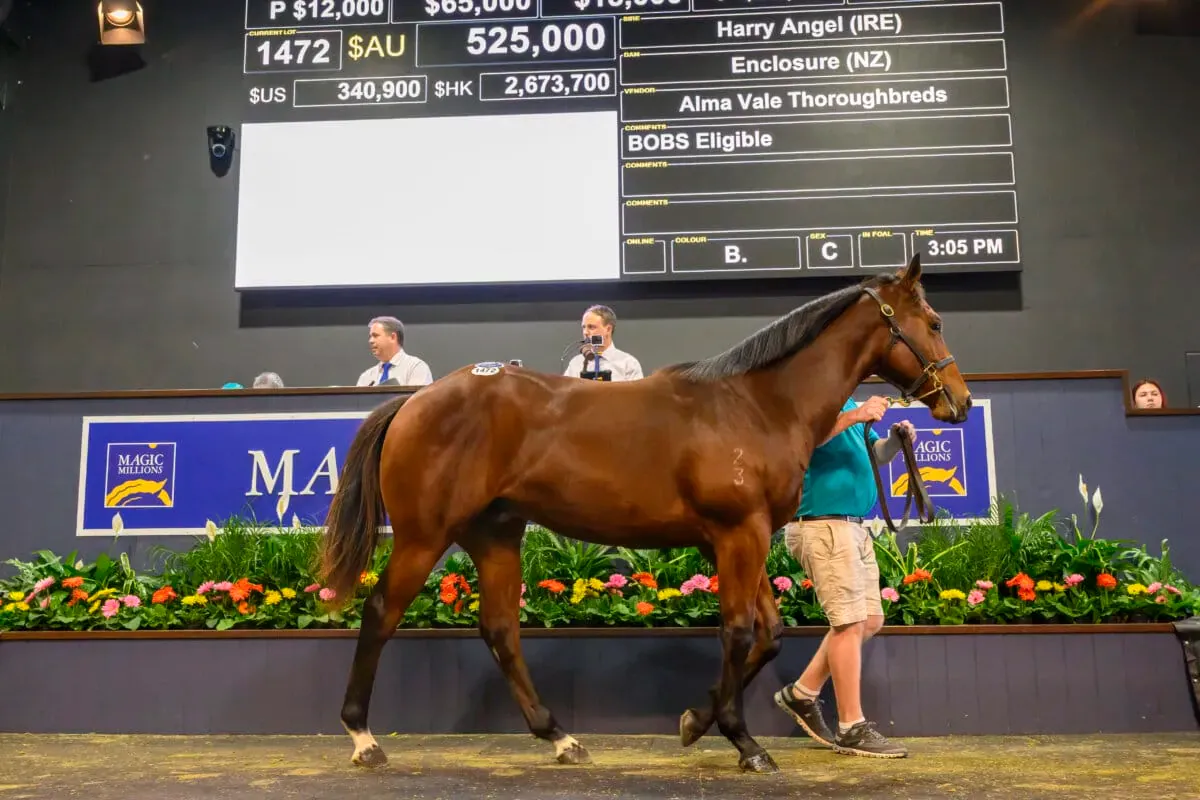
Silverdale aside, the most remarkable rags-to-riches result occurred at the Magic Millions National Yearling Sale, when New South Wales-based Temerity Park sold a $1500 weanling colt by Harry Angel for $525,000. Alma Vale Thoroughbreds had the honour of consigning him on the Gold Coast on behalf of Temerity’s TJ and Greg Le Breton.
Such is the vagaries of an auction, and proving a week, let alone 13 months, is a long time in racing and breeding, two Hong Kong buyers locked horns for the prized yearling to return the Le Bretons with a huge financial windfall.
The result occurred more than a year after Temerity saw something in the son of Harry Angel at the Inglis Australian Weanling Sale when virtually everyone else did not.
Temerity Park’s success, along with Silverdale Farm’s shrewd trading, offset the inevitable losses that go with the volatile but potentially lucrative quest that is pinhooking. Outside of those results, which, considering on-costs and commissions, yielded the investors a combined profit of just over $825,000, the rest of the market made a net loss.
Among this year’s horror stories was a $450,000 weanling by Frankel who was resold for $225,000, a paper loss of $225,000, but in reality, accounting for other costs, it was closer to $300,000.
Accounting for costs, there were 133 pinhooked yearlings which proved profitable and 196 which resulted in a loss.
The average profit, including costs, was $2248, offering some encouragement for a strong group of traders participating at the weanling sales conducted in Sydney and on the Gold Coast again this year.
The Inglis Great Southern Sale will be held on Friday while the New Zealand Bloodstock offering will be held on June 26 where the eternally optimistic will be out in force.
Across 11 yearling sales conducted this year by Inglis, Magic Millions and NZB from January to June, pinhookers achieved a gross profit of $19.417 million. After expenses and commissions, however, net profit dropped to just $739,525 from the 329 pinhooked yearlings sold at auction.
The Straight’s analysis included assumptions, after research, of $40,000 in costs, plus $12,500 in commissions.
The $40,000 expenses figure is based on actual costs incurred by a commercial east coast stud from May to February, an amount that doesn’t take into account any unforeseen veterinary costs.
Holding costs will decrease or increase depending when and where the yearling sale is conducted and the scale the vendor operates at.

Commissions, including sales company, levies and consignor fees, have been calculated at a total of 12.5 per cent of the yearling sale price.
No passed in or withdrawn yearlings, which were purchased as weanlings, have been considered as part of the data as the pinhook buyers may have other avenues to on-sell those horses and sale prices aren’t transparent.
Based on the above figures, if a weanling was bought for $100,000 and resold for the same amount the following year, the trader would lose, on average, over $50,000 due to production costs and commissions payable upon selling at a live yearling sale auction.
Approximate costs of pinhooking a weanling as a yearling (based on $100,000 weanling)
Property developer Grant, who owns NSW Southern Highlands stud Silverdale Farm, has bolstered his annual yearling drafts with a proportion of pinhooked weanlings and he has enjoyed a considerable financial upswing as a result.
The most notable is the unbeaten Autumn Glow, a star in the sale ring who has increased her immense value on the racetrack through her unbeaten three-year-old season.
Her trainer Chris Waller has declared the daughter of The Autumn Sun, a $600,000 weanling who was on-sold by Silverdale Farm for $1.8 million at the 2023 Inglis Easter sale, as a Group 1 winner in waiting.
This year’s profitable Stay Inside colt was bought by James Harron’s colts fund at the Easter sale.
There was a stroke of luck involved for Silverdale, too, having withdrawn him from the Inglis Classic Sale after already being broken in by renowned horseman Greg Bennett.
The Stay Inside colt did so well from the early education preparation that Grant and Silverdale general manager Rob Petith decided to have Inglis consider him for the Easter sale, which they did.
“Steve Grant never wants to just accept the status quo, he’s constantly looking for ways that we can try and improve the process that we go through,” Petith told The Straight.
“The thought behind us breaking a Classic draft in was to try and value-add to the people that were going to be buying off us there, so they weren’t losing time, in fact they were probably gaining a little bit of time, because they’d started (their education).
“It’s just a continuation of their education, and no work, no real work was put into them as far as pressure, excessive pressure on their legs or anything like that. It’s just about trying to own that process by engaging the best people in the business to continue that education with the breaking, and then bring them back and continue the prep.”
Sale by sale – Pinhook profitability
As one would expect, the Inglis Easter sale ($36,317) and Magic Millions on the Gold Coast in January ($20,000) were the most profitable by average given the select nature of their catalogues and relative wealth of the buying benches the two sales attract. Exactly half of the 28 pinhooks at eAster were profitable after costs, while 45 of 75 on the Gold Coast proved the same.
The NZB sale also proved profitable for the majority of pinhookers, with the 45 pinhooks finishing an average of $16,075 in the black. Twenty five proved profitable, with 20 registering a loss. (NZ dollar given parity to Australian dollar for the purposes of this article)
The other yearling sale which returned a profit on average was Inglis Premier, with 32 pinhooks, 18 of which were profitable after costs and 14 which returned a loss. The average profit was $6398.
As any pinhooker can attest, it’s not for the faint hearted, but the thrill of the chase will keep buyers coming back.
Author

Related Articles
🔒 🔒 Hinton heads to Hunter – Racing NSW chief executive and prominent breeders to break bread at Newgate
Racing NSW acting chief executive Graeme Hinton will visit the Hunter Valley next month as major thoroughbred farms attempt to mend relationships between the regulator and the breeding sector.
New Zealand faces up to industry ‘implosion’ with 40 per cent of Group 1s under threat
Racing jurisdictions, led by New Zealand, will use a key Asian Pattern Committee meeting in February next year to argue that changes need to be made to the way Group 1s are rated to protect their status as the country faces a brutal cull of its elite races.
British and Irish foal crop falls for a third straight year
Weatherbys’ Return of Mares puts the combined thoroughbred foal crop for 2026 at 11,312 in Britain and Ireland, down 17.2 per cent on 2023, with Britain falling hardest.
