
Rowe On Monday – A bidding cat and mouse, Messara’s statistical argument and a family formula pays off for Field
In this week’s Rowe On Monday, sales companies’ bidding strategies under the spotlight, John Messara ponders a fairer distribution of prize money and Henry Field’s formula for sire success.
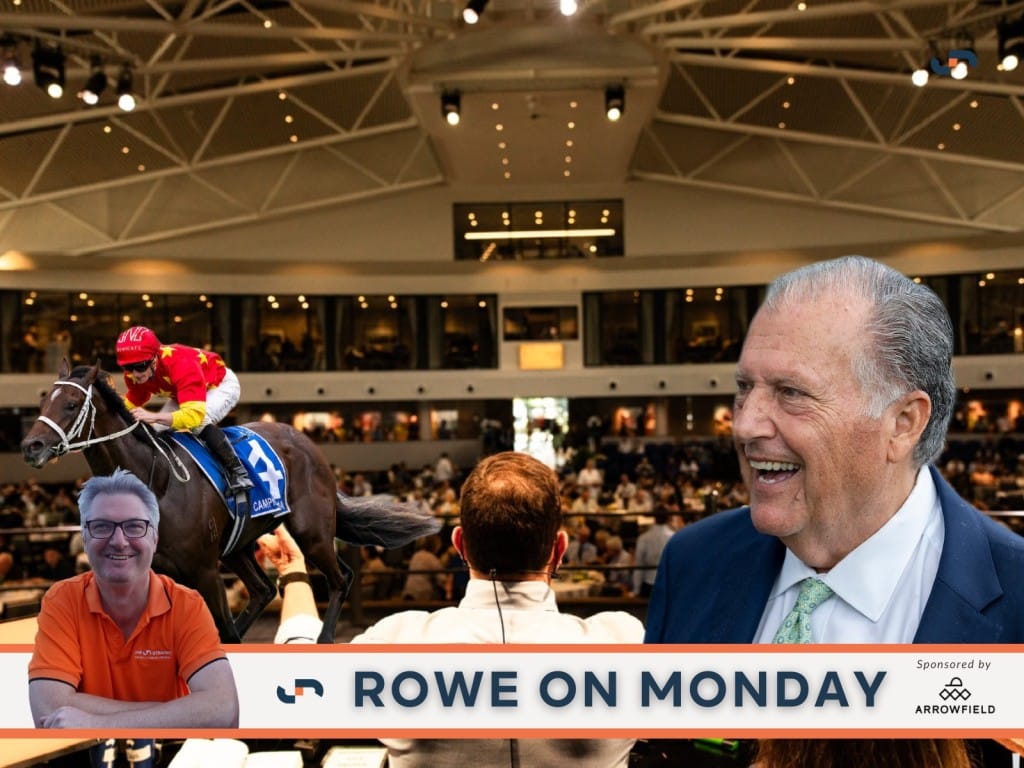
A thoroughbred sale tends to have its own sign language used by buyers, bid spotters and auctioneers.
A bidder, often communicated via the bid spotter, may want to cut the increment in half, from say $100,000 to $50,000 or $50,000 to $25,000.
There’s also the semi-regular scenario when a buyer thinks their competition is “out”, so they pull back the bid, only for their rival to bid to the figure they just relinquished.
It’s a cat and mouse game and the auctioneer behind the rostrum has the ultimate control over the increments used on particular horses and this column has been told that some buyers have become annoyed by the practice of “upselling” in the taking of bids.
And this has been taking place throughout the sales season – and it’s not singling out any particular auction house – but it was evident at the recent Inglis Easter Yearling Sale that there appeared to be a number of bids reduced at the behest of the potential buyer.
Inglis Bloodstock chief executive Sebastian Hutch didn’t think it happened any more regularly than it does at other sales.
He also denied that the issue had been raised inside the company prior to the Easter sale.
“There were a couple of instances where people got animated about it, but our mandate is to get the best result we can for the vendor,” Hutch said.
“We have a team of excellent auctioneers, a really good group of guys who are operating at a higher standard than what they’ve ever operated at before, and I would be 101 per cent supportive of their approach and how they sell the horses.
“There was some criticism from some buyers about taking too big of an increment … (but) it’s absolutely at the discretion of the auction house what increments they take and it’s absolutely discretion of the bidder about what increments they accept.”
As renowned auctioneer Steve Davis says from the various rostrums from which he stands, “you bid and I’ll add up”.
‘Looking at medians is a better statistic’
People won’t always agree with Arrowfield’s John Messara but he’s certainly well worth listening to his view when it comes to the administration of racing.
He has, along with Autumn Glow’s co-owner Hermitage, been a major beneficiary of the ballooning prize money at the top end of the racing industry but he argues that the distribution of that revenue could be better spent.
Autumn Glow won a tick over $5 million in last November’s Golden Eagle and she’s the short-priced favourite to stretch her winning run to 12 in Saturday’s $5 million Queen Elizabeth.
A victory will take her prize money to north of $11 million, almost $1 million a start, in an example that illustrates that “cumulative prize money is better than it’s ever been”.
But Messara says: “The distribution of that prize money has left a few gaps in that it’s sort of unrealistic to look at averages.
“I think looking at medians is a better statistic and while the regulators have done a great job increasing the revenue base, no question, inflation has overtaken racing like it’s overtaken other parts of the economy and costs of racing and costs of breeding have made it pretty uneconomic.
“On my calculations, only 10 per cent of horses that race in NSW break even. That’s not a good enough stat, so we need to find ways and means to make it more sustainable and that might mean some tinkering with distribution and finding other ways of supporting trainers and owners on costs because I think people will drop out and you can see it through the reducing size of the foal crop.
“This is not only NSW, it’s also other states and it’s New Zealand. We’re all suffering from the same symptoms.”
Messara is a former chair of Racing NSW and he also had a short-lived tenure as independent chair of Racing Australia, an appointment which was an attempt to bring all the principal racing authorities together and heading in the same direction.
It didn’t work and he resigned in frustration four years ago.
He hopes that eventually cool heads will prevail among the states and at a national level for the betterment of the sport.
“There’s a lot of discord at the moment, which is unfortunate, because we’re not a massive industry, but we’re a reasonably big industry.
“It’s got to be sorted out. There’s got to be a meeting of the minds and good consultation between the various groups to get back on the same page.
“I am concerned about it because the industry needs all the support and help and consistency that it can have and there is a lot of discord.”
“A number of court actions and similar and we’ve got to find a way through all that and I just hope that wise heads can get together and sort it out.”
Sticking to the system pays off for Field
Colts fund groups such as Henry Field’s Newgate and China Horse Club are well-versed in the volatility of buying yearlings in the hope they do enough on the racetrack to justify a spot on a stallion roster.
Snitzel colt Campione D’Italia, in winning the ATC Sires’, will be the combination’s 16th stallion in a decade.
It’s also uncanny how many of the colts bought by the various syndicates have pedigrees where other groups have also bought out of.
The pedigree of the Gerry Harvey-bred Campione D’Italia features the James Harron partnership-raced Breeders’ Plate and Kindergarten Stakes winner Espionage, a Zoustar colt retired to Lovatsville this year.
Russian Revolution, a dual Group 1 winner for Newgate and CHC, is also from the same family as is Coolmore’s Home Affairs and the WA-based Aysar.
And there’s a reason why many of the top-end buyers, where conformation and temperament matters as much as the pedigree, continually hunt from the same families.
“As long as we’re buying the right product and we’re fortunate to have great trainers working with us, you give yourself a great chance,” Field said at the Inglis Easter sale.
Author

Related Articles
Rowe On Monday – Connie gives Driscoll thrills in two codes, an elite Geegees legacy and NZB bucks weanling trend
In this week’s Rowe On Monday, a Flemington winner whets the appetite of Yabby Dam’s Pat Driscoll, a Group 1 upset caps an amazing Tasmanian legacy and numbers on the up at New Zealand Bloodstock’s National Weanling Sale.
Rowe On Monday – Mystery man unmasked, Price is right on incentives, an embargo relief and a US$10.5 million colt
In this week’s Rowe On Monday, Merrick Staunton reveals himself as one of Home Affairs’ early admirers, new Hong Kong incentives draw a lukewarm response from a major buyer, a Savabeel filly now free to race and expectations high for an eight-figure colt.
Rowe on Monday – Howard gets the bias right, an Irish influence in G1 upset, a Wooded winner and Mills’ new frontier
In this week’s Rowe On Monday, Brett Howard on taking on perception of sex bias in a stallion and picking out a future Group 1 winner, a moment to remember for Hubie de Burgh and Johnny McKeever, good early signs for a Swettenham stallion and a Kiwi stakes win for a couple of ambitious Aussie owners.