
Run The Numbers – What has become of the American shuttle stallion?
For the third year straight, there are no stallions standing in Australia in 2026 that have shuttled directly from the United States. Fifteen years ago, 23 made the annual trip. Run The Numbers looks at how this trend has evolved.
At the height of Danehill-mania in 1996, when Coolmore had successfully secured the sole ownership of the most influential shuttle stallion in Australian history, the thirst for American bloodlines among Australian studmasters was insatiable.
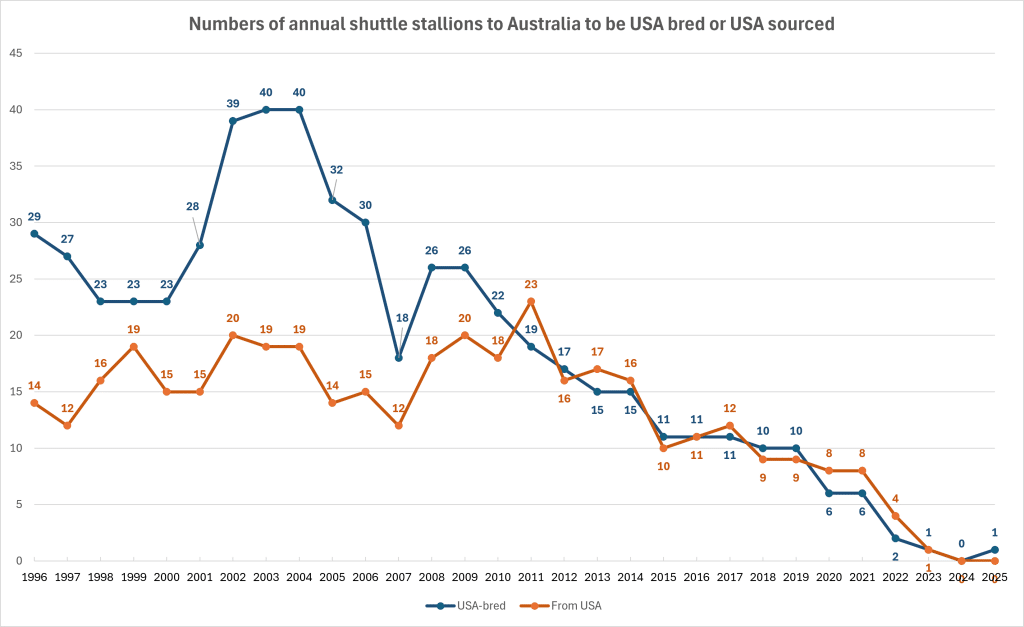
That year, 43 shuttle stallions visited Australia, 29 with the USA suffix. Of those 29, less than half, 14, had actually served in the US the previous season, with most of the others having been active at stud in Europe.
American-bred Danehill didn’t fit in either category in that season. In a bit of a curiosity, he served his one season in Japan in 1996 before returning to Australia for what would be his seventh season in the Hunter Valley.
In all, those 43 shuttle stallions covered 3144 mares in 1996. In a sign of that desire for American bloodlines, all six shuttlers that covered 100 mares or more carried the USA suffix.
Powered by the Danehill effect, the shuttle stallion phenomenon was at its peak in Australia in 2003, the first season since the great stallion’s death at age 17. In the space of seven years, the number of imported stallions to Australia grew to 61, a sizable leap.
Those 61 shuttle stallions covered 5127 mares that year, nearly 2000 more than they did just seven years prior. That was 19 per cent of all the mares covered in Australia that year.
Again, American-bred shuttle stallions were dominant, with 40 on Australian rosters. That was over twice as many as the Irish-bred stallions (16).
Ten of the top 16 busiest shuttle sires of 2003, including the top three, Fasliyev, Bianconi and Orpen, were American-bred.
In 2003, Coolmore had 13 American-bred stallions on its roster of 17, Vinery Stud had five on its NSW roster, Arrowfield had four with the USA suffix, as did Widden.
Similar to 1996, fewer than half of those stallions had actually shuttled from the USA, with 19 coming direct to Australia, 10 from Ireland, five from Great Britain, and four from Japan.
In a truly global era, where a horse was bred and raced, and where it stood at stud, were become less and less connected. It was also the era where star Australian horses were being given their chances to reverse shuttle.
On a recent trip to the Hunter Valley, it was clear how much has changed in the past 23 years. Just one stallion in the famous breeding heartland in 2026 features the American suffix, Coolmore’s City Of Troy.
Not one stallion has shuttled from America to be in Australia this season, the third year in a row this has happened.
American-bred Street Boss, who is having a remarkable late career renaissance from Darley’s Northwood Park in Victoria, has been a permanent resident in Australia since 2022. Woodside Park’s American-bred but Japanese-based Laurel River is the other Victorian-based stallion with a USA suffix.
There are two other non-shuttling American-bred stallions in New South Wales, The Brothers War and Glacial Gold, while Officiating has been Australian-based at Aquis Queensland since 2014. A Lot and King of Athens are the other American-bred non-shuttlers, with both based in WA.
So, what happened to the great American experiment? It declined along with the shuttle phenomenon.
From that peak of 61 shuttle stallions, just 15 made the trip here in 2025. Between them, they served 1526 mares, less than a third of that 2003 peak. The number of mares which went to a shuttle stallion had dropped to nine per cent.
The most dramatic decline has been in the American contingent.
The twin impacts of EI and the global financial crisis saw the number of American-bred shuttle stallions drop from 30 in 2006 to 19 in 2011. The numbers then fell away constantly from there. In 2016 there were 11, and then Covid hit and that number dropped to just six in 2020.
In the past few years, only a trickle of American stallion blood has been imported into Australia: one in 2023, none in 2024, and one in 2025.
Appetites and trends changed and arguably the outcross blood became more prevalent via the mares’ side, with a string of stars by Australian stallions out of American mares.
One of the world’s two biggest breeding operations, Darley, ceased trans-Pacific shuttling, something Godolphin Australian managing director Andy Makiv recently admitted may have been a misstep in hindsight.
There are moves to get more American stallions back into Darley’s Australian stallion ranks, with Sovereignty a chance to shuttle to Australia in 2027.
Coolmore has brought two Triple Crown winners to Australia in recent years, and in 2022/23, Justify became the first American-bred stallion since More Than Ready to win the Australian first-season sires title.
But it too has ceased the American shuttle route for now, with Justify’s son City Of Troy having been trained out of Ireland, despite being foaled in Kentucky.
As mentioned, he is one of only two of the 16 shuttlers for the 2026 Australian season with that suffix, the other being Laurel River.
The decline in shuttle stallion numbers has to be seen in the context of the broader contraction of stallion numbers. In 1996, there were 1708 registered stallions in Australia, of which 2.5 per cent were shuttlers.
By 2003, the overall figure had dropped to 994, with 6.1 per cent having shuttled from elsewhere. The most recent total stallion figure, from 2024, puts that overall number at 414, with 3.9 per cent of them shuttle stallions.
Run The Numbers is now published once every two weeks. The next edition will be published on September 15.
Author

Related Articles
Run The Numbers – A proven ‘colonial’ formula
Both General Nediym and Snitzel were champion sprinters who became highly influential stallions. As this week’s Run The Numbers finds out, the combination of their bloodlines is now becoming one of Australia’s most successful on the track.
Run The Numbers – It’s not always a clear path from sale-topper to superstar
It is arguable there has never been a better-performed horse to have topped an Australasian yearling sale than Autumn Glow, who is set to resume in this month’s Winx Stakes. But what of the other sale-toppers? This week’s Run The Numbers digs into the data across Australasian yearling sales since 2020.
Run The Numbers – The sire categories we don’t talk about
Each season, the champion general, broodmare, first-season, second-season, two-year-old and three-year-olds sires are celebrated, but there are other ways to cut the cake when it comes to sire influence. This week’s Run The Numbers takes a final look back at the 2025/26 Australian racing season through that lens.
