
Run The Numbers – The elevated state of the global yearling market
With US$536 million spent across 12 sessions, the recently completed Keeneland September Sale was the highest-grossing yearling sale in history. Run The Numbers looks at whether it speaks only to the American market or reflects a broader global demand for elite bloodstock.
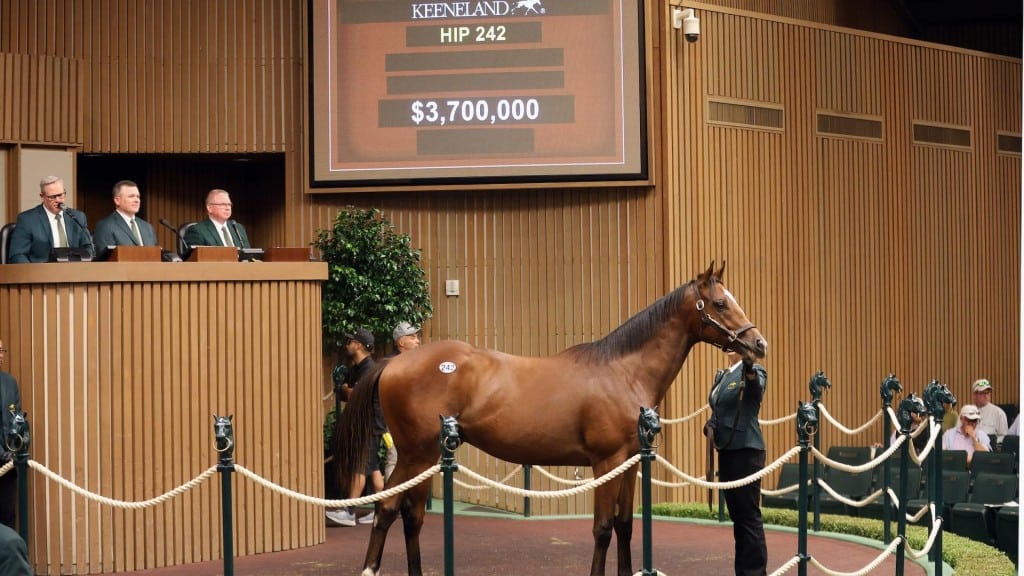
The American yearling market is used to its booms and busts. From 1970 to 1989, the turnover at the biggest American yearling sale, Keeneland September, grew from US$5 million (AU$7.1 million) to US$77.6 million (AU$110.5 million), a 15-fold jump in just 19 years.
From 1978 to 1980, the market doubled, with the Keeneland September sale’s gross jumping from US$22.5 million (AU$32.0 million) to US$51.7 million (AU$73.6 million), fuelled by international investment and friendly tax settings.
That formula seems to be repeating in 2026 as the American market reaches new heights.
The tax concessions in Donald Trump’s One Big Beautiful Bill last year, combined with record international interest from Europe, the Middle East, Africa and Japan, have pushed the Keeneland September Yearling Sale 2026 gross to US$536,737,900 (AU$764.2 million), with 2,856 sold.
That is a record through-the-ring gross for any thoroughbred auction worldwide, surpassing the sale’s previous record from 2025 by five per cent.
The average was US$187,933 (AU$267,600) and the median US$85,000 (AU$121,000), while 70 yearlings sold for US$1 million (AU$1.42 million) or more, up from 56 in 2025. Significantly, buyers from 30 different countries were represented.
Overall percentage growth at Keeneland over the past 20 years has not matched that of the 1970s and 1980s, with the 2006 aggregate just under US$400 million (AU$569.6 million), though 700 more horses were sold than in 2026.
The yearling market crashed twice in the intervening period, with Keeneland’s gross losing half its value from 2006 to 2009. It had not even got back to the 2006 level when the pandemic hit: the gross fell by US$123.4 million (AU$175.7 million), or 33 per cent, in 2020 compared with 2019.
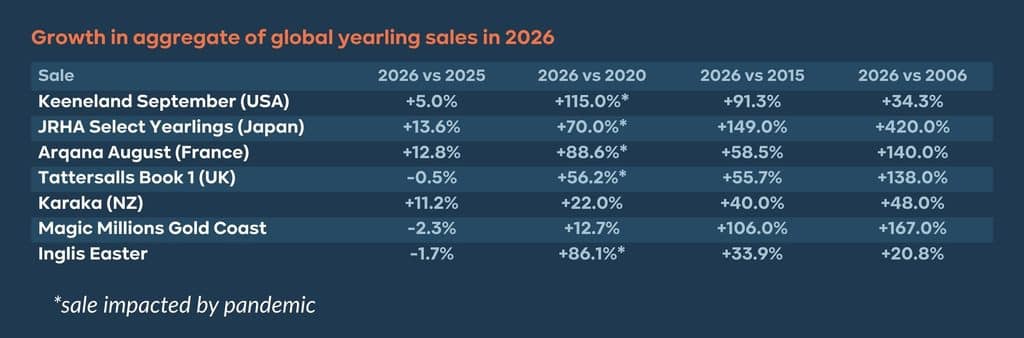
Since then, the American yearling market has continued to rise, with Keeneland’s gross in 2026 at 115 per cent higher than it was just six years ago.
All of these rises, especially recently, need to be seen in the context of broader inflation, but the nominal figures show strong demand for top-end bloodstock in the United States.
So is this just an American trend?
For comparison, we have looked at the results of the biggest yearling sales in major countries worldwide.
In Japan, historically the foal market has been stronger than the yearling market, and in 2006, of the ¥11.5 billion (AU$103.8 million) spent at the JRHA Select Sale, 71 per cent was on foals.
The Japanese yearling market has since grown to eclipse foals, at least at the JRHA Select Sale, and in 2026, 53 per cent of the sale’s gross was for yearlings.
The overall yearling gross in 2026 of ¥17.66 billion (AU$159.5 million) was the highest on record, up 13.6 per cent from 2025.
It was also 70 per cent higher than the amount spent on yearlings at the 2020 JRHA Select Sale, 149 per cent higher than it was in 2015, and 420 per cent higher than it was in 2006.
In France, the Arqana August Sale in 2026 delivered a record gross of €71.96 million (AU$116.6 million), a 12.8 per cent jump from 2025. That also represents an 88.6 per cent jump since the pandemic-impacted market of 2020 and a 58,5 per cent jump from the 2015 number.
The gross from the 2006 Arqana August Sale was €30 million (AU$48.6 million), meaning that the French yearling market, as judged by its largest sale, has increased 140 per cent over those 20 years, with 64 more yearlings sold in 2026 than in 2006.
In Great Britain, the biggest yearling sale, the Tattersalls October Sale, is not due to begin until October 6, so we are awaiting 2026 figures.
Looking at Book 1 results, 2025 turnover of 128.8 million guineas (AU$255.0 million) was slightly below 2024’s 129.4 million guineas (AU$256.2 million). However, it is still a jump of 56.2 per cent on what was spent in 2020.
There was a similar increase across the decade from 2015, when the Book 1 Tatts gross was 82.7 million guineas (AU$163.7 million).
Going back for global consistency to 2006, the Tattersalls Book 1 aggregate was 54.04 million guineas (AU$107.0 million), showing a 138 per cent jump in spend over those 19 years, despite 32 fewer yearlings being sold at that sale in 2025 than in 2006.
That brings us back to the New Zealand Bloodstock National Yearling Sale at Karaka. The data we have collated covers the entire sale across multiple books.
In 2026, NZ$96.2 million (AU$77.6 million) was spent at that yearling sale across 753 purchases. That was up 11.2 per cent year on year.
Going back to 2020, it’s worth noting that the Karaka sale was held before the pandemic affected global travel. NZB’s yearling gross that year was NZ$78.9 million (AU$63.7 million). That means the aggregate spend grew 22 per cent across the past six editions.
In 2015, the gross was NZ$68.7 million (AU$55.4 million), putting the reported 2026 total more than 40 per cent higher, although the sale formats differed.
Meanwhile, in 2006, NZ$64.9 million (AU$52.4 million) was spent, putting the reported 2026 total about 48 per cent higher, though the sale formats differed. It is worth noting, however, that in the peak of pre-global financial crisis fever, the Karaka sale grossed a record NZ$110.4 million (AU$89.1 million) in 2008.
That takes us back to Australia, where we will look at the two major sales, the Magic Millions Gold Coast Yearling Sale and Inglis’ Easter Yearling Sale.
In 2026, Gold Coast’s January sale grossed $213.2 million, down 2.3 per cent from 2025. That sale had actually come back off 2022-24 peaks of over $240 million.
The 2026 figure was 12.7 per cent higher than the 2020 figure (again, that sale was before the pandemic impact), but was 106 per cent higher than the gross of $103.1 million in 2015.
Going back to 2006, the Magic Millions marquee sale grossed $79.7 million, meaning its aggregate grew by 167 per cent between 2006 and 2026.
The pattern for the Inglis Easter Yearling Sale is not quite as dramatic, although recent trends favour that sale.
In 2026, Easter grossed $148.9 million, 1.7 per cent down on the record heights of the previous two editions. Going back further, this sale was badly impacted by the shutdowns of the pandemic in 2020; across two sales its aggregate was less than $80 million.
Between 2015, when it sold $111.2 million worth of yearlings, and 2026, the Inglis Easter Yearling Sale grew its aggregate by 33.9 per cent.
In 2006, the Easter Sale grossed $118 million, meaning its aggregate spend has increased by 20.8 per cent.
Given Easter’s more select nature, aggregate comparisons can be problematic. Inglis sold 85 fewer horses in the 2026 edition than in 2006, while Magic Millions increased its number of yearlings sold by 361 over the same period.
However, this article is about overall spending trends across the globe. The data above shows that yearling spend is at or near historic highs worldwide, but the American market is hotter than the rest.
Another constant theme is that competition at the top end has never been hotter, but beyond that, buyers are more selective than ever.
Currency note: AU$ equivalents are rounded using the Reserve Bank of Australia’s September 28, 2026 exchange rates, including for historical figures These are current-rate conversions, not the exchange rates at the time of each sale; no figures are adjusted for inflation.
Author

Related Articles

Run The Numbers – King’s latest successes put female jockeys on brink of 50 Australian Group 1 wins
As Rachel King builds her own formidable Group 1 record, she is also helping female jockeys power towards a significant milestone: 50 Group 1 wins in Australia. Run The Numbers dives into the major contributors from Diane Moseley to Siena Grima.
Run The Numbers – An influence runs Deep into the next generation
Legendary Japanese sire Deep Impact made a major mark on Australian racing from less than 50 runners. Does the emergence of Sheza Alibi point to that influence continuing to his sire sons as well? Run The Numbers takes a look.
Run The Numbers – What has become of the American shuttle stallion?
After a major decline in trans-Pacific shuttling of stallions, there are no stallions standing in Australia in 2026 that have shuttled directly from the United States. Fifteen years ago, 23 made the annual trip. Run The Numbers looks at how this trend has evolved.
