
🔒 🔒 How sports betting is becoming a normal part of ‘investing’ for Gen Z
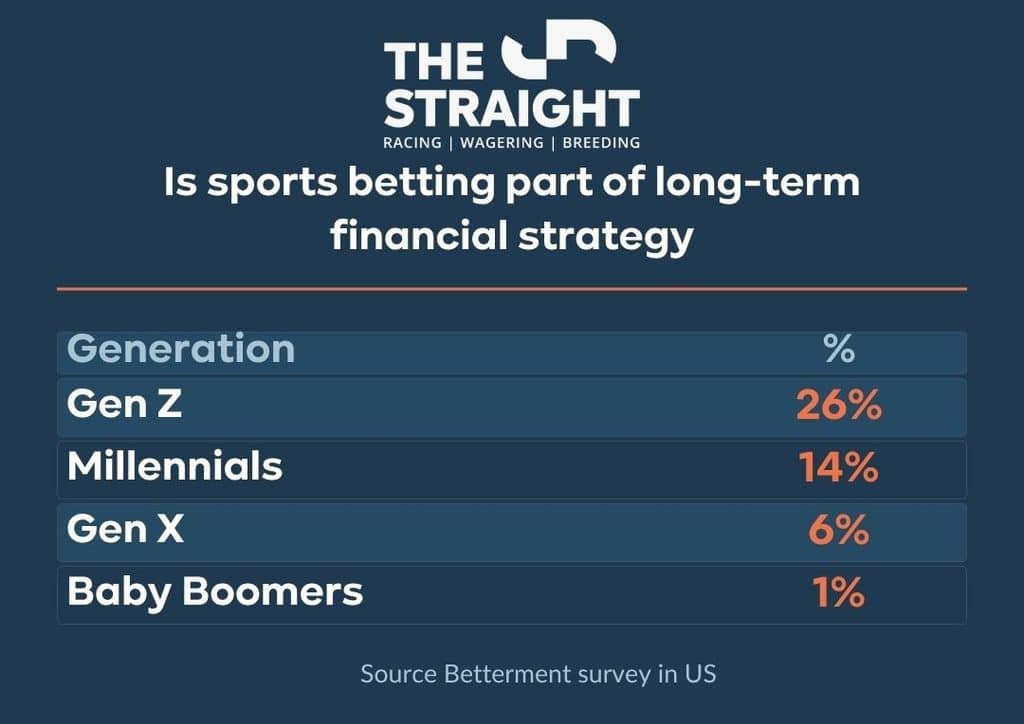
An American survey has found 26 per cent of Gen Z investors regard sports betting as part of their long-term financial strategy, highlighting a generational shift in wagering behaviour. Where does racing fit into this trend?

Australian racing is about to get its annual look at whether the habits formed by a generation of sports bettors can transfer from football fields to the racecourse.
With the AFL and NRL seasons now over, the country’s attention turns to the spring carnival at a time when the boundaries between sports betting, financial speculation and other forms of wagering are becoming increasingly difficult to define.
That gives racing a chance to capture some of the audience that spent the winter betting on football, particularly younger punters for whom wagering on an event and speculating on an outcome are increasingly interchangeable.
A new US survey illustrates the trend: 26 per cent of Gen Z investors said they considered sports betting part of their long-term financial strategy, while 52 per cent said they diverted money intended for investment into sports bets during the previous year.
The findings from Betterment’s survey of 1000 US retail investors suggest sports betting has moved beyond its traditional role as an entertainment expense, with younger consumers increasingly viewing it through the same lens as other forms of financial risk-taking.
Betterment is a US digital investment company that uses technology to provide automated portfolios, retirement accounts, cash management and financial guidance to retail investors.
Its core service is a robo-advisor that builds and manages diversified portfolios based on a customer’s financial goals, time horizon and risk tolerance.
The company also provides investment advice and educational resources, making its survey particularly relevant because it examines how mainstream retail investors view and allocate money rather than surveying customers of a wagering business.
Fourteen per cent of Gen Z respondents said they diverted investment money into sports betting several times a month, reinforcing the idea that the distinction between allocating capital and placing a wager is becoming harder to draw.
Sports betting has expanded nationwide at a phenomenal rate in the US since the landmark Professional and Amateur Sports Protection Act ruling in 2018.
Eight years later, that shift is happening alongside the rapid growth of prediction markets, where customers buy contracts based on the probability of an event occurring and can watch their positions rise or fall before the outcome is known.
The experience has more in common with trading than conventional fixed-odds betting, while offerings around elections, economic indicators and sporting results have introduced financial-market language and behaviour to an environment historically occupied by bookmakers.
Sportsbooks such as DraftKings and FanDuel generally describe their products as entertainment rather than investments, while prediction-market platforms argue that event contracts are financial derivatives regardless of the subject.
Dan Egan, director of behavioural finance and investing at Betterment, said the growing presence of sports betting alongside conventional investments on the same apps and devices was helping to blur the distinction.
Egan said the comparison was concerning because sports wagering demands far more active involvement than a conventional long-term investment.
“It’s not an asset that grows with the economy, that kind of gets better as time goes on, that has a positive expected return, and that you can kind of sit back and not have to do anything with,” he told CNBC. “It’s the exact opposite.”
In Australia, sports betting and racing already share a large proportion of their customer base.
Australian research has found that 70 per cent of gamblers use two or more gambling products, while race betting and sports betting are both among the country’s most widely used forms of wagering.
The connection is also evident in how younger Australians encounter betting, with sports wagering increasingly woven into watching games, socialising and using mobile applications rather than being treated as a separate activity undertaken by specialist punters.
Social media has accelerated that change, with influencers and content creators increasingly presenting wagering alongside sports commentary, market analysis and personal-finance content, making betting appear as another form of speculation.
The generational divide is pronounced, with 26 per cent of Gen Z investors surveyed treating sports betting as an ongoing component of their financial strategy, compared with 14 per cent of millennials, 6 per cent of Gen X and just 1 per cent of baby boomers.
Only about one-third of Gen Z respondents said they did not participate in sports betting, compared with 63 per cent across all four generations surveyed, indicating how deeply the activity has become embedded among younger investors.
The survey also found social media had become Gen Z’s most commonly cited source of financial news, with the proportion citing it rising from 45 per cent in 2024 to 60 per cent this year, almost three times the 21 per cent who nominated a financial adviser.
These platforms have also helped introduce younger audiences to prediction markets, where influencers can discuss probabilities, outcomes and potential returns in much the same language used for stocks, cryptocurrencies and other financial assets.
A consumer can therefore move from a sports tip or betting market to investment content, prediction contracts or trading platforms without leaving the same social-media environment, making the boundaries between those activities increasingly academic.
For racing, that creates both a competitive threat and a potential growth opportunity.
The dominant football codes in Australia have become one of the most powerful customer-acquisition channels for wagering operators, exposing young consumers to betting products, in-play markets, multis and increasingly sophisticated forms of event-based speculation.
The same audience could become a source of new business for racing if thoroughbred wagering is presented as part of that broader market rather than as an older, more specialised form of gambling.
The timing is significant because the end of the AFL and NRL seasons leaves a substantial sports-betting audience without its two biggest domestic football competitions just as marquee thoroughbred events such as the Caulfield Cup, Everest, Cox Plate and Melbourne Cup approach.
Bookmakers have told The Straight that sports betting is a gateway to customers betting on racing.
But Tabcorp says it is already looking outside the traditional boundaries of wagering, with chief wagering officer Michael Fitzsimmons identifying prediction markets as one area that could form part of the company’s evolution as betting habits change.
The company’s One Pool initiative, which brings the NSW TAB together with SuperTAB and UniTAB, is designed partly to strengthen the tote’s appeal, while Tabcorp’s broader ambition is to develop wagering products suited to customers who increasingly expect liquidity, immediacy and the ability to respond to changing information.
Prediction markets take that concept a step further by allowing customers to trade on the probability of an outcome rather than simply select a winner and wait for the result.
That approach could be particularly relevant to racing, where prices are already constantly recalibrated as information emerges about weather, track conditions, scratchings, barriers and betting support.
Racing has traditionally sold the event and the wager as one package, whereas the emerging generation of prediction products makes the probability itself the object of the transaction.
What the research indicates is that young bettors also do not necessarily approach sport, finance and wagering as discrete categories and that gambling can operate as part of sporting identity and peer interaction.
The broader financial environment has also encouraged some younger investors to take greater risks in pursuit of returns that conventional saving may seem unlikely to deliver.
That helps explain why the Betterment findings matter in Australia as well as the United States.
If a generation is growing up seeing a wager as a short-term financial position rather than simply a bet, racing may be compelled to find a way to attract their business.
Related Articles

🔒 🔒 NSW regulators investigating Apollo Tech collapse
Wagering tech company Apollo Tech has entered liquidation, prompting a NSW regulatory investigation into its collapse and possible impact on online bookmakers, as investors question where their money went.

Ex-Brisbane Lions teammates warned over illegal gambling promotions
Ex-AFL players Mitch Robinson and Rhys Mathieson promoted offshore operator Vegastars on Instagram and YouTube, prompting official warnings from regulator ACMA as focus turns to the regulated market ahead of pending crackdowns on influencers in Australia.

Flutter to cut up to 1400 UK and Ireland jobs as gaming tax rises bite
Sportsbet’s parent company will shed up to 1400 roles to offset steeper UK duties, with the cuts part of a group-wide cost overhaul.
