
Illawarra Grange launch signals potential wet-weather shift for NSW racing
A new $8 million inner track at Kembla Grange is expected to reshape programming across NSW’s South Coast by reducing washouts and strengthening training and racing capacity in all conditions.
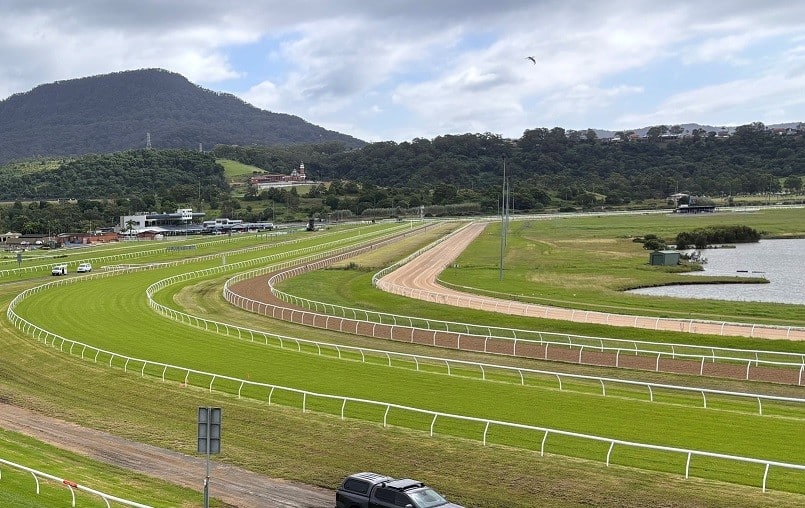
The debut of Kembla’s inner track promises to be more than a routine provincial meeting as it heralds an era designed to future-proof one of the state’s most weather-exposed racing regions.
Built at a cost of more than $8 million, the 22-metre-wide circuit, with its 1980m circumference, 410m straight, and pronounced 4 per cent camber, arrives with a brief to provide continuity to a racing calendar that is often interrupted by rain.
Illawarra Turf Club chief executive Steve Keene said the new racetrack, known as the Illawarra Grange, had been years in the making and would finally be unveiled after an extended trial period designed to remove as much uncertainty as possible from day one.
“It’s been a project that’s obviously been talked about for a lot of years here in the Illawarra with Racing NSW and the club’s really grateful for the support in this project and financially to make it happen,” Keene said.
“We’ve been using it for over 12 months now with jumpouts and barrier trials and we’re getting amazing feedback from trainers and jockeys so we’re looking forward to letting it off the leash and showing everyone what it can do.”
Six races will be staged at the first race meeting on Tuesday.
The track, developed by Evergreen Turf alongside Abax Constructions and Elite Soil & Sand, has effectively been in a soft-launch phase since early 2025, allowing its sand-based profile and high-tech drainage system to settle as infrastructure was completed around it.
Keene said that patience was already paying dividends, with the surface repeatedly tested during wet periods that would typically compromise the course proper, offering a glimpse of how the new track could alter programming decisions.
“We’ve had washed-out days in the last 12 months where if the Illawarra Grange track was ready to go we potentially would have run on it, and now we’ll be able to look at how that affects the racing calendar around wet weather in the south of Sydney,” he said.
The contrast between the new surface and the existing track has been stark, with significant differences in footing and recovery times under similar rainfall conditions.
“The drainage is amazing and it really does help the water get away and get it back to that good four rating really quickly,” Keene said.
“If we were to get a large amount of rain 24 hours before a race meeting we’re still confident we’d be able to race the next day,” Keene said.
From a training perspective, alongside the polytrack and sand track, the Illawarra Grange is expected to ease pressure on facilities and broaden the appeal of the ITC Kembla Grange as a racing hub.
Trainer Luke Price said the camber and consistency of the new track had already made an impression in trackwork and trials.
“It’s got a fantastic camber, it corners so well and it can cop some rain so it is going to be a huge asset when we get those real wet periods,” Price said.
Industry stalwarts expect the track to be a strategic piece of infrastructure for the broader NSW south coast thoroughbred industry where abandoned meetings and transfers have long been a bugbear of winter racing.
Former long-time Sydney Turf Club and Australian Turf Club track manager Lindsay Murphy had an insight into the plans for a second Kembla track as an ex-board member of the ITC.
Murphy said the ability to maintain a scheduling continuity would ultimately be the best barometer for industry money well spent.
“It’ll be a workhorse, but it’ll be a backup in bad weather with the course proper, and it will be able to take meetings off that in winter and spread the wear and tear,” he said.
“It’s another huge asset for the industry to have the two tracks because you can keep racing while upgrading the course proper and not lose meetings or transfer them, and that’s a big tick for the industry,” he said.
The races programmed for the inner track on Tuesday cover distances from 1150m to 1450m, with scope to extend beyond 2000m.
Related Articles

Racing Minister’s resignation increases uncertainty for Tasmanian racing industry
Already dealing with future funding uncertainty, Tasmania’s racing industry must now confront the fallout of the resignation of the state’s racing minister Jane Howlett.
$6 million Cup – Caulfield raises stakes, boosts ballot-free races for 150th running of 2400m handicap
Connections of all runners in this year’s 150th running of the Caulfield Cup will receive a slice of the $6 million prize money on offer, with four ballot-free races also added by the Melbourne Racing Club.

Tasmanian racing minister under pressure to resign over Tasracing communications
Tasracing has been dragged into a Tasmanian political scandal as calls grow for Racing Minister Jane Howlett to resign.
