
‘The economy’s a primary driver’ – no hiding from outside influences as Inglis prepares for Australian Weanling Sale
In a market shaped by conflict, currency and caution, the weanling sales ring at Riverside Stables will be an early litmus test of appetite for pinhookers into next year’s yearling sales.
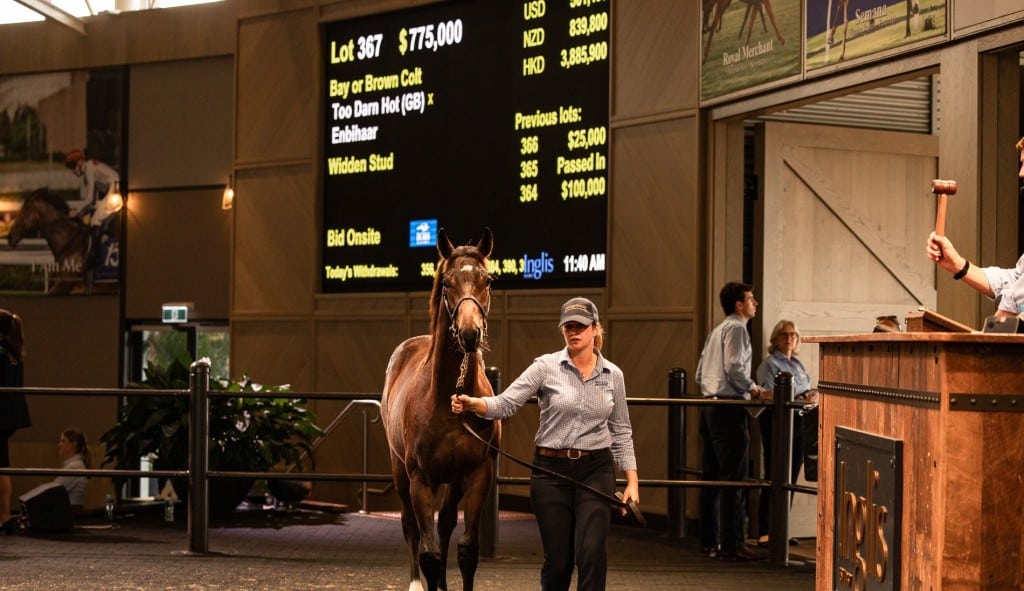
Global issues, none more so than the Middle East conflict and the economic turmoil it’s caused, will have an impact on foal sales over the next six to eight weeks across Australasia.
The first exposure to buyers’ willingness to speculate on young horses, for pinhooking and racing purposes, will be at Riverside Stables at Warwick Farm on Tuesday and Wednesday at the Australian Weanling Sale.
“There’ll be some high-end foals here for end-users and for pinhookers into the select sales and there’ll be some foals that are appealing race prospects for people, and then there’ll be a whole load of alternative trading opportunities for people,” Inglis Bloodstock chief executive Sebastian Hutch told The Straight.
“And so when that’s the case, as it is here, you tend to get good engagement.”
The 504-Lot Sydney catalogue of weanlings will offer high-end buyers pinhooking into Inglis Easter and Magic Millions next January but there will also be influences beyond the auction houses’ control..
The New Zealand dollar is buying 82 Australian cents, its lowest level in 13 years.
The weak New Zealand dollar proved advantageous at the New Zealand Bloodstock Karaka sale in January, helping boost the Australian spend by $12 million at the country’s 100th National Yearling auction.
In contrast, the low New Zealand dollar could stymie Kiwi pinhookers’ investment at the Australian weanling sales, given their reduced buying power due to the exchange rate.
That factor, the rising interest rates, fuel prices and the drought, which is predominantly impacting farmers in NSW, could also limit the appetite from buyers to speculate on 2025-born foals to either pinhook into the yearling market or retain to race.
“There’s no disguising the fact that in certain parts of the market there isn’t the same level of confidence as what there might have been in years past, and that will affect the participation of some people,” Hutch said.
“The economy’s a primary driver of that, and that’s ultimately what shaped the behaviour of … a huge number of people through Easter, and will shape the behaviour of some people here.
“But the simple fact of the matter is that if you’re inclined to want to be involved in a yearling market in 2027, and it’s been an incredibly lucrative yearling market in Australia in 2026, certainly through the Inglis yearling sale series, the foal sales are something you’ve got to take very, very seriously.”
With that in mind, an already polarised bloodstock market could lead to buyers being more risk-averse, preferring to arguably pay more for weanlings likely to be highly sought after at select weanling sales.
But Hutch played down the prospect of that trend being more evident this year than it was in past seasons.
“As with any trade, it’s all relative to price. Value is a subjective thing, and the appeal of certain foals of horse and certain pedigrees is very subjective,” he said.
“I think there’ll be people who find value at a variety of different levels here on Tuesday and Wednesday with a view to trading into a huge variety of different markets, whether it’s Magic Millions in January, New Zealand, Classic, Premier, Perth, Adelaide, Tasmania or the March sale. There’s a broad cross-section of sales that people would target to trade into.
“And there’ll be people who look to trade beyond the yearling sale season. We have a number of people whose primary income comes from trading breeze-up horses and they’re here looking for value with a view to targeting two-year-old sales in 2027.”
The Australian Weanling Sale starts at 10am (AEST) on Tuesday.
Author

Related Articles
New Zealand faces up to industry ‘implosion’ with 40 per cent of Group 1s under threat
Racing jurisdictions, led by New Zealand, will use a key Asian Pattern Committee meeting in February next year to argue that changes need to be made to the way Group 1s are rated to protect their status as the country faces a brutal cull of its elite races.
British and Irish foal crop falls for a third straight year
Weatherbys’ Return of Mares puts the combined thoroughbred foal crop for 2026 at 11,312 in Britain and Ireland, down 17.2 per cent on 2023, with Britain falling hardest.
Rowe On Monday – Inglis finds right size for breeze-up sale, a Magic path emerges, Hutch to stay hands-on and Arrowfield’s treble to remember
In this week’s Rowe On Monday, Tim chats to Sebastian Hutch, Bruce Slade and Merrick Staunton about the dynamic of the Australian breeze-up market, hails the emergence of a key Gold Coast two-year-old race and reflects on an unforgettable Saturday for Arrowfield.
